
The 'Heavy Water' Advantage: How the WSL's Upcoming Reef Breaks Could Upend the 2026 Standings
With Leonardo Fioravanti and Carissa Moore clinging to the Yellow Jerseys, the World Surf League enters a treacherous stretch of reef breaks that heavily favors barrel specialists. Defending champion Molly Picklum and returning veterans are perfectly positioned to surge up the leaderboard.

Share this story
The 2026 World Surf League (WSL) Championship Tour has reached its most critical inflection point. Following the dramatic conclusion of the VIVO Rio Pro in Saquarema, Italy's Leonardo Fioravanti and Hawaii's Carissa Moore currently wear the coveted Yellow Jerseys as the world's top-ranked surfers. However, the complexion of the title race is about to change entirely.
As the tour pivots away from the high-performance, ramp-heavy beach breaks of the Americas, the athletes are bracing for a massive collision with reality. The upcoming stretch of the schedule will test the current leaders against the ocean's most unforgiving environments, setting the stage for a volatile shakeup in the global standings.[1]
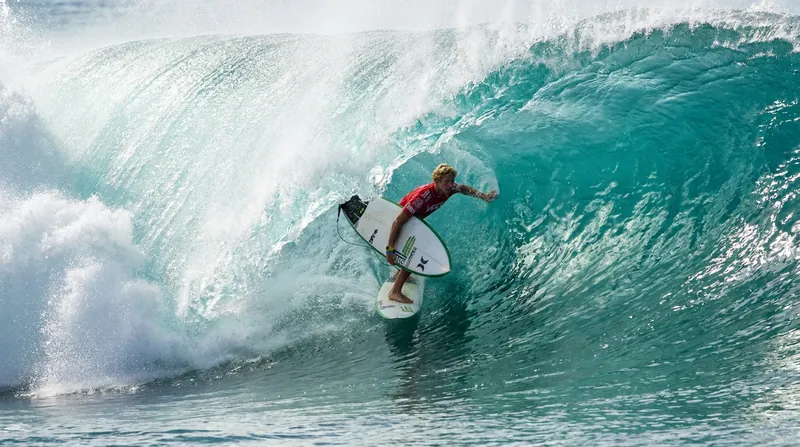
This impending transition—widely revered and feared by competitors as the "heavy water" leg—features some of the most dangerous and hollow reef breaks on the planet. With upcoming stops at Jeffreys Bay in South Africa, Teahupo'o in Tahiti, and Cloudbreak in Fiji, the judging criteria shifts dramatically.
The aerial progression and rapid-fire turns that dominated the early season will take a back seat to fearless barrel riding and raw power surfing. For surfers hovering just outside the top five, this leg represents the ultimate opportunity to erase the points gap and overtake the frontrunners before the season finale.[1][4]
Fioravanti made history in late June, becoming the first Italian surfer to ever lead the WSL rankings. He secured the World No. 1 spot through tactical brilliance, utilizing active wave selection to secure a runner-up finish against Yago Dora in Brazil.
His consistency throughout the first half of the 2026 season has been remarkable, proving his elite competitive surfing IQ. But defending that top spot in the South Pacific will require a different gear entirely. Fioravanti must now prove he can match the world's best inside the thick, heaving barrels of Teahupo'o—a wave that demands absolute commitment and punishes hesitation.[2]
Hot on his heels is Brazil's Yago Dora, who vaulted to World No. 2 following a spectacular victory in front of a massive, rain-soaked home crowd in Rio. Dora's high-flying antics and searing rail work earned him a near-perfect 15.00 heat total in the final, solidifying his status as a premier threat.
Yet, like Fioravanti, Dora's ultimate test will be translating that beach-break momentum into the heavy left-hand barrels of Tahiti and Fiji. While Dora has proven his capability in waves of consequence, the margin for error against dedicated reef specialists is virtually nonexistent.[2]
This is exactly where the lurking heavy-water specialists come into play. Defending 2025 World Champion Molly Picklum currently sits just outside the top three in the women's standings, but she is widely considered one of the most lethal barrel riders on the tour. Her fearless approach at Pipeline and Teahupo'o makes her a heavy favorite to reclaim the top spot by September. Picklum thrives when the conditions become intimidating, and the upcoming schedule aligns perfectly with her aggressive, uncompromising style of surfing.[1][4]
On the men's side of the draw, returning veterans Gabriel Medina and Jack Robinson are perfectly positioned to play spoiler. Both surfers have historically been dominant in heavy reef conditions. Medina, a multi-time winner at Cloudbreak and Teahupo'o, possesses an unmatched ability to navigate deep, foamball-ridden tubes.
Robinson, similarly, is a savant in waves of consequence. Because both men missed crucial points earlier in their careers due to injury, they view the South Pacific leg not just as an opportunity, but as a mandatory strike zone to vault back into world title contention.[3][4]
The women's standings are equally volatile as the tour heads into the Pacific. While Carissa Moore's all-around mastery and veteran experience keep her in the yellow jersey, 20-year-old Sawyer Lindblad is surging up the rankings after securing her maiden Championship Tour victory in Rio. However, the expanded 24-woman field introduces a new layer of unpredictability. Local wildcards and Teahupo'o specialists—such as Tahiti's Vahiné Fierro—could easily knock top contenders out in the early rounds, denying them crucial points and violently shuffling the top ten.[1]
The stakes of this upcoming leg are magnified by the WSL's revamped 2026 format. With the controversial "Final 5" one-day playoff system officially retired, the world title has returned to a season-long marathon that culminates at the Banzai Pipeline in Hawaii this December.
Under this traditional points system, there are no shortcuts. Every single heat in Tahiti, Fiji, and the newly added stop at Cloud 9 in the Philippines carries permanent, unerasable weight in the championship math. A 17th-place finish at Teahupo'o could be the fatal blow to a frontrunner's title hopes.[1][3]
For surfing purists and global fans, this transition represents the ultimate test in professional surfing. The current leaders must prove they can survive the gauntlet and adapt to life-threatening conditions, while the heavy-water specialists have a shrinking window to close the points gap. As the massive winter swells begin to build in the Southern Hemisphere, the race for the 2026 World Title is wide open, promising one of the most dramatic second-half showdowns in the history of the sport.[4]
Key points
- Leonardo Fioravanti and Carissa Moore hold the World No. 1 rankings heading into the second half of the 2026 WSL season.
- The tour now shifts to the 'heavy water' leg, featuring dangerous reef breaks in Tahiti, Fiji, and South Africa.
- Barrel specialists like Molly Picklum, Gabriel Medina, and Jack Robinson are perfectly positioned to close the points gap.
- The WSL's return to a cumulative points format means every heat in these heavy conditions permanently impacts the world title race.
How we got here
May 2026
The mid-season cut reduces the men's field to 22 and the women's to 14, intensifying the points race.
June 26, 2026
Leonardo Fioravanti finishes runner-up at the VIVO Rio Pro, becoming the first Italian to claim the World No. 1 ranking.
June 28, 2026
Sawyer Lindblad and Yago Dora secure victories in Rio, shaking up the top three in both divisions.
July 2, 2026
The WSL announces the addition of Cloud 9 to the late-season schedule, adding another heavy reef break to the title race.
- Heavy-Water Specialists
- Power surfers and barrel riders who view the upcoming reef breaks as their primary opportunity to surge up the leaderboard.
- Current Leaders
- Surfers who built their rankings on consistency and high-performance beach breaks, now fighting to defend their spots.
- Tour Analysts
- Observers emphasizing how the return to a season-long points format makes the Tahiti and Fiji stops statistically critical.
Perspectives this story doesn't cover
- Rookies and lower-ranked surfers fighting strictly for re-qualification rather than the world title.
- Local wildcards in Tahiti and Fiji who don't compete for the world title but can eliminate top contenders.
Sources
Source coverage
4 outlets
3 viewpoints surfaced




- [1]World Surf LeagueHeavy-Water Specialists
2026 Championship Tour Schedule and Rankings
Read on World Surf League → - [2]Sports247Current Leaders
Fioravanti Surfs To Second At VIVO Rio Pro To Lead WSL Championship Tour Rankings
Read on Sports247 → - [3]WikipediaHeavy-Water Specialists
2026 World Surf League
Read on Wikipedia → - [4]Factlen Editorial TeamTour Analysts
Synthesis by Factlen editorial team
Read on Factlen Editorial Team →
More in Sports
See all →Standings
The Hidden WSL Leaderboard: How Discard Math is Reshaping the 2026 Title Race
3 sources
Standings
WSL Standings Watch: Marks, Colapinto, and Waida Surge as the 2026 Championship Picture Tightens
2 sources
Injury
Kelly Slater Returns to Teahupo'o for 2026 Tahiti Pro Following Hip Surgery Recovery
5 sources
Standings
The Race for the Top 8: Why Deep Seeding at Pipeline is the WSL's New Ultimate Prize
2 sources
Comments
Every angle. Every day.
Get Sports stories with full source coverage and perspective breakdowns, free every day.