
The Geography of Endurance: How Altitude, Heat, and Distance Redefined the 2026 World Cup
Spanning three nations, four time zones, and extreme variations in altitude and climate, the 2026 FIFA World Cup represents the greatest logistical and physiological challenge in the tournament's history.

Share this story
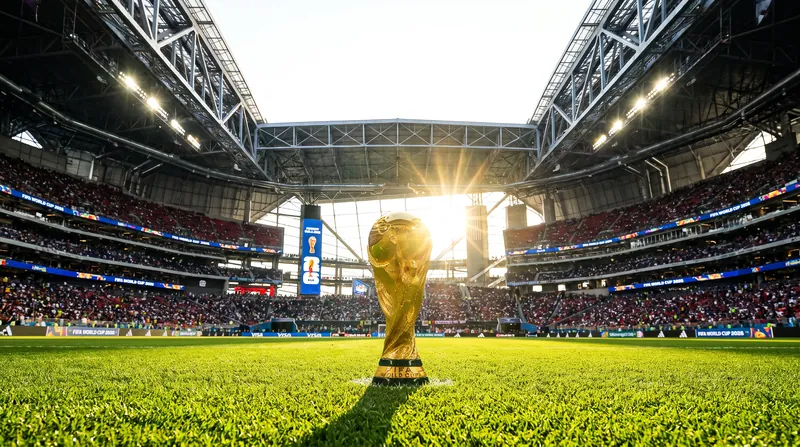
The 2026 FIFA World Cup is not merely a football tournament; it is a continental expedition. Spanning the United States, Canada, and Mexico, the 48-team spectacle represents the largest geographical footprint in the history of international sports.[1]
To lift the newly redesigned trophy, a team will not only have to survive eight grueling matches—one more than in previous editions—but also conquer an unprecedented triad of environmental extremes: suffocating heat, draining travel, and lung-burning altitude.[6]
Never before has a World Cup demanded such a high degree of physiological adaptability. While the 2014 tournament in Brazil tested teams with vast travel distances, and the 1986 edition in Mexico pushed players to their physical limits in the thin mountain air, 2026 combines all these variables into a single, month-long gauntlet.[3]
The most immediate environmental shock awaits teams drawn into the Mexican clusters. Mexico City’s iconic Estadio Azteca, which hosted the finals in 1970 and 1986, sits at a staggering 2,240 meters (7,350 feet) above sea level.[1]
At this elevation, the partial pressure of oxygen drops significantly. Sports scientists note that unacclimatized players experience a 10 to 15 percent reduction in their VO2 max—the maximum rate at which their bodies can utilize oxygen during intense exercise.[2]
The physics of the game also fundamentally change in the thin air. With less aerodynamic drag, a struck football travels faster and deviates less from its flight path, turning long-range shots into lethal weapons and making cross-field passes harder to intercept.[5]
To combat altitude sickness and premature fatigue, federations have invested heavily in pre-tournament acclimatization. Teams anticipating matches in Mexico City or Guadalajara (1,566 meters) have booked high-altitude training camps in the Alps or the Rocky Mountains, utilizing the 'live high, train low' methodology to stimulate red blood cell production.[2][5]
Yet, altitude is only one piece of the puzzle. Teams stationed in the southern United States face an entirely different adversary: extreme summer heat and oppressive humidity.[4]
While state-of-the-art venues in Houston, Dallas, and Miami feature advanced climate-control systems or retractable roofs to protect players and fans during the actual 90 minutes of play, the reality of a World Cup campaign extends far beyond the stadium walls.[4]
Daily training sessions, recovery protocols, and base camp life must be conducted in the sweltering North American summer. Prolonged exposure to high heat indexes accelerates fluid loss, impairs cognitive decision-making, and significantly lengthens muscle recovery times between matches.[2][6]
To mitigate this, performance directors have implemented aggressive core-cooling strategies. Ice slushies, cooling vests worn during warm-ups, and hyper-calibrated hydration plans tailored to individual players' sweat rates have become standard operational procedure rather than marginal gains.[6]
Then comes the sheer scale of the continent. The distance between the northernmost host city, Vancouver, and the southernmost, Mexico City, is roughly 4,000 kilometers. Traveling from West Coast hubs like Seattle to East Coast fortresses like Miami involves crossing four time zones.[3]
Recognizing the logistical nightmare, FIFA organized the group stage into three regionalized clusters—West, Central, and East. This pod system guarantees that teams will not have to cross more than one time zone during their initial three matches, preserving vital energy reserves.[1]
However, the regionalized safety net vanishes once the knockout stages begin. A team advancing from a West Coast group might suddenly find themselves flying to Atlanta or Philadelphia for a Round of 32 clash, forcing sports scientists to manage acute jet lag and disrupted circadian rhythms on just three days of rest.[3]
Sleep science has consequently taken center stage. Federations are transporting custom mattresses, utilizing light-therapy glasses to artificially shift players' biological clocks, and timing in-flight meals to sync with the destination's time zone.[5][6]
The expansion to 48 teams has also democratized access to these advanced sports science protocols. Nations making their modern World Cup debuts or returning after long absences—such as Canada, Curacao, and Uzbekistan—have partnered with elite performance consultancies to ensure their logistical preparation matches the traditional powerhouses.[6]
This equalization of off-pitch preparation means that the 2026 World Cup is unlikely to be won purely on tactical brilliance or individual flair. The margins for error have shrunk, and the physical toll of the tournament will ruthlessly expose any federation that neglects its logistical homework.[4][6]
Ultimately, the expanded North American World Cup serves as the ultimate test of a modern footballing infrastructure. The team that lifts the trophy will be the one that best navigates the thin air of the Azteca, the sweltering heat of the Sun Belt, and the vast skies stretching across a continent.[6]
Key points
- The 2026 World Cup spans three nations and four time zones, creating unprecedented logistical challenges.
- Matches in Mexico City and Guadalajara force teams to adapt to extreme altitudes, altering both physiology and ball physics.
- Southern US host cities require advanced core-cooling strategies to combat severe summer heat and humidity during training.
- FIFA implemented regionalized group stage hubs to minimize travel, but knockout rounds will require cross-continental flights.
- Sports science, particularly sleep and hydration management, has become as critical as tactical preparation for advancing teams.
How we got here
1970
Mexico hosts the World Cup, introducing the global audience to the extreme physiological demands of altitude football.
1986
The tournament returns to Mexico, further cementing the Azteca as one of the most physically demanding venues in sports.
1994
The United States hosts the World Cup, testing teams with extreme summer heat and humidity across vast distances.
2014
Brazil's sprawling geography forces teams to navigate massive internal travel distances and varying climates.
2026
The expanded 48-team tournament combines the altitude of Mexico, the heat of the US, and the vast distances of North America into a single event.
- Sports Scientists
- Focus on the physiological toll of the tournament, emphasizing acclimatization, hydration, and sleep optimization.
- Logistics Directors
- Prioritize base camp selection, travel minimization, and the seamless movement of equipment across borders.
- Tournament Organizers
- Highlight the regionalized group stage hubs designed to mitigate early-tournament travel fatigue for the 48 teams.
Perspectives this story doesn't cover
- Local host city infrastructure managers
- Traveling supporters facing logistical costs
Sources
Source coverage
6 outlets
3 viewpoints surfaced






- [1]FIFA OfficialTournament Organizers
FIFA 2026 World Cup Match Schedule and Regional Hubs
Read on FIFA Official → - [2]Journal of Sports SciencesSports Scientists
The physiological demands of playing football at moderate-to-high altitude
Read on Journal of Sports Sciences → - [3]The AthleticLogistics Directors
How 2026 World Cup teams are navigating the North American travel nightmare
Read on The Athletic → - [4]ESPNLogistics Directors
Heat, humidity, and the science of summer soccer in the USA
- [5]BBC SportSports Scientists
Altitude training camps: The secret weapon for Mexico 2026?
Read on BBC Sport → - [6]Factlen Editorial TeamTournament Organizers
Synthesis by Factlen editorial team
Read on Factlen Editorial Team →
More in Sports
See all →History
The Pursuit of Immortality: How the World Cup Golden Boot Evolved Across a Century of Football
4 sources

Looking back
The Qatar Crucible: How the 2022 World Cup Redefined Football's Global Hierarchy
4 sources

History
The Bench Revolution: How Substitutions Transformed from a World Cup Afterthought to the Ultimate Tactical Weapon
4 sources
Storyline
The Wing-Back Evolution: How Defenders Became the World Cup's Primary Playmakers
7 sources

Comments
Every angle. Every day.
Get Sports stories with full source coverage and perspective breakdowns, free every day.