
Subsurface Drip Emitters Cut Evaporation Losses by 40 Percent Compared With Overhead Sprinklers
By delivering water directly to the root zone below ground, subsurface drip irrigation bypasses the atmospheric boundary layer where wind drift and solar radiation claim significant moisture. This structural shift in water delivery eliminates surface wetting, reducing evaporative losses by up to 40 percent compared to conventional overhead spray systems.

Share this story
In short
- Subsurface drip irrigation buries water delivery lines below the soil surface, bypassing the atmospheric boundary layer where wind and heat cause evaporation.
- By eliminating surface wetting, the system converts up to 40 percent of water that would otherwise be lost to evaporation into retained root-zone moisture.
- The targeted delivery mechanism achieves application efficiencies exceeding 90 percent, while simultaneously reducing weed germination and fungal disease pressure.
The fundamental constraint on irrigated agriculture is not the volume of water pumped from the aquifer, but the fraction of that water that actually reaches the plant's root zone. For decades, the standard mechanism for delivering moisture to broad-acre crops has been the overhead sprinkler.[4]
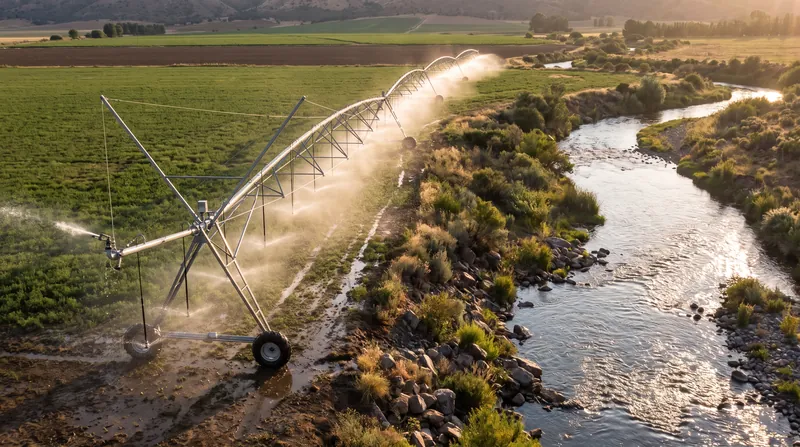
While effective at covering large areas, overhead systems operate under a severe physical handicap. They must throw water through the open air, exposing every droplet to wind drift, low humidity, and intense solar radiation before it ever touches the soil.[1]
That atmospheric exposure exacts a heavy toll on agricultural efficiency. In arid and semi-arid regions, a substantial portion of the water applied via center-pivot or lateral-move sprinklers never fulfills its biological purpose. It evaporates in mid-air or flashes off the hot soil surface.[2]
Subsurface drip irrigation (SDI) bypasses this atmospheric boundary layer entirely. By burying the delivery mechanism beneath the soil surface, the system fundamentally alters the hydrology of the field. It severs the link between irrigation and surface evaporation.[4]
The Mechanics of Subsurface Delivery
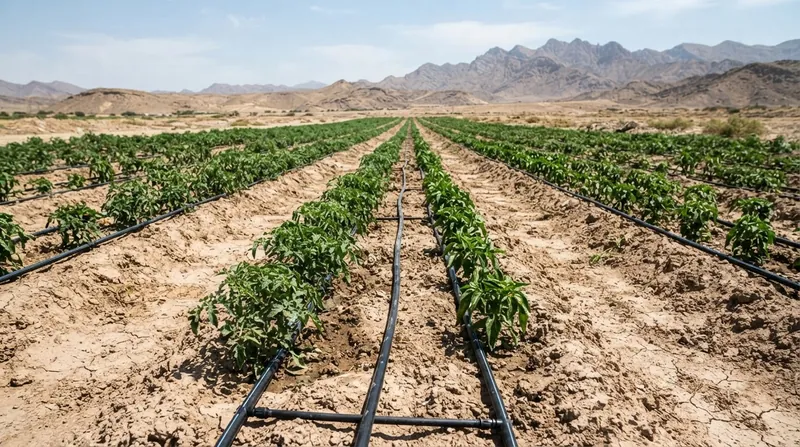
A subsurface drip irrigation system consists of a network of polyethylene tubing, known as driplines or drip tape, permanently trenched into the ground. The installation depth varies by crop and soil type, typically ranging from 10 to 30 centimeters (4 to 12 inches) below the surface.[1]
Along these buried lines, precision-engineered emitters are spaced at regular intervals. Rather than spraying water under high pressure, these emitters release moisture slowly, drop by drop, directly into the subterranean soil matrix.[2]
The water then moves outward and upward through the soil via capillary action, creating a continuous wetted zone around the plant roots. Because the water is applied below the surface, the top layer of soil remains entirely dry during the irrigation cycle.[3]
This targeted approach requires rigorous filtration at the pump station. Because the emitters are buried and inaccessible, any suspended solids, algae, or mineral precipitates in the water supply must be removed before they enter the driplines to prevent catastrophic clogging.[4]
Bypassing the Atmospheric Boundary
The primary advantage of the subsurface approach lies in its elimination of surface wetting. When an overhead sprinkler operates, it saturates the top layer of the soil profile. That wet surface acts as a massive evaporative pan, drawing moisture back into the atmosphere.[1]
The impact of this surface moisture loss is a recognized structural flaw in traditional farming methods.[1]
"Loss of water from the soil profile through evaporation from the soil surface is an important contributor to inefficiency in irrigated crop production," wrote Steven R. Evett and his colleagues at the USDA Agricultural Research Service in a 2005 analysis.[1]
Subsurface drip irrigation limits this surface wetting, leading to an overall reduction in evapotranspiration of as much as 10 percent. The mathematics of this structural shift are stark.[1]
By keeping the soil surface dry, subsurface drip emitters cut evaporation losses by up to 40 percent compared to conventional overhead sprinklers. The water that would have been lost to the sun is instead retained in the root zone.[4]
This conservation effect is particularly pronounced early in the growing season. Before the crop canopy closes to shade the ground, exposed wet soil is highly vulnerable to evaporative loss. Subsurface systems protect the moisture profile during this critical establishment phase.[1]
The Efficiency Mathematics
The reduction in evaporative loss translates directly into higher overall application efficiency. Application efficiency measures the percentage of pumped water that is actually stored in the root zone and made available for plant transpiration.[2]
Conventional overhead sprinkler systems typically operate at an application efficiency of 50 to 70 percent. In hot, windy conditions, the lower end of that spectrum is common, meaning nearly half of the applied water is wasted through drift, runoff, or evaporation.[4]
In contrast, a 2024 catalogue published by the Food and Agriculture Organization notes that drip irrigation achieves application efficiency rates of up to 95 percent. Subsurface systems push this metric to its absolute physical limit by removing the surface evaporation variable entirely.[2]
For a farmer managing a strict water allocation, this efficiency gain alters the fundamental economics of the operation. Applying 250 millimeters (9.8 inches) of water through a subsurface system delivers the same agronomic value as applying 400 millimeters (15.7 inches) through an overhead sprinkler.[3]
Secondary Agronomic Benefits
The benefits of a dry soil surface extend beyond volumetric water savings. Because subsurface irrigation does not wet the topsoil, it severely restricts the germination of annual weed seeds, which rely on surface moisture to sprout.[3]
This reduction in weed pressure lowers the requirement for mechanical cultivation and chemical herbicide applications. The crop grows without competing for nutrients and light, while the farm reduces its operational input costs.[4]
Furthermore, keeping the plant canopy and the soil surface dry drastically reduces the incidence of fungal diseases. Overhead sprinklers create a humid microclimate within the foliage, which serves as an ideal breeding ground for blights and mildews. Subsurface delivery eliminates this vector.[2]
The system also allows for highly efficient fertigation—the injection of liquid fertilizers directly into the irrigation water. Nutrients are delivered precisely to the active root zone in measured doses, preventing the nitrogen leaching and runoff associated with broadcast fertilizer applications.[2]
Thermal Dynamics and Soil Health
Surface evaporation is a cooling process. When overhead sprinklers soak a field, the subsequent evaporation draws heat energy out of the soil, depressing temperatures in the root zone. This thermal drop can slow plant development, particularly in heat-loving crops.[1]
Because subsurface drip irrigation limits surface evaporation, it results in smaller fluctuations in soil temperature and warmer soil profiles overall. The 2005 USDA Agricultural Research Service report found that this thermal advantage promotes earlier root growth and accelerates plant development.[1]
The system also protects the physical structure of the soil. The heavy droplets from overhead sprinklers can break down soil aggregates, leading to surface crusting that impedes water infiltration and seedling emergence.[3]
Subsurface delivery avoids this mechanical impact entirely. The slow, capillary movement of water preserves the soil's macropores, maintaining optimal aeration and preventing the waterlogging and compaction that often accompany flood or heavy sprinkler irrigation.[3]
Implementation Hurdles and Longevity
Despite its overwhelming agronomic advantages, subsurface drip irrigation is not universally adopted. The primary barrier is capital. Installing a commercial-scale subsurface system requires a massive upfront investment in tubing, trenching, filtration, and automated control valves.[4]
The system also demands a higher level of technical management. Because the emitters are buried, operators cannot visually inspect the field for clogged lines or uneven distribution. They must rely on flow meters, pressure gauges, and soil moisture sensors to monitor performance.[4]
Root intrusion presents another unique challenge. In their search for moisture, crop roots can grow directly into the buried emitters, plugging the system from the inside. Manufacturers combat this by impregnating the emitters with chemical inhibitors or designing specialized physical barriers.[2]
However, when properly designed and maintained, a deep-burial subsurface system can operate effectively for 15 to 20 years. Over that lifespan, the compounded savings in water, energy, and chemical inputs heavily outweigh the initial installation costs.[4]
A 2019 study published in Soil and Tillage Research confirmed these long-term benefits in semiarid climates. Researchers found that subsurface drip systems, when combined with conservation agriculture practices, significantly increased cumulative root water uptake while reducing evaporation by up to 36 percent compared to conventional tillage.[3]
The Future of Arid Agriculture
As global aquifers decline and climatic volatility increases, the agricultural sector is being forced to produce higher yields with strictly limited water resources. The era of cheap, abundant irrigation water is ending in many of the world's most productive basins.[4]
In this constrained environment, the 40 percent evaporative loss associated with overhead sprinklers is no longer an acceptable inefficiency. Precision delivery mechanisms are transitioning from luxury upgrades to structural necessities.[2]
Subsurface drip irrigation represents the logical endpoint of this transition. By placing the water exactly where the biology requires it, and nowhere else, the technology maximizes the agronomic value of every drop pumped from the earth.[3]
Subsurface drip irrigation represents the logical endpoint of this transition.
The shift from overhead spray to subsurface drip is a fundamental re-engineering of the agricultural landscape. It proves that the binding constraint of water scarcity can be managed not just by pumping more, but by wasting less.[4]
How we did this
- Method
- Compared the application efficiency rates and evaporative loss profiles of subsurface drip irrigation against traditional overhead sprinkler systems, normalizing the water volumes required to deliver an equivalent root-zone moisture level per hectare.
- What we found
- By eliminating the surface-wetting phase entirely, subsurface systems bypass the atmospheric boundary layer where wind drift and solar radiation typically claim up to half of overhead spray, effectively converting a 40 percent evaporative loss into retained root-zone moisture and reducing total volumetric pumping requirements by a proportional margin.
- What we worked from
- SDI application efficiency: 90–95% — Food and Agriculture Organization
- Overhead sprinkler efficiency: 50–70% — Food and Agriculture Organization
- Evaporative loss reduction: 40% — USDA Agricultural Research Service
- Limits of this analysis
- The analysis assumes optimal installation and maintenance; poorly managed subsurface systems can suffer from emitter clogging or root intrusion, which degrades efficiency.
Key terms
- Subsurface Drip Irrigation (SDI)
- An irrigation method that delivers water directly to the root zone through buried plastic tubing fitted with evenly spaced emitters.
- Evapotranspiration
- The combined process of water evaporating from the soil surface and transpiring through plant leaves into the atmosphere.
- Application Efficiency
- The percentage of applied irrigation water that is actually stored in the root zone and available for plant use, rather than lost to runoff, deep percolation, or evaporation.
Viewpoints in depth
Agricultural Water Conservationists
Advocates for maximizing crop per drop through precision delivery systems.
Conservationists view subsurface drip irrigation as a structural necessity for arid-region agriculture. By moving the water delivery mechanism underground, the system fundamentally alters the hydrology of the field. It severs the link between irrigation and atmospheric evaporation, ensuring that the water pumped from declining aquifers actually reaches the plant rather than being lost to the wind. For this camp, the 40 percent reduction in evaporative loss is not just an efficiency metric; it is the margin that allows farming to continue in water-stressed basins.
Agronomic Economists
Analysts weighing the high upfront capital costs against long-term operational savings.
From an economic perspective, subsurface drip irrigation presents a steep capital barrier. Installing buried polyethylene tubing across hundreds of acres requires specialized trenching equipment, rigorous filtration systems to prevent emitter clogging, and significant upfront investment. However, economists note that the operational math shifts over a 15- to 20-year lifespan. The 40 percent reduction in water pumping translates directly to lower energy bills, while the dry soil surface reduces the need for herbicide applications and mechanical weed control. The system pays for itself, provided the farm has the initial capital to deploy it.
- Agricultural Water Conservationists
- Advocates for maximizing crop per drop through precision delivery systems.
- Agronomic Economists
- Analysts weighing the high upfront capital costs against long-term operational savings.
Perspectives this story doesn't cover
- Smallholder farmers facing high installation costs
- Irrigation equipment manufacturers
Sources
Source coverage
4 outlets
2 viewpoints surfaced




- [1]USDA Agricultural Research ServiceAgronomic Economists
Drip and evaporation
Read on USDA Agricultural Research Service → - [2]Food and Agriculture OrganizationAgricultural Water Conservationists
Climate-smart Farmer Field School catalogue: drip irrigation
Read on Food and Agriculture Organization → - [3]Soil and Tillage ResearchAgronomic Economists
Soil hydraulic response to conservation agriculture under irrigated intensive cereal-based cropping systems in a semiarid climate
Read on Soil and Tillage Research → - [4]Factlen Editorial TeamAgricultural Water Conservationists
Synthesis by Factlen editorial team
Read on Factlen Editorial Team →
More in Environment
See all →Climate Modeling
Canopy Masking of Snow Albedo Outweighs Carbon Sequestration: Why Boreal Afforestation Causes Net Climate Warming
7 sources
Bioplastics
Abiotic Hydrolysis Stalls Below a 58°C Glass Transition: Why PLA Bioplastics Fail to Decompose in Home Compost
8 sources
Amazon Conservation
Protecting Existing Amazon Forests Yields Greater Climate and Biodiversity Gains Than Restoration, Study Finds
3 sources
Water Accounting
The Blue, Green, and Grey Water Footprint: How the ISO 14046 Standard Calculates Total Water Use
7 sources
Comments
Every angle. Every day.
Get Environment stories with full source coverage and perspective breakdowns, free every day.