
Stanford AI Model Predicts Risk for 130+ Diseases From a Single Night's Sleep Data
Researchers have developed SleepFM, an artificial intelligence system that analyzes clinical sleep recordings to forecast long-term risks for conditions ranging from Parkinson's to cancer. The breakthrough suggests that overnight sleep studies could soon become a powerful preventative screening tool.
By Lan Xu

Share this story
A restless night is usually treated as a short-term nuisance that guarantees a bleary-eyed morning. But according to new research, the physiological signals our bodies emit while unconscious contain a hidden, highly detailed map of our long-term health.[1]
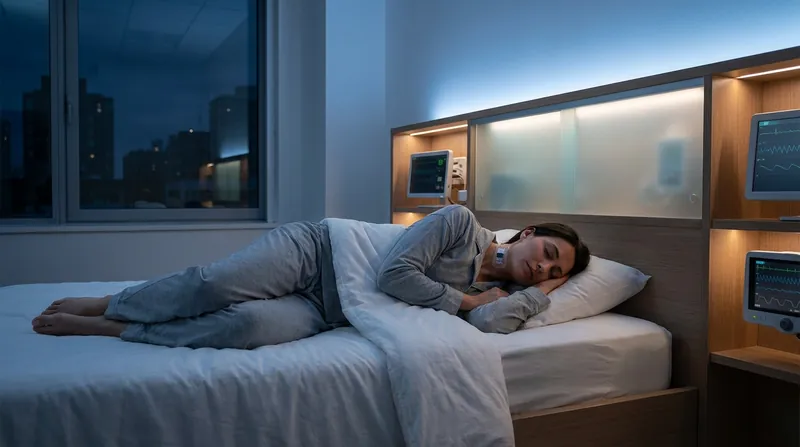
Scientists at Stanford Medicine have developed a first-of-its-kind artificial intelligence system capable of forecasting a person's risk for more than 130 different medical conditions based entirely on a single night of sleep data.[1][2]
The model, dubbed SleepFM (Sleep Foundation Model), was detailed in the journal Nature Medicine. It successfully predicted the onset of severe illnesses—including Parkinson's disease, dementia, heart failure, and multiple types of cancer—years before patients showed clinical symptoms.[1]
Historically, sleep medicine has been narrowly focused. When patients undergo overnight sleep studies, doctors typically look for immediate, mechanical issues like obstructive sleep apnea or insomnia, leaving the broader implications of the data largely unexplored.[3]
"We record an amazing number of signals when we study sleep," said Emmanuel Mignot, a professor of sleep medicine at Stanford and co-senior author of the study. "It's a kind of general physiology that we study for eight hours in a subject who's completely captive. It's very data-rich."[1][2]
Despite this richness, the vast majority of the data collected during these overnight sessions has traditionally been ignored. Human doctors simply cannot process the millions of subtle, overlapping data points generated by a sleeping brain and body simultaneously.[4]
To unlock this information, the Stanford team turned to a "foundation model"—the same underlying AI architecture that powers large language models. But instead of learning the patterns of human language, SleepFM was trained to understand the complex language of human physiology.[2]
The researchers fed the AI nearly 600,000 hours of sleep recordings from 65,000 individuals. This data came from polysomnography, the clinical gold standard for sleep testing, which uses an array of sensors to continuously track brain waves, heart rhythms, breathing patterns, blood oxygen levels, and muscle movements.[1][3]
The training process relied on a technique called "leave-one-out contrastive learning." The AI was given data in five-second chunks, but researchers would intentionally hide one data stream—such as the heart rate—and force the model to reconstruct it based solely on the brain waves and breathing patterns.[4]
By repeating this process millions of times, SleepFM learned exactly how a healthy body's systems interact. It learned, for example, that a specific type of brain wave should correspond with a specific dip in heart rate and a certain rhythm of respiration.[3]
Once the AI understood normal physiological harmony, it became exceptionally good at spotting microscopic misalignments. The researchers discovered that these subtle mismatches—such as a sleeping brain paired with an unusually alert cardiovascular system—are powerful early indicators of systemic disease.
To test the model's predictive power, the team linked the sleep data to up to 25 years of electronic health records from the Stanford Sleep Medicine Center. They asked the AI to predict which patients would eventually develop various conditions, and then checked the historical records to verify the outcomes.[1][2]
The results were striking. SleepFM evaluated more than 1,000 disease categories and found 130 that could be predicted with high accuracy using only the overnight sleep data, fundamentally changing how researchers view the diagnostic potential of sleep.[1][3]
The model's accuracy is measured using a "C-index," which evaluates how often the AI correctly ranks which of two patients will develop a condition first. A score of 0.8 means the model is correct 80% of the time, a highly significant threshold in medical forecasting.[1][2]
SleepFM achieved a C-index of 0.89 for Parkinson's disease and prostate cancer, 0.87 for breast cancer, 0.85 for dementia, and 0.81 for heart attacks. It even predicted overall all-cause mortality with an impressive 84% accuracy.[1][4]
"We were pleasantly surprised that for a pretty diverse set of conditions, the model is able to make informative predictions," noted James Zou, an associate professor of biomedical data science at Stanford and co-senior author of the research.[1][2]
The breakthrough represents a fundamental shift in preventive medicine. It suggests that overnight sleep studies, currently viewed as specialized diagnostic tools for breathing disorders, could eventually be repurposed as broad, non-invasive screening mechanisms for a wide array of life-threatening illnesses.[3]
However, researchers caution that the technology is not yet ready for consumer smartphones or smartwatches. SleepFM relies on the dense, multi-channel data provided by clinical polysomnography, which requires a patient to sleep in a lab hooked up to medical-grade sensors.[2][3]
The next frontier for the Stanford team is determining whether these predictive capabilities can be adapted for consumer wearables. If foundation models can learn to extract similar insights from the simplified sensors on a smartwatch, continuous, passive disease screening could become a reality for millions.[4]
Key points
- Stanford Medicine researchers developed SleepFM, an AI model that predicts future disease risk from a single night of sleep data.
- The model was trained on nearly 600,000 hours of clinical polysomnography recordings from 65,000 patients.
- SleepFM successfully predicted the onset of 130 conditions, including Parkinson's, dementia, and various cancers, with high accuracy.
- The AI detects microscopic misalignments between body systems, such as a mismatch between brain waves and heart rhythms.
What we don’t know
- Whether the predictive accuracy of the model will hold up when applied to the lower-fidelity data collected by consumer smartwatches and fitness trackers.
- How the medical community will integrate long-term AI risk forecasts into standard clinical care and insurance models.
- To what extent lifestyle interventions made after an AI prediction can alter the forecasted trajectory of the disease.
How we got here
1970
The Stanford Sleep Medicine Center is founded, beginning decades of clinical polysomnography data collection.
1999–2024
Stanford digitizes sleep study recordings, pairing them with long-term electronic health records.
2023
Advances in self-supervised AI foundation models allow researchers to process massive, unlabeled datasets.
January 2026
Stanford researchers publish the SleepFM findings in Nature Medicine, demonstrating the model's ability to predict 130 diseases.
- Clinical Researchers
- Advocate for utilizing discarded sleep data as a comprehensive preventative screening tool.
- Data Scientists
- Focus on the breakthrough of applying self-supervised foundation models to multimodal medical data.
- Preventative Care Skeptics
- Caution that point-in-time physiological data cannot account for future lifestyle changes or dynamic health shifts.
Perspectives this story doesn't cover
- Consumer Wearable Manufacturers
- Health Insurance Providers
Sources
Source coverage
4 outlets
3 viewpoints surfaced




- [1]Stanford MedicineClinical Researchers
New AI model predicts disease risk while you sleep
- [2]SciTechDailyPreventative Care Skeptics
Stanford's AI Predicts Disease Risk From a Single Night of Sleep
- [3]StudyFindsData Scientists
AI model predicts risk for 130 diseases from single night of sleep
- [4]Digital Health NewsData Scientists
Stanford researchers develop AI model to predict disease risk from sleep data

More in Lifestyle
See all →Remote Work
Landmark Study of 500,000 Workers Links Full-Time Remote Work to Poorer Mental Health Due to Isolation
4 sources

Sleep Tech
Wearable Ultrasound Patch Non-Invasively Boosts REM Sleep, Promising Emotional Reset and Productivity Gains
5 sources
Digital Mental Health
The Unlicensed Therapist: Why 48% of Adults Are Using AI for Emotional Support
5 sources

Cognitive Endurance
The 5-Minute Rule: New 19,000-Person Study Finds Hourly Movement Breaks Are the Optimal Balance for Productivity and Mood
2 sources

Comments
Every angle. Every day.
Get Lifestyle stories with full source coverage and perspective breakdowns, free every day.