
South Africa Holds World No. 1 Rugby Ranking as All Blacks Close Gap Ahead of Rivalry Series
South Africa retained the top spot in the World Rugby Rankings following a gritty win over Argentina, but New Zealand has narrowed the gap. The tightening race comes just weeks after World Rugby scrapped its traditional 'home weighting' formula, reshaping how ranking points are calculated globally.

Share this story
South Africa has successfully defended its position at the summit of the World Rugby Rankings, surviving a grueling test against Argentina to remain the number one team on the planet. Rassie Erasmus’s squad ground out a hard-fought 17-10 victory over Los Pumas in Buenos Aires, relying on a crucial fourth-quarter try from Cameron Hanekom to break a 10-10 deadlock.
The gritty performance did not earn the Springboks any additional rating points due to the existing mathematical gap between the two nations, but it successfully shielded them from a costly penalty that would have accompanied an upset defeat. With 93.96 points, South Africa remains the benchmark in international rugby, though their margin for error has practically vanished as the international calendar heats up.[2][6]
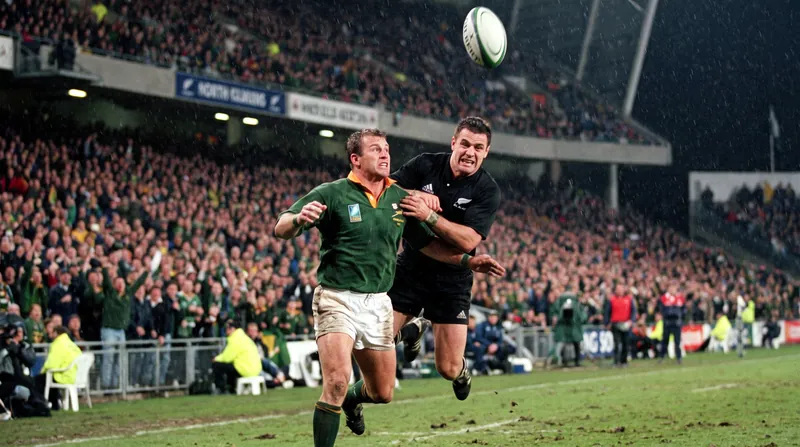
Breathing directly down South Africa's neck is New Zealand, sitting ominously in second place with 92.28 points. The All Blacks have steadily closed the gap, setting the stage for a monumental collision between the sport's two heavyweights. The tightening of the leaderboard comes at a pivotal moment, as the two nations prepare for their highly anticipated "Greatest Rivalry" series.
Because the points differential between the Springboks and the All Blacks is now less than two full points, their upcoming encounters—beginning with a blockbuster clash at Ellis Park on August 22—will serve as a direct, winner-takes-all shootout for the number one global ranking.[1][2]
The intense jockeying at the top of the table is unfolding under a brand-new mathematical reality. On July 1, 2026, World Rugby implemented the most significant structural change to its ranking system since its inception in 2003: the complete removal of the "home weighting" component.
For over two decades, the ranking algorithm automatically awarded host nations an artificial three-point advantage before kickoff. This adjustment was originally designed to account for the undeniable benefits of playing in front of a home crowd, but it created a paradoxical mathematical skew where winning on home soil often yielded negligible ranking rewards compared to securing a victory on the road.[1][3][5]
World Rugby’s decision to scrap the home weighting was driven by the rapidly evolving landscape of the international game. Governing body officials noted that the traditional home-and-away bilateral test model is increasingly being supplemented by neutral-venue fixtures and clustered tournament formats.
With nations like Fiji playing "home" matches in the United Kingdom, and Japan hosting Ireland in Australia, the old formula frequently penalized teams for playing away from home even when the venue offered no true geographic advantage to their opponent. By stripping away the three-point handicap, the rankings now offer a purer, venue-agnostic reflection of raw team performance.[3][5]
The removal of the home weighting has already begun to reshape the middle tiers of the global standings, where the margins between nations are razor-thin. Australia provided the most notable movement of the weekend, improving their rating to 82.09 points following a thrilling 35-32 victory over Japan in Osaka.
The Wallabies, playing their first match under newly appointed head coach Les Kiss, overcame sweltering conditions and a 20-minute red card to secure the win. While the victory was not enough to propel Australia past seventh-placed Argentina, it injected crucial momentum into a program looking to rebuild its standing on the world stage.[2][6]
Australia's triumph in Osaka triggered an immediate ripple effect further down the rankings board. Eddie Jones’s Japanese squad, having failed to defend their home turf, suffered a costly two-place drop, tumbling out of the global top 10 entirely to land at 12th.
Japan's misfortune proved to be a lifeline for Wales, who passively benefited from the mathematical shuffle. Without taking the field, the Welsh squad was elevated back into the top 10 for the first time since July 2024, a small but significant psychological boost for a union that has endured a turbulent period in the international arena.[2][4]
Ireland and France continue to hold firm in the third and fourth positions, boasting 88.08 and 87.43 points respectively, while England and Scotland remain locked in a tight battle for fifth and sixth.
The compression of the top tier underscores the rising parity in global rugby, a trend that World Rugby hopes will only be amplified by the new, venue-neutral ranking calculations. For emerging nations and tier-two squads, the updated math provides a clearer, unencumbered pathway to climb the ladder, as their progress will no longer be artificially gated by a lack of home fixtures.[1][4][7]
Ultimately, all eyes remain fixed on the summit, where the new ranking formula will face its ultimate stress test. When South Africa and New Zealand take the pitch in Johannesburg, the absence of the traditional home weighting means the Springboks will receive no mathematical buffer for hosting the match at the intimidating Ellis Park. It will be a pure, unweighted contest between the two best teams on the planet, with the victor rightfully claiming the undisputed title of world number one.[1][2][5]
Key points
- South Africa retained the #1 world ranking with 93.96 points after defeating Argentina.
- New Zealand sits closely behind at #2 with 92.28 points.
- World Rugby officially removed the three-point "home weighting" from its ranking calculations on July 1, 2026.
- Australia improved its standing to eighth following a victory over Japan under new coach Les Kiss.
- Wales re-entered the global top 10 as a direct result of Japan's defeat.
How we got here
October 2003
World Rugby introduces the official Men's Rankings with a built-in home weighting.
June 2026
World Rugby announces the impending removal of the home advantage metric.
July 1, 2026
The home weighting is officially scrapped from all ranking calculations.
August 8, 2026
South Africa defeats Argentina 17-10 to maintain the number one spot.
August 22, 2026
South Africa and New Zealand are scheduled to meet at Ellis Park with the top ranking on the line.
- Global Governing Body
- Argues that removing the home weighting creates a fairer, modernized system that reflects the rise of neutral-venue matches.
- Top-Tier Contenders
- Acknowledges that defending the top ranking now requires unblemished perfection without the mathematical safety net of home advantage.
- Emerging & Mid-Tier Nations
- Views the venue-agnostic formula as a transparent pathway to climb the global ladder and secure better tournament seedings.
Perspectives this story doesn't cover
- Local match promoters relying on home-field narratives
- Statistical analysts tracking historical ranking trends
Sources
Source coverage
7 outlets
3 viewpoints surfaced







- [1]Read Rugby UnionEmerging & Mid-Tier Nations
World Rugby Rankings: South Africa Hold Top Spot as All Blacks Close Gap
- [2]Planet RugbyTop-Tier Contenders
Springboks stay top ahead of All Blacks series
- [3]World RugbyGlobal Governing Body
New World Rugby Rankings criteria
- [4]RugbyPassEmerging & Mid-Tier Nations
Men's World Rugby Union International Rankings
- [5]WalesOnlineGlobal Governing Body
World Rugby announce rankings change
- [6]The South AfricanTop-Tier Contenders
Updated World Rugby rankings after another Springbok win
- [7]Rugby World Rankings
View the latest World Rugby Rankings for 2026

More in Sports
See all →Preview
NRL Finals Week 1 Schedule Confirmed: Panthers Clinch Minor Premiership as Sharks Lose Home Ground Advantage
6 sources

Recap
Bristol Bears Edge Gloucester 43-40 in 83-Point PREM Rugby Cup Thriller
6 sources

Power ranking
Global Rugby Power Rankings: Springboks and All Blacks Deadlocked at the Summit
5 sources
Trade
James Slipper Re-Signs With Brumbies for 17th Super Rugby Season
6 sources

Comments
Every angle. Every day.
Get Sports stories with full source coverage and perspective breakdowns, free every day.