
Pebble Droplets Shrink Contact Area to Avert Capillary Suction: Why Curling Ice Is Sprayed Rather Than Smooth
If curling were played on perfectly flat ice, the 44-pound granite stones would grind to a halt halfway down the sheet. Ice technicians prevent this by spraying frozen water droplets that drastically reduce contact area, amplifying pressure to create a microscopic glide path while avoiding the vacuum-like grip of capillary suction.
By Xia Wu

Share this story
In short
- Curling stones would quickly grind to a halt on flat ice due to capillary suction, a vacuum-like grip caused by a wide film of frictional meltwater.
- Ice technicians spray frozen droplets to create a pebbled surface, which reduces the stone's contact area by an estimated 95 percent.
- This drastically reduced contact area amplifies the downward pressure of the stone, creating a localized lubricating water film that enables the glide.
The outcome of a curling match is determined hours before the first stone is thrown, during a meticulous preparation phase that looks like a groundskeeper watering a lawn. An ice technician walks backward down the 138-foot sheet, swinging a specialized nozzle to spray fine water droplets across the frozen surface.[1]
These droplets freeze instantly upon contact, creating a textured, bumpy surface known throughout the sport as pebbled ice. Without this specific, engineered texture, the sport of curling would be physically impossible, as the heavy granite stones would never reach their target at the far end of the rink.[1]
The precision required during this pebbling process is immense, as the temperature of the water, the ambient humidity, and the swing rate of the technician all dictate the size and spacing of the droplets. Ice makers often apply two distinct layers of pebble, using different water temperatures to create a varied topography.[1]
This meticulous preparation is entirely about managing friction and contact area. While sports like speed skating and ice hockey rely on the smoothest possible surface to facilitate glide, curling demands a deliberately uneven terrain to manipulate the microscopic physics occurring beneath the stone.[2]
The water used for pebbling is highly purified, often treated through reverse osmosis to remove dissolved solids and minerals. Any impurities left in the water would create weak spots in the frozen droplets, causing the pebbles to shatter under the immense weight of the granite stones during play.[3]
The Trap of Capillary Suction
To understand why the ice must be pebbled, one must look at what happens when a 19.1-kilogram curling stone slides across a perfectly flat, smooth ice sheet. The immense weight of the moving granite generates frictional heat, which instantly melts a microscopic layer of water beneath the rock.[1][2]
On smooth ice, this frictional meltwater spreads evenly across the entire contact surface between the stone and the sheet. This wide, unbroken film of water creates a powerful physical phenomenon known as capillary suction, which acts like a vacuum seal pulling the stone downward.[2]
Capillary suction is the same adhesive force that makes it incredibly difficult to pull two wet panes of glass apart. When applied to a sliding curling stone, this suction generates massive drag, halting a forcefully thrown 44-pound rock within seconds and leaving it stranded halfway down the sheet.[1][2]
Tribologists and physicists have long studied this threshold, noting that while a thin water film acts as a lubricant, too much surface area turns that same water into an adhesive brake. Defeating this suction is the central engineering challenge of the sport.[2]
This capillary effect is highly sensitive to the ambient temperature of the arena and the ice itself. If the ice surface warms even slightly, the frictional meltwater film thickens, drastically increasing the suction forces and forcing players to throw the stones with significantly more power to reach the house.[2]
Engineering the Running Band
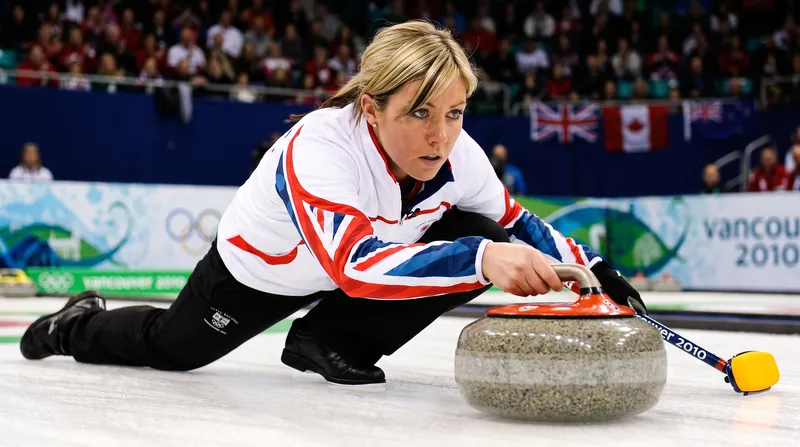
The curling stone itself is heavily engineered to fight this friction trap before it even touches the ice. The bottom of the polished granite rock is not flat; it is deeply concave, resembling the punt at the bottom of a traditional wine bottle.[1]
Because of this deep concavity, only a narrow, 6-millimeter-wide outer ring actually makes contact with the playing surface. This raised ring, known as the running band, limits the stone's total potential contact area to approximately 22 square centimeters.
If the stone were completely flat on the bottom, the capillary suction would be insurmountable, anchoring the rock to the ice the moment it began to slide. The running band is the first line of defense, drastically reducing the surface area available for the water film to grip.[2]
However, decades of experimental data have proven that the running band alone is not enough to overcome the adhesive forces of smooth ice. Even with the contact area reduced to 22 square centimeters, a stone thrown on a flat hockey rink will still succumb to capillary drag.[2]
Amplifying Pressure Through Pebbles
This is where the frozen pebbles become the critical variable in the physics of the glide. When the stone rides over the pebbled ice, the running band only makes contact with the very tops of the frozen droplets, rather than a continuous flat sheet.[1]
This interaction reduces the actual contact area by an estimated 95 percent, leaving the stone resting on just a few microscopic points at any given millisecond. By concentrating the stone's 19.1-kilogram mass onto these tiny plateaus, the downward pressure spikes dramatically.[1][4]
On flat ice, the running band exerts a baseline pressure of roughly 85 kilopascals. When elevated onto the pebbles, that pressure is amplified to over 1.7 megapascals, forcing the ice to respond differently to the passing granite.[4]
This immense localized pressure, combined with the sliding friction, instantly melts the peaks of the pebbles to create a hydrodynamic lubricating film. Because the contact points are so small, the water film remains highly localized, providing perfect lubrication without ever triggering sheet-wide capillary suction.[2]
The physics of this interaction represent a perfect balance between dry friction and wet lubrication. If the pressure were any lower, the stone would grind abrasively against dry ice, but because the pebbles force the pressure so high, the resulting micro-melt provides an ideal, low-drag glide path.[2]
Nipping the Peaks and Ice Wear
The pebbling process is not complete the moment the water freezes, as the freshly formed droplets naturally freeze into sharp, conical peaks. If left untreated, these sharp ice cones would rapidly degrade the granite running band and cause the stones to grind unpredictably.
To prevent this, technicians perform a vital secondary process called nipping, using a heavy steel blade to shave the sharp tips off the frozen pebbles. This precise scraping leaves thousands of tiny, flat plateaus—roughly 10,000 per square meter—that provide a consistent track.[3]
These microscopic plateaus are the actual playing surface of a curling match, and their condition dictates every strategic decision the players make. As the heavy stones repeatedly slide over the same paths, they gradually wear the plateaus down, flattening the pebbles and increasing the contact area.[3]
This progressive wear changes the friction dynamics entirely, forcing players to constantly adjust their throwing weight as the match extends into the later ends. A stone thrown with identical force will travel a drastically different distance on fresh pebbles compared to worn ones.
The Physics of Sweeping
Because the stone's glide depends entirely on this delicate balance of micro-friction, players can manipulate its trajectory mid-flight by sweeping the ice directly in its path. Sweeping is not about clearing debris; it is a rapid application of mechanical heat to the pebble plateaus.[1]
Vigorous sweeping generates intense frictional heat, which slightly warms the tops of the pebbles and thickens the microscopic water film just milliseconds before the stone arrives. This temporary reduction in friction allows the stone to travel significantly farther than it would on its own.[1][2]
The thickened water film also allows the stone to maintain a straighter path, delaying the lateral deflection—the curl—that gives the sport its name. By carefully modulating their sweeping intensity, the team can steer the rock around guards and into exact scoring positions.[1]
Once the sweepers lift their brooms, the water film instantly thins out in the freezing ambient air. Friction reasserts its grip on the running band, capillary forces begin to tug at the contact points, and the stone bites into the pebbles to curve toward its final resting place.[1][2]
Once the sweepers lift their brooms, the water film instantly thins out in the freezing ambient air.
The effectiveness of this sweeping is heavily dependent on the fabric used on the broom heads, which is strictly regulated by the World Curling Federation. Modern synthetic fabrics are engineered to maximize frictional heating without scratching the ice, ensuring the delicate pebble plateaus remain intact throughout the match.[1]
Key terms
- Capillary Suction
- The vacuum-like adhesive force created when a thin film of liquid spreads between two flat surfaces, resisting separation or sliding.
- Running Band
- The narrow, 6-millimeter-wide raised ring on the concave bottom of a curling stone that makes contact with the ice.
- Pebbling
- The process of spraying fine water droplets onto a curling sheet, which freeze into tiny bumps to reduce friction.
- Nipping
- Shaving the sharp tops off freshly frozen pebbles to create flat, uniform plateaus for the stones to glide across.
- Hydrodynamic Lubrication
- A state where two surfaces are completely separated by a thin film of fluid, drastically reducing friction.
Frequently asked
Why doesn't a curling stone slide on regular hockey ice?
Hockey ice is completely flat, which causes the heavy stone to melt a wide film of water beneath it. This triggers capillary suction, halting the stone almost immediately.
Does sweeping actually melt the ice into a puddle?
Sweeping does not create a puddle, but the intense friction warms the pebble plateaus enough to thicken the microscopic lubricating water film, reducing drag.
Why do curling stones have a concave bottom?
The hollow bottom ensures that only a narrow outer ring—the running band—touches the ice, minimizing the initial contact area before the pebbles reduce it even further.
Viewpoints in depth
Ice Technicians
Focusing on the precision required to create and maintain the perfect playing surface.
For the professionals who prepare the sheets, curling is an exercise in environmental control. They view the ice not as a static surface, but as a fragile, evolving topography. The temperature of the pebbling water, the ambient humidity of the arena, and the exact height of the nipped plateaus must be perfectly calibrated. If the pebbles are too high, the stones will chip them; if they are too flat, capillary suction ruins the glide.
Tribologists & Physicists
Analyzing the micro-mechanics of friction, capillary suction, and hydrodynamic lubrication.
Scientists studying ice friction view the curling sheet as a massive tribological laboratory. They focus on the transition between dry friction and hydrodynamic lubrication, noting that the sport exists entirely on the razor-thin margin between the two. For physicists, the pebble is a mechanism to artificially inflate contact pressure, forcing the ice to melt just enough to lubricate the stone without generating the massive adhesive drag of capillary suction.
Competitive Curlers
Reading the ice wear and manipulating friction dynamically through sweeping.
Athletes experience these physics entirely through feel and observation. They must constantly read how the heavy granite stones are wearing down the pebble plateaus over the course of a three-hour match. For a competitive curler, sweeping is the physical act of managing this friction in real time—applying mechanical heat to temporarily thicken the water film and coax a dying stone an extra few feet toward the button.
- Ice Technicians
- Focus on the precision of pebbling and nipping to create the perfect playing surface.
- Tribologists & Physicists
- Focus on the micro-mechanics of friction, capillary suction, and hydrodynamic lubrication.
- Competitive Curlers
- Focus on reading the ice wear and manipulating friction through sweeping.
Perspectives this story doesn't cover
- Materials Engineers designing synthetic ice alternatives
- Broom Manufacturers optimizing fabric friction
Sources
Source coverage
4 outlets
3 viewpoints surfaced




- [1]Smithsonian InstitutionCompetitive Curlers
The Physics of Curling
Read on Smithsonian Institution → - [2]AIP PublishingTribologists & Physicists
Friction on ice: How temperature, pressure, and speed affect the friction coefficient
Read on AIP Publishing → - [3]MDPITribologists & Physicists
Measurement of the Stone–Ice Friction Coefficient in a Prefabricated Ice Rink
Read on MDPI → - [4]Factlen Editorial Team
Synthesis by Factlen editorial team
Read on Factlen Editorial Team →
More in Sports
See all →World Curling
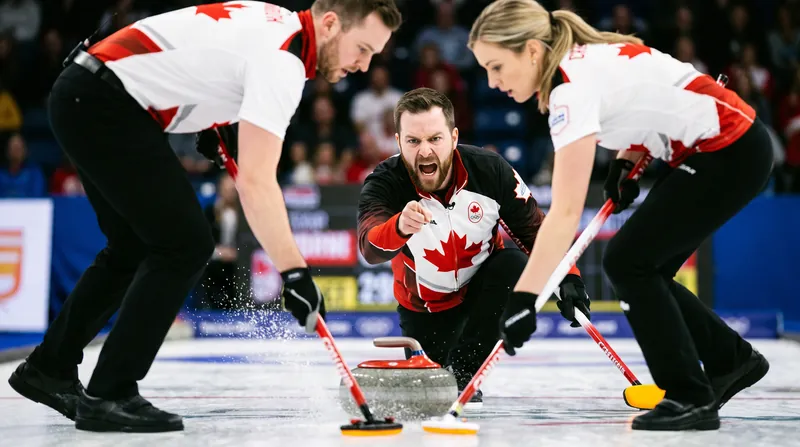
LGT Private Banking Secures Title Sponsorship for World Men's and Women's Curling Championships
3 sources
Curling Leadership
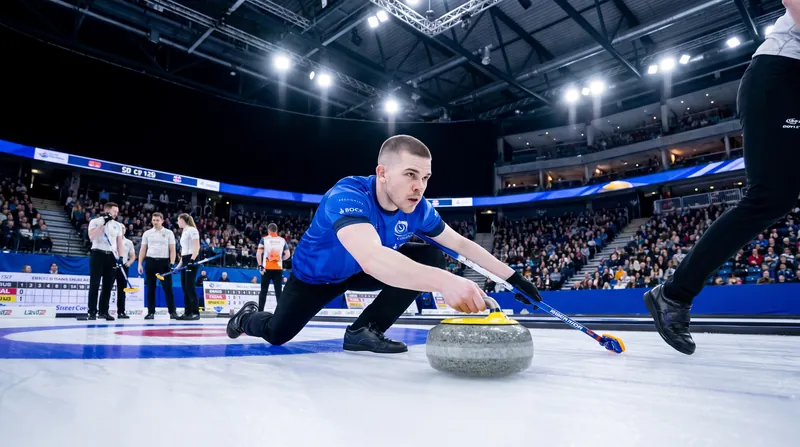
Canadian Olympic Champion Brad Gushue Named USA Curling High Performance Director
5 sources
Curling Rankings
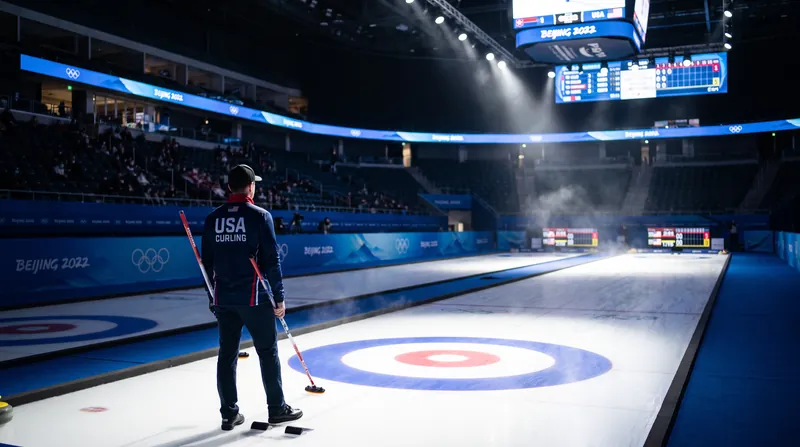
World Curling Expands Team Ranking System with Three New Competition Series for 2026-27 Season
6 sources
Mixed Doubles
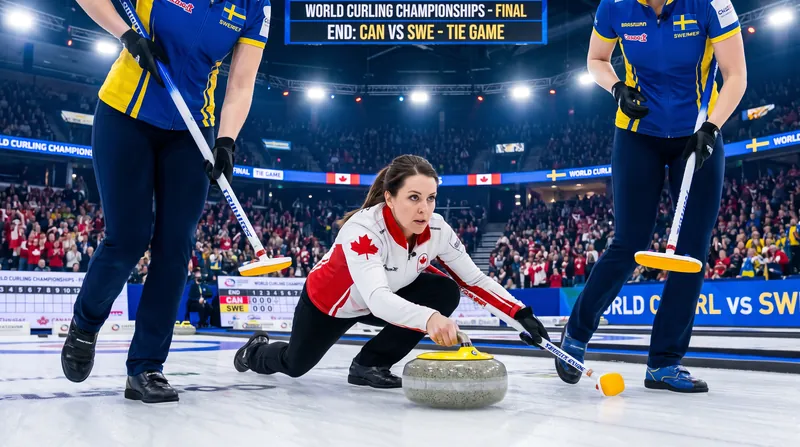
Olympic Champion Eve Muirhead Ends Retirement to Target 2030 Games in Mixed Doubles
6 sources
Comments
Every angle. Every day.
Get Sports stories with full source coverage and perspective breakdowns, free every day.