
Pan American Gymnastics Standings: USA, Brazil, and Canada Secure World Championship Berths After Rio Showdown
The continental power rankings are set after a dramatic Pan American Championships in Rio de Janeiro, with the top nations officially booking their tickets to the 2026 World Championships in Rotterdam.
By Xia Wu

Share this story
The continental hierarchy of the Americas has officially been set, bringing an end to months of speculation and intense training camps. Following five days of grueling and spectacular competition at the 2026 Pan American Gymnastics Championships in Rio de Janeiro, the final standings have dictated exactly which nations will represent the Western Hemisphere at the upcoming World Championships.
For the athletes involved, these standings represent the culmination of a grueling summer circuit and the realization of long-held international ambitions. The results from Rio not only finalize the qualification picture for Rotterdam but also establish the critical power dynamics and momentum that will carry these national programs into the second half of the Olympic cycle.[1]
In the highly anticipated women's team race, the United States reaffirmed its status as the premier force in the Americas, capturing the gold medal with a commanding total score of 161.628. However, the victory was far from a simple coronation and required significant resilience from the entire roster.
The U.S. squad was forced to navigate sudden adversity when reigning national champion and Olympic gold medalist Hezly Rivera was forced to withdraw mid-competition due to a sore hamstring. Relying heavily on their world-renowned depth, the remaining American athletes seamlessly absorbed the extra routines, executing difficult skills under pressure to outpace the rest of the field and secure the top spot on the podium.[1][2]
Brazil, buoyed by a passionate and deafening home crowd inside the Rio de Janeiro arena, secured second place in the continental standings with a final score of 157.796. The host nation's performance was undoubtedly highlighted by the highly anticipated return of six-time Olympic medalist Rebeca Andrade.
Competing for the first time since the Paris 2024 Games, Andrade opted to ease back into elite competition by performing exclusively on the vault. She did not disappoint the local fans, delivering a massive, gold-medal-winning 14.266 average that electrified the stadium and proved she remains one of the most formidable vaulters on the planet.[1]
Canada rounded out the women's team podium in third place with a score of 156.997, showcasing incredibly consistent routines across all four apparatuses to hold off the chasing pack. Argentina finished in fourth place with a 154.397, while Mexico secured the fifth position with a 151.096.
Under the strict qualification rules established by the International Gymnastics Federation for the 2026 cycle, all five of these top-ranked women's teams have officially punched their tickets to the World Championships in October. This guarantees that the Americas will send a full and highly competitive delegation to challenge the European and Asian stalwarts in the Netherlands.[3]
The individual women's all-around standings closely mirrored the dominance seen in the team results, with American teenagers Claire Pease and Charleigh Bullock delivering a spectacular 1-2 finish. Pease, a 17-year-old rising star, claimed the continental all-around title with a massive 54.498, excelling particularly on the uneven bars and balance beam where her execution scores separated her from the field.
Bullock, competing in her first year as a senior elite, followed closely to take silver with a 54.032, narrowly missing the top spot due to a minor vault deduction. Brazil's Thais Fidelis secured the bronze medal with a 52.232, giving the home crowd another reason to celebrate a successful championship run.[2][4]
While the women's standings followed a relatively familiar script, the men's continental race produced a historic and thrilling breakthrough that reshaped the region's hierarchy. Canada surged to the top of the leaderboard to claim its first-ever Pan American men's team title, a monumental achievement for a program that has spent years steadily building its depth.
Posting a final score of 243.026, the Canadian squad found themselves locked in a tense battle that came down to the very last routine. Jordan Carroll, anchoring the team on the notoriously unforgiving pommel horse, needed a massive score to secure the gold and delivered a clutch 14.266 to seal the historic victory.[1]
Colombia also entirely disrupted the traditional power dynamic of the Americas, finishing a close second in the team standings with a 241.594. The Colombian surge was driven by the spectacular performances of their all-around stars, proving that their long-term investments in the men's program are finally yielding deep, world-class rosters capable of challenging for team hardware.
By outscoring traditional heavyweights and executing high-difficulty routines across all six apparatuses, the Colombian men sent a clear message that they are no longer just a collection of individual event specialists, but a cohesive unit ready to make noise on the global stage.[1][4]
The United States men, who entered the competition as the defending Pan American champions and reigning Olympic bronze medalists, slipped to third in the final standings with a 235.961 after a surprisingly rocky competition. The Americans found themselves in early trouble and were forced to count multiple major errors, including a disastrous 11.900 on the pommel horse and a 9.833 on the high bar.
Despite the uncharacteristic falls that derailed their hopes for gold, the U.S. men managed to steady themselves on the floor exercise, relying on veteran leadership to stop the bleeding and ensure they remained on the podium.[1][2]
Brazil's men's team finished fourth with a total score of 234.927, successfully securing the final team qualification berth for the upcoming World Championships. The top-four finish was a massive relief for the host nation, ensuring that they will send a full men's delegation to the global stage alongside Canada, Colombia, and the United States.
While the Brazilian men missed out on a team medal in front of their home fans, their ability to navigate a high-pressure qualification scenario ensures their program remains on track for the remainder of the Olympic cycle.[1][3]
In the men's individual all-around standings, Colombia completely dominated the top of the leaderboard in a dramatic intra-squad battle. Camilo Vera snuck in to claim the all-around gold medal, executing a brilliant and steady competition to edge out his highly decorated teammate Angel Barajas. Barajas was on pace to run away with the title but suffered a costly and heavy fall on his Cassina release move during the final high bar rotation, dropping him to the silver medal position and opening the door for Vera's victory.[4]
American veteran Yul Moldauer showcased his characteristic consistency and grit to claim the all-around bronze medal, adding an individual accolade to his team bronze. Moldauer's performance was a masterclass in pacing, as he not only secured a spot on the all-around podium but also qualified for five out of the six individual event finals. His steady presence provided a crucial stabilizing force for a U.S. men's team that was actively navigating a challenging and highly transitional meet, proving his enduring value to the national program.[2]
With the Pan American standings now officially finalized and the continental medals awarded, the focus of the gymnastics world shifts entirely to the World Championships in Rotterdam, scheduled for October 17-25. The upcoming global event, operating under the unifying theme 'Building Bridges,' will serve as the ultimate proving ground for these newly crowned continental champions.
The teams from the Americas will now return to their respective training centers to refine their routines and upgrade their difficulty, knowing they will soon face off against the surging European and Asian powerhouses in the Netherlands.[5]
Key points
- The USA women's team won gold at the Pan American Championships despite the mid-meet withdrawal of Hezly Rivera.
- Brazil's Rebeca Andrade made a successful return to competition, winning gold on the vault.
- Canada's men's team claimed a historic first-ever continental team title, edging out Colombia.
- The US men's team suffered multiple falls but managed to secure the bronze medal.
- The top five women's teams and top four men's teams officially qualified for the 2026 World Championships in Rotterdam.
How we got here
February 2026
The FIG Apparatus World Cup series begins in Cottbus, opening the global qualification pathway.
June 17, 2026
The USA women and Canadian men secure team gold medals at the Pan American Championships in Rio de Janeiro.
June 19, 2026
Claire Pease and Camilo Vera claim the individual all-around continental titles.
October 17, 2026
The 2026 World Gymnastics Championships will commence in Rotterdam, Netherlands.
- US National Program Coverage
- Focuses on the depth of the American roster and their resilience through injuries.
- International Olympic Analysts
- Highlights the historic breakthroughs of Canada and Colombia and the global implications.
- Event Organizers & Archivists
- Provides the raw data, historical context, and looks ahead to the World Championships.
Perspectives this story doesn't cover
- European and Asian national programs scouting their World Championship competition
- Athletes who missed qualification due to the two-per-country rule
Sources
Source coverage
5 outlets
3 viewpoints surfaced




- [1]Olympics.comInternational Olympic Analysts
The United States won the women's team title at the Pan American Gymnastics Championships in Rio de Janeiro
Read on Olympics.com → - [2]ForbesUS National Program Coverage
U.S. Women Win Pan American Gymnastics Title, Men Hold On For Bronze
Read on Forbes → - [3]WikipediaEvent Organizers & Archivists
2026 Pan American Artistic Gymnastics Championships
Read on Wikipedia → - [4]Olympic ChannelInternational Olympic Analysts
Claire Pease, Camilo Vera claim respective individual all-around titles at Pan American Gymnastics Championships
Read on Olympic Channel → - [5]Rotterdam 2026Event Organizers & Archivists
All about the Artistic Gymnastics World Championships 2026 in Rotterdam
Read on Rotterdam 2026 →
More in Sports
See all →Standings
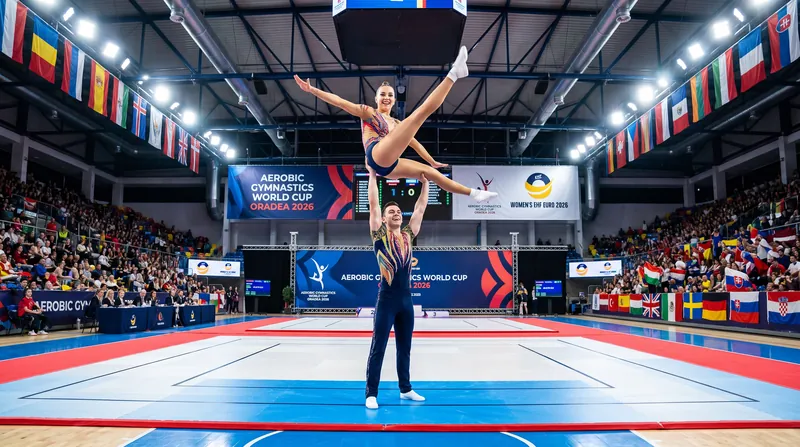
Ukraine's Kurashvili and Halaida Capture Mixed Pair Title as Aerobic World Cup Standings Finalize in Oradea
2 sources
Standings
Global Men's All-Around Standings: Richard, Oka, and Zhang Headline the High-Stakes Race to Rotterdam
4 sources
Standings
Global Women's Balance Beam and Floor Exercise Standings: Nemour and Kalmykova Headline the Apparatus Race to Rotterdam
4 sources
Standings
Global Rhythmic Gymnastics Standings: Varfolomeev Surges as Frankfurt Worlds Approach
9 sources
Comments
Every angle. Every day.
Get Sports stories with full source coverage and perspective breakdowns, free every day.