
Oracle Cancels $7 Billion AI Chip Lease With Tencent Amid US and Chinese Pressure
Oracle has abandoned a five-year contract to lease 100,000 advanced AI chips to Tencent across its Southeast Asian data centers. The cancellation follows direct intervention from the US administration and parallel pressure from Chinese provincial officials urging reliance on domestic hardware.
By Sergei Orlov

Share this story
Oracle has abruptly canceled a five-year, $7 billion contract to lease artificial intelligence computing capacity to Chinese technology giant Tencent. The agreement would have provided the Shenzhen-based company with access to roughly 100,000 advanced AI processors hosted in Oracle’s Southeast Asian data centers.[1][2]
The collapse of the arrangement follows direct intervention from the US administration, whose officials approached the California-based cloud provider to raise national security concerns. The cancellation effectively closes a highly lucrative loophole that allowed Chinese developers to rent hardware they are legally barred from purchasing.[4][5]
The Offshore Workaround
For the past two years, offshore leasing has served as a reliable workaround for Chinese technology firms facing strict US export controls. Because the physical processors never cross into Chinese territory, renting capacity in third countries like Malaysia or Singapore remains entirely legal under current commerce regulations.[4][6]
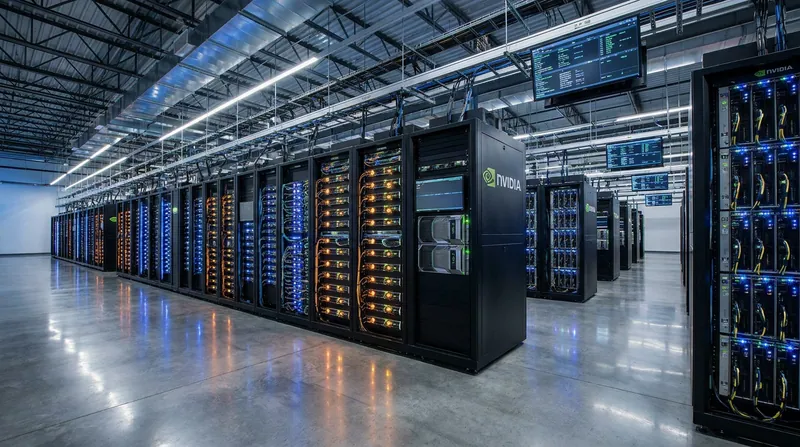
The Oracle-Tencent deal was designed to exploit exactly this geographic loophole at an unprecedented scale. By securing 100,000 advanced chips—widely understood to be Nvidia hardware, though neither company confirmed the specific architecture—Tencent aimed to guarantee its computing supply through the end of the decade.[1][4]
The contract was reportedly structured with a massive 30 percent upfront payment, meaning Tencent was prepared to hand Oracle approximately $2.1 billion immediately. This capital-intensive approach highlights how desperate Chinese artificial intelligence labs have become to secure reliable, high-performance training infrastructure.[1][2]
However, the deal did not just face headwinds from Washington. According to sources familiar with the negotiations, Tencent simultaneously received visits from senior provincial officials in Guangdong, where the company is headquartered. These meetings underscored Beijing's growing impatience with offshore dependencies.[1][6]
These local authorities reportedly urged the technology conglomerate to abandon its reliance on American cloud providers and instead support domestic Chinese semiconductor manufacturers. The dual pressure campaign left the $7 billion agreement squeezed between two competing geopolitical mandates, making its survival practically impossible.[3][5]
Shifting Regulatory Tactics
The US administration’s approach to killing the contract represents a notable shift in regulatory tactics. Rather than drafting new, complex export rules to govern offshore data centers, officials simply applied direct administrative pressure to a major American corporation to halt the transaction.[2][6]
This informal intervention creates immediate uncertainty for other hyperscale cloud providers operating in the region. Companies like Microsoft, Amazon, and Google must now price in the risk that any large-scale leasing agreement with a Chinese client could be dismantled by a single phone call from Washington.[3][4]
The cancellation also coincides with new, unpublicized restrictions quietly rolling out across the artificial intelligence supply chain. Nvidia has reportedly begun instructing its cloud computing partners that they must ensure at least 51 percent of their hosted services are sold to non-Chinese customers.[4][6]
That quota system fundamentally alters the economics of building massive data centers in Southeast Asia. Facilities constructed specifically to serve Chinese technology giants may now struggle to find enough alternative tenants to satisfy the new hardware allocation requirements imposed by silicon vendors.[4][5]
The Illusion of Cloud Computing
While the technology industry routinely markets these arrangements as advanced artificial intelligence infrastructure, the reality is far more industrial. These contracts are essentially long-term, high-margin server rental agreements, requiring massive upfront capital expenditure to procure and install the physical hardware.[1][2]
Oracle has aggressively positioned itself as a tier-one provider in this space, recently touting a reported $300 billion infrastructure commitment with OpenAI. However, the capital intensity of purchasing hundreds of thousands of advanced processors has placed real pressure on the company’s free cash flow.[1][2]
Losing a $7 billion guaranteed revenue stream removes a significant pillar of Oracle’s near-term growth strategy in the Asia-Pacific region. The company has already invested heavily in Malaysian data centers, many of which currently serve other major Chinese clients like ByteDance and Alibaba.[4][6]
For Tencent, the cancellation represents a severe setback in its race to develop frontier artificial intelligence models. The company has been rapidly expanding its infrastructure spending to train its Hunyuan models, attempting to close the performance gap with domestic rivals like Alibaba’s Qwen.[3][5]
The Domestic Hardware Gap
Chinese authorities are using the moment to push their own industrial policy, insisting that companies like Tencent transition to domestic hardware. Processors like Huawei’s Ascend series are heavily promoted by state officials as viable alternatives to restricted American technology.[1][4]
Yet the reality of the silicon market tells a different story regarding current capabilities. Chinese artificial intelligence companies continue to seek overseas data centers precisely because domestic chips are not yet capable of handling massive, cluster-scale training workloads with the same efficiency and reliability.[4][6]
Training a frontier model requires tens of thousands of processors to operate in perfect synchronization for months at a time. The networking bandwidth and software ecosystem required to manage that process remain a significant vulnerability for China’s domestic semiconductor industry.[4][5]
By forcing Tencent to abandon its offshore strategy, Beijing is essentially forcing the company to accept a slower development timeline. The mandate prioritizes the long-term survival of the domestic chip ecosystem over the immediate competitiveness of China’s leading software developers.[1][4]
Unanswered Financial Questions
The abrupt termination of the contract leaves several major financial questions unresolved for both corporations. It remains entirely unclear whether Tencent had already transferred the $2.1 billion upfront payment, and if so, what legal mechanism Oracle might use to refund or retain that capital.[1][2]
Neither Oracle, Tencent, nor the US administration have issued formal public statements regarding the cancellation. The silence from all parties underscores the intense political sensitivity surrounding artificial intelligence infrastructure and the quiet, behind-the-scenes nature of the intervention.[3][6]
The collapse of this specific deal will likely accelerate the fragmentation of the global computing market. As offshore leasing becomes increasingly contested, Chinese firms may be forced to rely on complex networks of shell companies to secure smaller, less visible compute clusters.[4][5]
Southeast Asia, which had positioned itself as a neutral digital Switzerland for the artificial intelligence boom, now finds its data centers on the front lines of a technological cold war. The region’s infrastructure investments are suddenly vulnerable to policy shifts in both Washington and Beijing.[4][6]
The cancellation proves that computing power is no longer treated as a neutral, borderless commodity. Advanced processors and the data centers that house them are now heavily guarded strategic assets, subject to direct government control regardless of where they are physically located.[1][4]
Balance Sheet Pressures
Oracle’s stock has faced significant volatility this year as Wall Street scrutinizes the massive debt required to fund its artificial intelligence ambitions. The company recently announced a $700 million increase in restructuring costs as it attempts to pivot its legacy software business toward high-performance computing.[1][2]
The loss of the Tencent contract forces Oracle to find new tenants for the hardware it had earmarked for the Southeast Asian deployment. While global demand for advanced processors remains exceptionally high, securing a single client willing to commit $7 billion over five years is a rare achievement.[4][6]
The immediate challenge for Oracle now lies in its upcoming quarterly earnings report, where analysts will look for a formal revenue adjustment tied to the lost contract. The broader industry is watching to see if the administration follows this private phone call with a codified rule banning offshore leasing entirely.[4][5]
Key points
- Oracle has canceled a $7 billion contract to lease 100,000 advanced AI processors to Tencent in Southeast Asia.
- The termination followed direct pressure from the US administration, bypassing the need for formal export control rule changes.
- Tencent faced simultaneous pressure from Chinese provincial officials urging the company to purchase domestic hardware instead.
- The cancellation exposes the geopolitical vulnerability of offshore data centers, which Chinese firms use to bypass hardware import restrictions.
What we don’t know
- Whether Tencent had already transferred the estimated $2.1 billion upfront payment, and how Oracle will handle any required refunds.
- If the US administration plans to formalize this intervention into a codified rule banning all offshore AI compute leasing.
- How quickly Oracle can secure alternative tenants for the massive hardware deployment originally earmarked for this contract.
How we got here
September 2026
Reports emerge that Oracle and Tencent have signed a five-year, $7 billion AI chip leasing agreement.
October 2026
Nvidia reportedly instructs cloud providers to ensure 51 percent of their hosted capacity is sold to non-Chinese clients.
November 2026
Oracle abruptly cancels the Tencent contract following direct interventions from both US and Chinese officials.
- US Security Hawks
- Advocate for closing all offshore compute loopholes to restrict Chinese AI development.
- Chinese Industrial Planners
- Push for complete reliance on domestic hardware to build technological sovereignty.
- Cloud Infrastructure Providers
- Seek clear, predictable regulations rather than ad-hoc contract interventions.
Perspectives this story doesn't cover
- Southeast Asian data center operators whose facilities are caught in the regulatory crossfire.
- Nvidia executives managing the sudden 51 percent non-Chinese allocation mandate.
Sources
Source coverage
6 outlets
3 viewpoints surfaced






- [1]BloombergUS Security Hawks
Oracle Scraps $7 Billion Deal to Lease Chips to Tencent, FT Says
Read on Bloomberg → - [2]The Next WebCloud Infrastructure Providers
Oracle cancels $7B Tencent AI chip lease under US pressure, FT reports
Read on The Next Web → - [3]MarketScreenerCloud Infrastructure Providers
Oracle Scraps $7bn Tencent Chip Deal Under US Pressure
Read on MarketScreener → - [4]India TimesChinese Industrial Planners
Oracle 'dumps' $7 billion with one of China's biggest IT company
Read on India Times → - [5]Business StandardCloud Infrastructure Providers
Oracle abandons $7 billion Tencent AI deal under Trump's pressure
Read on Business Standard → - [6]EuronextUS Security Hawks
Oracle abandons $7 billion Tencent AI deal under Trump pressure, FT reports
Read on Euronext →
More in Technology
See all →Cloud Infrastructure
Oracle to Offer Google TPUs on Its Cloud Infrastructure Starting in 2027
5 sources

AI Hardware
OpenAI Negotiates Google TPU Purchases to Diversify AI Infrastructure
7 sources

AI Infrastructure
Anthropic Negotiates $45 Billion Cloud Compute Contract With Nvidia-Backed Nscale
7 sources

AI Infrastructure
Nscale Faces Investor Pushback on $30 Billion IPO Valuation After Microsoft Cancels UK Data Center
5 sources
Comments
Every angle. Every day.
Get Technology stories with full source coverage and perspective breakdowns, free every day.