
Manchester City Shatter Club Record With £116 Million Signing of Elliot Anderson
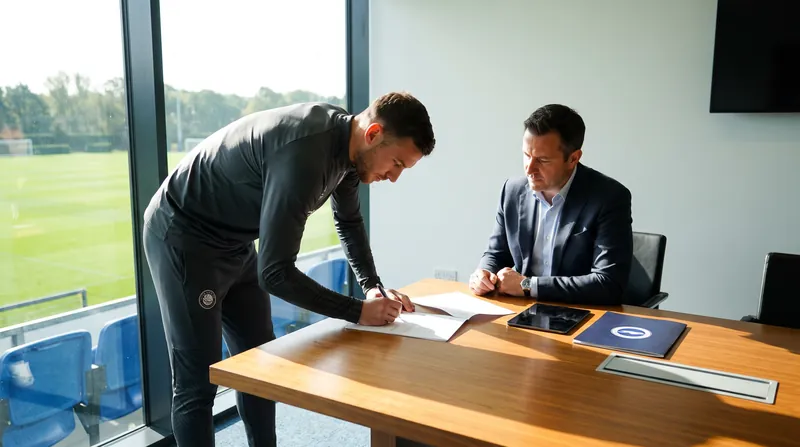
Manchester City have completed the £116 million signing of Elliot Anderson from Nottingham Forest, making the 23-year-old the most expensive British player in history. The move signals a major tactical shift for the club as they transition into a new high-energy era under Enzo Maresca.
By Xia Wu

Share this story
£116 million. When the ink dried on Elliot Anderson's five-year contract, Manchester City didn't just shatter their club transfer record—they signaled a seismic, high-stakes shift in their post-Pep Guardiola identity. For a club that spent the last decade meticulously calibrating its midfield with surgical, possession-heavy technicians, dropping nine figures on a relentless, high-energy engine represents a fundamental change in philosophy.
The sheer scale of the investment immediately places the weight of a new era squarely on the shoulders of a player who was fighting for minutes just a few seasons ago.[2]
The 23-year-old midfielder arrives from Nottingham Forest for a staggering $155 million, officially eclipsing the £100 million benchmark set by Jack Grealish in 2021. In doing so, Anderson becomes the most expensive British player in history, narrowly surpassing the massive fees previously commanded by the likes of Declan Rice and Harry Kane. It is a monumental statement of intent from the City hierarchy, proving they are willing to flex their unparalleled financial muscle to secure the exact profile required for their impending tactical rebuild.[1][2]
Anderson's rapid ascent from a Newcastle United academy prospect—sold to Forest for £35 million in the summer of 2024—to a nine-figure talisman underscores a frantic, premium-driven market. In today's Premier League, elite midfield engines who can seamlessly transition from defensive destroyers to attacking catalysts dictate the terms of engagement. Forest's massive profit margin on the player highlights how quickly valuations can skyrocket when a young, homegrown talent proves capable of dominating the center of the park week in and week out.[1][5]
Under new manager Enzo Maresca, City is aggressively pivoting away from the established blueprint. The meticulous, slow-possession dominance that suffocated opponents over the past decade is making room for a relentless, box-to-box tactical framework designed to overwhelm teams in transition. Maresca's vision requires athletes who can cover immense ground, disrupt opposition passing lanes, and instantly launch counter-attacks—a profile that Anderson fits perfectly, even if it means sacrificing some of the metronomic control City fans have grown accustomed to.[2]
Hugo Viana, City's director of football, pointed directly to Anderson's 'outstanding work rate' and 'exceptional range of passing' as the primary catalysts for the historic investment. Viana and the recruitment team are betting heavily on the midfielder's physical ceiling, noting that at just 23 years old, he has the runway to develop into the most complete two-way player in world football. The front office clearly believes that securing a foundational piece for the next half-decade justifies paying a massive premium in an inflated summer market.[2]
The underlying numbers provide a compelling justification for a system that increasingly values defensive contribution and rapid ball recovery over static possession. Anderson racked up a staggering 104 tackles and 51 successful crosses during his final 37-appearance season at the City Ground. For a manager looking to inject immediate intensity and defensive bite into a midfield that occasionally looked vulnerable to rapid counter-attacks last season, those metrics represent the gold standard of modern Premier League engine-room performance.[5]
However, the record-breaking fee has not been immune to intense scrutiny. Critics point to his relatively modest attacking output—registering just four goals and five assists last season—arguing that a £116 million outlay should guarantee a primary goal-scoring threat rather than a two-way facilitator. Skeptics question whether a player primarily known for his defensive work rate and transition speed can truly replace the sheer creative output and final-third magic that City's traditional playmakers have historically provided.[5][6]
Yet, Anderson's pedigree on the biggest stages is undeniable and rapidly expanding. Fresh off a highly successful bronze medal run with the England national team at the 2026 World Cup in North America, he brings immediate, battle-tested international experience to the Etihad. Having cemented his place in Thomas Tuchel's England setup, Anderson has proven he can thrive under the immense pressure of knockout football, a trait that City's brass clearly valued when authorizing the record-breaking transfer fee.[1][3]
Off the pitch, the battle to secure his signature was a fierce, high-stakes drama that played out across the summer. Manchester United made a desperate late push to hijack the deal, with club legends Phil Bardsley and Ryan Giggs reportedly trying to sway the undecided midfielder during a chance encounter on a golf course in Portugal. The aggressive pursuit by City's fiercest rivals only underscores Anderson's immense value and the scarcity of elite, homegrown midfield talent available on the open market.[6]
Anderson's response to the competing interest was definitive and immediately endeared him to the blue half of the city. Upon signing, he publicly dubbed his new employers the 'kings of Manchester,' a pointed remark that instantly sets the stage for a fiery, highly anticipated Manchester derby on September 13. By embracing the pressure and leaning into the rivalry, the 23-year-old has signaled that he is more than ready to handle the intense spotlight that accompanies his historic price tag.[1]
Ultimately, this transfer is far more than a simple player acquisition; it is a bold tactical declaration. Manchester City is betting hundreds of millions of pounds that the future of the Premier League belongs to relentless, two-way athletes who can shatter defensive lines in an instant. By shattering their own transfer record to secure Elliot Anderson, the club has drawn a line in the sand, committing fully to a high-octane future that promises to redefine how the reigning champions approach the beautiful game.[2][4]
Key points
- Manchester City signed 23-year-old midfielder Elliot Anderson from Nottingham Forest for a club-record £116 million ($155 million).
- The transfer eclipses the £100 million paid for Jack Grealish, making Anderson the most expensive British player in history.
- Anderson recorded 104 tackles and 51 successful crosses last season, signaling City's tactical shift toward a high-energy transition midfield.
- The midfielder rejected a late push from Manchester United, publicly declaring City the 'kings of Manchester' ahead of the September 13 derby.
What we don’t know
- How quickly Anderson will adapt to Enzo Maresca's tactical system after spending his formative years in counter-attacking setups.
- Whether his relatively low goal-scoring output will become a liability for a team accustomed to high-scoring midfielders.
- How the massive £116 million price tag will affect his performance under the intense spotlight of the Etihad.
- Tactical Evolution Advocates
- View the transfer as a necessary modernization of City's midfield engine.
- Value & Output Skeptics
- Question whether a defensive-minded midfielder warrants a record-breaking fee.
- Market Reality Analysts
- See the fee as a natural consequence of Premier League inflation and premium English talent.
Perspectives this story doesn't cover
- Nottingham Forest supporters losing a homegrown star just as the club pushes for European qualification
- Manchester City academy prospects whose pathways to the first team are now blocked by a record-breaking signing
Sources
Source coverage
6 outlets
3 viewpoints surfaced






- [1]The GuardianMarket Reality Analysts
Elliot Anderson calls Manchester City the 'kings of Manchester' after £116m move
Read on The Guardian → - [2]Fox SportsTactical Evolution Advocates
England's Elliot Anderson Joins Manchester City In $155 Million Transfer
Read on Fox Sports → - [3]Sports IllustratedMarket Reality Analysts
Man City Confirm Record-Breaking Elliot Anderson Transfer
Read on Sports Illustrated → - [4]ManCity.comTactical Evolution Advocates
Anderson joins City
Read on ManCity.com → - [5]Fantasy Football ScoutValue & Output Skeptics
FPL new signings: Now at Man City, is Anderson a better or worse pick?
Read on Fantasy Football Scout → - [6]Manchester Evening NewsValue & Output Skeptics
Phil Bardsley and Ryan Giggs tried to persuade Elliot Anderson to join Man United
Read on Manchester Evening News →
More in Sports
See all →Transfer Economics
The High Guaranteed Base Fee vs. The Performance-Heavy Add-On Package: Quantifying the Trade-Offs in Modern Soccer Transfers
3 sources

Transfer Mechanics
The Prohibitive Release Clause vs. The Active Market Valuation: Quantifying the Trade-Offs in Modern Soccer Contracts
2 sources

Transfer Economics
The Bosman Pre-Contract vs. The January Cut-Price Transfer: Quantifying the Trade-Offs in Expiring Soccer Deals
4 sources

Squad Building
The Successive Loan Spell vs. The Permanent Transfer: Quantifying the Trade-Offs in Modern Soccer Squad Building
6 sources

Comments
Every angle. Every day.
Get Sports stories with full source coverage and perspective breakdowns, free every day.