
How the Nine-Dash Line Collides With UNCLOS Archipelagic Sea Lanes
Two incompatible legal frameworks govern the South China Sea, creating a paradox where international transit rights intersect with domestic territorial claims. The overlap forces commercial and military vessels to navigate conflicting navigational rules in the same geographic space.

Share this story
In short
- The United Nations Convention on the Law of the Sea guarantees foreign vessels the right of non-suspendable transit through designated Archipelagic Sea Lanes.
- China's Nine-Dash Line overlaps geographically with these internationally recognized corridors, particularly in the North Natuna Sea and proposed Philippine routes.
- This intersection creates a dual-regime paradox where ships are simultaneously exercising international transit rights and navigating waters claimed under domestic Chinese law.
Every year, roughly $3.4 trillion in global trade—representing one-fifth of all international commerce—passes through a body of water governed by two entirely incompatible rulebooks. The South China Sea operates under a dual reality where international maritime law and historical territorial claims occupy the exact same geographic space.[5]
At the center of this friction is a specific legal collision between the United Nations Convention on the Law of the Sea and China’s Nine-Dash Line. The conflict is not merely about who owns which islands, but about the fundamental rules of navigation.[1][4]
For archipelagic nations like Indonesia and the Philippines, the 1982 convention provides a mechanism to protect their sovereignty while allowing global shipping to proceed. They designate Archipelagic Sea Lanes—specific corridors where foreign vessels enjoy non-suspendable transit rights.[1][3]
However, these internationally recognized corridors run directly through the U-shaped boundary China uses to claim roughly 90 percent of the South China Sea. Where these lines cross, a vessel is simultaneously in an international transit lane and a contested domestic zone.[4][5]
The Architecture of Archipelagic Sea Lanes
To understand the collision, one must first understand how archipelagos are defined under international law. Before 1982, nations composed entirely of islands struggled to define their maritime borders, as traditional rules left pockets of international waters between their islands.[1][3]
The convention solved this by allowing these nations to draw straight baselines connecting their outermost islands. The waters inside these lines became archipelagic waters, granting the state sovereignty over the sea, the seabed, and the airspace above it.[1]
In exchange for this massive enclosure of ocean, archipelagic states had to make a concession to global trade and military mobility. They were required to designate specific sea lanes through their waters to ensure global supply chains remained unbroken.[1][3]
According to Article 53 of the convention, these lanes must include all normal passage routes used for international navigation. Within these corridors, foreign ships and aircraft exercise the right of archipelagic sea lanes passage.[1]
The treaty is explicit about what this right entails. "Archipelagic sea lanes passage means the exercise in accordance with this Convention of the rights of navigation and overflight in the normal mode solely for the purpose of continuous, expeditious and unobstructed transit," the text states.[1]
This means a foreign warship or commercial freighter can travel through a designated lane without asking permission, provided it does not deviate from the axis of the lane by more than 25 nautical miles or engage in threatening activities.[1][3]
The Geometry of the Nine-Dash Line
Operating in direct opposition to this framework is the Nine-Dash Line. Originally published by the Republic of China in 1947 as an eleven-dash line, it was later adopted and modified by the People's Republic of China.[4]
The line first entered the modern international legal record in 2009, when China attached a map featuring the nine dashes to a Note Verbale submitted to the United Nations. The submission protested a joint extended continental shelf claim by Malaysia and Vietnam.[4]
The precise legal nature of the waters enclosed by the Nine-Dash Line has remained intentionally ambiguous. Chinese legal scholars and state pronouncements often refer to historical rights within the line, a concept that does not neatly map onto standard categories like the Exclusive Economic Zone or territorial sea.[4][5]
In 2016, the Permanent Court of Arbitration in The Hague issued a landmark ruling on the matter. The tribunal concluded that China's claims to historic rights within the Nine-Dash Line were "contrary to the Convention and without lawful effect" to the extent they exceeded the geographic and substantive limits of the treaty.[2]
Despite the ruling, Beijing rejected the tribunal's authority and has continued to enforce its jurisdiction within the boundary. This enforcement includes the 2021 revision of China’s Maritime Traffic Safety Law, which requires certain foreign vessels to report their details when entering what China considers its jurisdictional waters.[2][4]
Where the Frameworks Intersect
The theoretical conflict becomes a practical crisis where designated sea lanes intersect with the Nine-Dash Line. The most prominent example lies in the North Natuna Sea, where Indonesia's primary transit corridor overlaps with the southernmost dash of China's claim.[5]
Indonesia formally proposed its three North-South corridors to the International Maritime Organization in 1996, and they were adopted in 1998. The first of these routes traffic from the Sunda Strait northwards into the South China Sea, serving as a critical artery for vessels bypassing the congested Strait of Malacca.
As ships exit the northern terminus of this corridor, they cross directly into the waters claimed by the Nine-Dash Line. For a commercial captain, this creates an immediate legal paradox.[5]
Under the 1982 convention, the ship is exercising a non-suspendable right of transit passage, moving from an archipelagic sea lane into an Exclusive Economic Zone or high seas. Under China's domestic framework, the ship has entered waters subject to historical rights and potential prior-notification requirements.[1][4]
The Philippines faces a similar, albeit prospective, dilemma. Manila has spent years drafting legislation to formally designate its own corridors, a complex process given the country's geography and the presence of contested features in the Spratly Islands.[6]
Any East-West corridor designated by the Philippines would inevitably cross the Nine-Dash Line. "The establishment of Philippine ASLs presents a unique geopolitical challenge, as these internationally recognized corridors will bisect waters claimed by a neighboring state," notes a 2022 analysis in Marine Policy.[6]
The Paradox of Transit
The collision of these frameworks creates a dual-regime paradox that affects both commercial shipping and naval operations. The rules of engagement and navigation change depending on which legal map a captain chooses to follow.[3][5]
For commercial vessels, the primary concern is insurance and liability. If a collision or incident occurs in an overlap zone, determining which legal regime applies can complicate claims and investigations.[5]
For military vessels, the stakes are significantly higher. The United States and its allies regularly conduct Freedom of Navigation Operations to assert the primacy of the 1982 convention and challenge what they view as excessive maritime claims.[3]
When a US Navy destroyer transits a corridor that overlaps with the Nine-Dash Line, it is simultaneously exercising a recognized international right and deliberately violating a domestic Chinese regulation. This dual reality increases the risk of miscalculation.[3][4]
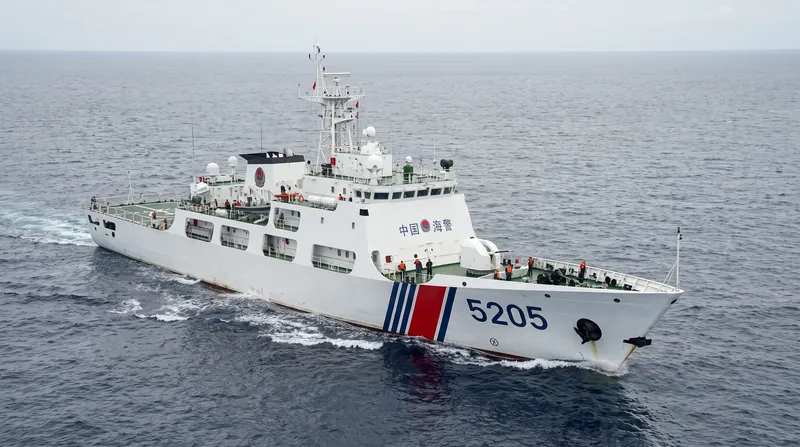
The Chinese Coast Guard and maritime militia frequently shadow foreign vessels in these overlap zones. Their presence is designed to enforce the Nine-Dash Line through physical proximity rather than formal legal proceedings, creating a gray-zone environment where might often dictates right.[4]
The Integrity of the Global Commons
The friction between these transit corridors and the Nine-Dash Line extends far beyond the South China Sea. It represents a fundamental test of whether a universal, rules-based maritime order can survive when challenged by a major power's historical claims.[3][5]
The 1982 convention was negotiated over nine years by more than 160 nations. It was designed as a package deal, meaning states could not cherry-pick the provisions they liked while ignoring those they found inconvenient.[1]
The archipelagic regime was one of the most delicate compromises in the entire convention. Island nations gained massive new territories, but only by guaranteeing that the global commons would not be fractured by new maritime walls.[1][3]
If the Nine-Dash Line successfully supersedes transit rights in practice, that grand bargain begins to unravel. The precedent would suggest that domestic historical claims can override the codified rights of international navigation.[3][5]
For now, the South China Sea remains a space governed by two contradictory maps. Every vessel that transits the overlap zones must navigate not only the physical hazards of the ocean, but the invisible, colliding lines of international law.[5]
Jargon, explained
- UNCLOS
- The 1982 United Nations Convention on the Law of the Sea, which establishes the comprehensive legal framework for all marine and maritime activities.
- Archipelagic Baseline
- A straight line connecting the outermost points of an island nation, enclosing its internal waters and defining its sovereign territory.
- Transit Passage
- The exercise of the rights of navigation and overflight solely for the purpose of continuous and expeditious transit through a strait or sea lane.
- Nine-Dash Line
- A U-shaped boundary used by China to claim historical rights over approximately 90 percent of the South China Sea.
Common questions
What is an Archipelagic Sea Lane?
A designated corridor through the waters of an island nation where foreign ships and aircraft have the right of continuous and expeditious transit, without needing prior permission from the host country.
Did the 2016 arbitral ruling invalidate the Nine-Dash Line?
The Permanent Court of Arbitration ruled that China's claims to historic rights within the line had no legal basis under international law, though Beijing formally rejected the decision and continues to enforce the boundary.
How does this conflict affect commercial shipping?
It creates severe legal uncertainty. Ships in overlap zones are technically subject to both international transit rights and domestic Chinese prior-notification laws, which complicates insurance coverage and liability in the event of an incident.
Competing readings
UNCLOS Traditionalists
Argues that the 1982 Convention is the sole legitimate framework for maritime navigation.
This perspective, anchored by the 2016 Permanent Court of Arbitration ruling and supported by major naval powers like the United States, maintains that historical claims cannot override codified transit rights. Proponents argue that UNCLOS was a comprehensive package deal; nations cannot enjoy the benefits of Exclusive Economic Zones while rejecting the transit rights that made the treaty possible. From this view, any domestic law requiring prior notification within an internationally recognized Archipelagic Sea Lane is fundamentally invalid.
Historical Rights Advocates
Maintains that China's historical presence justifies a parallel domestic regulatory regime.
Chinese legal scholars and state institutions argue that the Nine-Dash Line predates the 1982 convention and represents a distinct category of historical rights not extinguished by the treaty. This viewpoint asserts that while freedom of navigation for commercial vessels is respected, the unique historical status of the waters allows Beijing to impose domestic security regulations, such as the 2021 Maritime Traffic Safety Law, to monitor and control foreign military presence within its claimed jurisdiction.
Archipelagic Sovereignty Defenders
Focuses on the right of island nations to protect their internal waters while facilitating shipping.
For nations like Indonesia and the Philippines, the primary concern is maintaining the integrity of their archipelagic baselines. They view the designation of sea lanes as a necessary compromise to secure international recognition of their sprawling maritime borders. This perspective is highly sensitive to any foreign encroachment—whether from Chinese coast guard vessels enforcing the Nine-Dash Line or from foreign navies deviating from the strict axis of designated transit corridors—viewing both as threats to their hard-won sovereignty.
- UNCLOS Traditionalists
- Argues that the 1982 Convention is the sole legitimate framework for maritime navigation and that historical claims cannot override codified transit rights.
- Historical Rights Advocates
- Maintains that China's historical presence and administration of the South China Sea predates UNCLOS, justifying a parallel domestic regulatory regime.
- Archipelagic Sovereignty Defenders
- Focuses on the right of island nations to protect their internal waters from exploitation while fulfilling their obligation to facilitate international shipping.
Perspectives this story doesn't cover
- Commercial maritime insurance underwriters
- Civilian cargo ship captains
Sources
Source coverage
6 outlets
3 viewpoints surfaced






- [1]United Nations Division for Ocean Affairs and the Law of the Sea
United Nations Convention on the Law of the Sea
Read on United Nations Division for Ocean Affairs and the Law of the Sea → - [2]Permanent Court of ArbitrationUNCLOS Traditionalists
The South China Sea Arbitration (The Republic of Philippines v. The People's Republic of China)
Read on Permanent Court of Arbitration → - [3]Naval War College ReviewUNCLOS Traditionalists
Archipelagic Sea Lanes Passage and the South China Sea
Read on Naval War College Review → - [4]Asia-Pacific Journal of Ocean Law and PolicyHistorical Rights Advocates
The Nine-Dash Line and Its Legal Implications under UNCLOS
Read on Asia-Pacific Journal of Ocean Law and Policy → - [5]Factlen Editorial TeamUNCLOS Traditionalists
Synthesis by Factlen editorial team
Read on Factlen Editorial Team → - [6]Marine PolicyArchipelagic Sovereignty Defenders
Philippine Archipelagic Sea Lanes: Legal and Geopolitical Challenges
Read on Marine Policy →
More in World
See all →South China Sea
Chinese Coast Guard Rams Philippine Fisheries Vessel Near Sabina Shoal
6 sources
South China Sea
The Geographic Incompatibility of the Nine-Dash Line and the UNCLOS Exclusive Economic Zone
6 sources
Maritime Law
How China's Coast Guard Detention Rules Reshape Maritime Law in the Pacific
4 sources
South China Sea
China Confirms Two Fatalities in 2025 South China Sea Collision Between Coast Guard and PLA Navy
5 sources
Comments
Every angle. Every day.
Get World stories with full source coverage and perspective breakdowns, free every day.