
How the Brain Deliberately Forms Amyloids to Store Long-Term Memories
For decades, amyloid proteins have been viewed strictly as the toxic drivers of neurodegenerative diseases. But a paradigm-shifting discovery reveals that the healthy nervous system intentionally constructs these same structures to encode lasting memories.

Share this story
In short
- Amyloid proteins, long associated exclusively with neurodegenerative diseases, are actively used by the healthy brain to store long-term memories.
- A newly identified chaperone protein named 'Funes' acts as a master regulator, converting the Orb2 protein into a stable amyloid structure at the synapse.
- Without the Funes chaperone triggering this amyloid conversion, the brain completely loses its ability to consolidate long-term memories.
In the century since Alzheimer's disease was first characterized, amyloid proteins have been cast as the undisputed villains of neuroscience. These tightly packed, highly stable protein fibers are infamous for clumping into plaques that suffocate neurons and erase memories. Consequently, billions of dollars in drug development have been poured into a single, seemingly logical goal: stopping amyloid formation at all costs. Yet, a profound tension has emerged in recent years as researchers noticed these same proteins appearing in perfectly healthy brains.[4]
That tension has now been resolved by a paradigm-shifting discovery: the nervous system deliberately constructs functional amyloids to turn fleeting sensory experiences into permanent long-term memories. Rather than being exclusively pathological byproducts, amyloids are essential tools. By identifying the exact molecular machinery the brain uses to build them, researchers have proven that the healthy mind relies on the very structures long blamed for its destruction.[1]
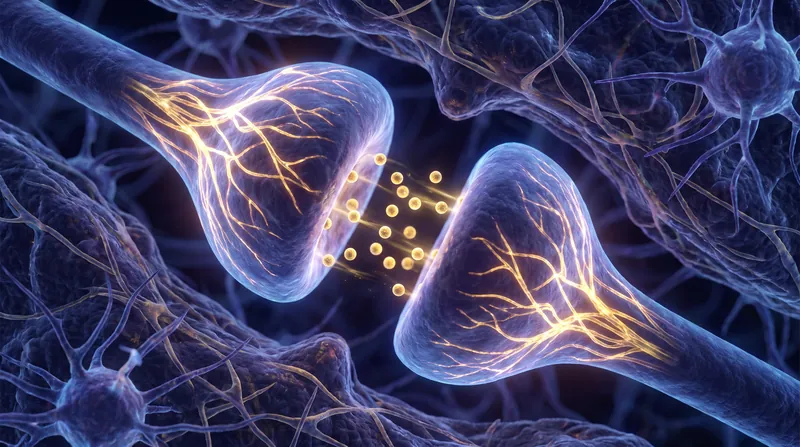
The mechanism centers on a specific mRNA-binding protein called Orb2 (and its mammalian equivalent, CPEB). When a memory is formed, Orb2 undergoes a radical shape change at the synapse—the junction between two neurons. It self-assembles into an amyloid structure. Unlike the toxic plaques seen in disease, this physiological amyloid is translationally active. It actively helps synthesize the new proteins required to physically maintain the memory trace over time, locking the synaptic changes into place.[1][2]
The critical question was how the brain controls this dangerous assembly process without triggering runaway toxicity. The answer lies in a newly identified molecular chaperone. By screening thirty different chaperone proteins in the memory centers of fruit flies, scientists pinpointed a specific J-domain protein that acts as the master regulator. They named it 'Funes,' inspired by the Jorge Luis Borges short story Funes the Memorious, about a man cursed with an infallible memory.[1]
Funes binds directly to the Orb2 protein and actively promotes its transition into the amyloid state. When researchers engineered a mutant version of Funes that could still bind to Orb2 but lacked the ability to trigger the amyloid conversion, the flies completely lost their ability to form long-term memories of an odor-reward link. The memory simply failed to consolidate, proving that the chaperone-guided amyloid formation is an absolute requirement for long-term storage.[1][2]
Cryo-electron microscopy revealed that the amyloids created with the help of Funes are structurally identical to the endogenous amyloids extracted directly from healthy brains. They possess the exact same 'cross-beta' architecture that characterizes both functional and pathological amyloids. This confirms that the brain has evolved sophisticated, dedicated machinery to harness these ultra-stable structures for information storage, rather than them being accidental misfolds.[1]
This revelation arrives during a period of rapid upheaval in our understanding of memory consolidation. Just recently, a separate study demonstrated that memories in mice can persist even after the synaptic connections previously thought necessary for recall are severed. Together, these findings suggest that the physical engram of a memory is far more resilient—and molecularly complex—than the traditional model of simple synaptic strengthening.[3]
The discovery of Funes forces a profound rethinking of how we approach neurodegenerative diseases. If amyloids are a natural and necessary part of memory formation, indiscriminately clearing them might inadvertently damage the very cognitive functions therapies aim to save. While it remains unproven whether targeting these chaperones can successfully reverse Alzheimer's in human patients, the identification of proteins like Funes opens a new therapeutic frontier: developing drugs that fine-tune the amyloid assembly process, guiding toxic misfolds back toward beneficial, tightly regulated structures.[1][4]
Where opinion splits
The Functional Amyloid Paradigm
Why molecular neuroscientists believe amyloids are essential for survival.
For decades, the definition of an amyloid was inextricably linked to disease. But molecular neuroscientists now argue that the very properties making amyloids dangerous—their incredible stability and resistance to being broken down—are exactly why the brain selected them to store lifelong memories. In this view, pathological conditions like Alzheimer's are not caused by the mere presence of amyloids, but by a failure in the regulatory chaperone systems that normally keep their formation strictly controlled.
The Drug Development Pivot
How this discovery alters the search for Alzheimer's treatments.
The pharmaceutical industry has spent decades pursuing 'amyloid hypothesis' drugs designed to scrub the brain of these protein aggregates. However, researchers focusing on chaperone biology warn that blunt-force clearance might be counterproductive if it disrupts the physiological amyloids needed for memory. They advocate for a pivot toward 'chaperone-targeted' therapies—drugs that don't destroy amyloids, but rather repair the molecular machinery (like the Funes protein) that ensures they fold correctly and safely.
- Molecular Neuroscientists
- Argue that amyloids are a fundamental, evolutionarily conserved mechanism for biological information storage, requiring a complete rewrite of basic neuroscience textbooks.
- Drug Development Researchers
- View the discovery as a cautionary tale against indiscriminate amyloid-clearing drugs, advocating instead for targeted therapies that modulate chaperone proteins.
- Systems Biologists
- Focus on how the brain's memory architecture is far more distributed and molecularly resilient than previously thought, surviving even synaptic pruning.
Perspectives this story doesn't cover
- Alzheimer's Patients and Advocates
Sources
Source coverage
4 outlets
3 viewpoints surfaced




- [1]Proceedings of the National Academy of SciencesMolecular Neuroscientists
A J-domain protein enhances memory by promoting physiological amyloid formation in Drosophila
Read on Proceedings of the National Academy of Sciences → - [2]PubMedMolecular Neuroscientists
A J-domain protein enhances memory by promoting physiological amyloid formation in Drosophila
Read on PubMed → - [3]New ScientistSystems Biologists
‘Remarkable’ discovery upends our understanding of how brains store memories
Read on New Scientist → - [4]Factlen Editorial TeamDrug Development Researchers
Synthesis by Factlen editorial team
Read on Factlen Editorial Team →
More in Science
See all →Brain Plasticity
Synaptic Homeostasis: How Microglia Physically Dismantle Neural Connections During Sleep
7 sources
Connectomics
First Complete Map of a Male Fruit Fly's Central Nervous System Details 124 Million Connections
6 sources

Genome Architecture
Researchers Discover Alzheimer's Disease Disrupts the 3D Architecture of DNA in Brain Cells
6 sources
Brain Mechanics
The Active Role of Glial Cells: How Astrocytes, Microglia, and Oligodendrocytes Drive Brain Function
7 sources
Comments
Every angle. Every day.
Get Science stories with full source coverage and perspective breakdowns, free every day.