
How High-Impact Mechanical Loading Reverses Age-Related Bone Loss
Standard low-impact exercises fail to halt age-related bone mineral density loss because they do not cross the mechanical strain threshold required to trigger new bone formation. High-intensity resistance and impact training actively rebuilds the skeleton by forcing osteocytes to signal for structural reinforcement.

Share this story
In short
- Standard low-impact exercises like walking do not generate enough physical force to trigger new bone formation.
- Bone tissue requires a mechanical load of roughly 4.2 times body weight to signal osteocytes to rebuild the skeleton.
- Supervised heavy resistance and impact training safely increased spinal bone density by 2.9% in postmenopausal women over 8 months.
In October 2017, the publication of the LIFTMOR trial in the Journal of Bone and Mineral Research fundamentally altered clinical assumptions about aging skeletons. For the first time, researchers demonstrated that postmenopausal women with low bone mass could safely perform heavy deadlifts, squats, and jumping exercises to actively rebuild bone mineral density. The findings dismantled the prevailing medical consensus that older adults with osteopenia should strictly avoid heavy lifting to prevent fractures.[1]
Prior to that data, standard medical advice for preserving bone density centered almost entirely on low-impact activities like walking or swimming, paired with calcium supplementation. But while those interventions reliably improved cardiovascular health and muscle endurance, they consistently failed to halt the structural degradation of the skeleton. The disconnect lay in a misunderstanding of how bone tissue registers the need to grow.[3]
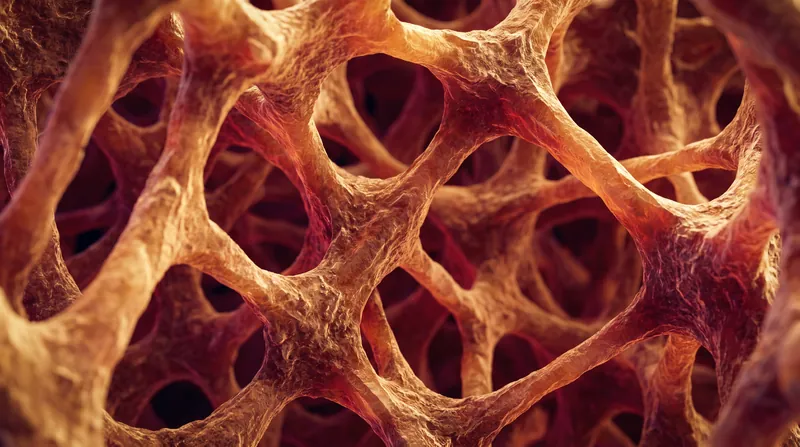
The biological mechanism governing this process is mechanotransduction. Deep within the mineralized matrix of the skeleton reside osteocytes, star-shaped cells that make up 90% of all bone tissue. "Osteocytes are the primary mechanosensors of the skeleton, translating physical deformation into biochemical signals," notes a 2021 review in Nature Reviews Endocrinology. When a bone bends slightly under a heavy load, fluid is forced through the microscopic canals connecting these cells, alerting them to the structural strain.[2]
The critical variable is the magnitude of that strain. Research indicates that to trigger the formation of new bone—a process called osteogenesis—the mechanical load must exceed a specific threshold, generally estimated at roughly 4.2 multiples of body weight in the lower extremities. Loads below this threshold signal to the body that the current bone architecture is sufficient for daily demands, prompting no new structural reinforcement.
This threshold explains the failure of standard aerobic guidelines to prevent osteoporosis. A typical walking stride generates a peak ground reaction force of only 1.0 to 1.2 times a person's body weight. Because this falls drastically short of the 4.2-multiple requirement, walking provides less than one-third of the mechanical strain necessary to trigger new bone formation in the femoral neck or lumbar spine.[3]
When the threshold is crossed via high-impact or heavy-resistance training, the osteocytes release biochemical signals that suppress osteoclasts—the cells responsible for breaking down old bone—and stimulate osteoblasts, the cells that build new bone matrix. This cellular shift changes the net balance of the skeleton from degradation to accumulation.[2]
The clinical results of crossing this threshold are substantial. In the 8-month LIFTMOR trial, participants engaging in 30 minutes of high-intensity resistance and impact training twice a week saw a 2.9% increase in lumbar spine bone mineral density. Conversely, the control group, which performed low-intensity, home-based exercise, experienced a 1.2% decline over the same period.[1]
Translating these clinical findings into practical application requires distinguishing between muscle tension and bone compression. Muscle hypertrophy can be achieved with slow, controlled movements using moderate weights. Bone remodeling, however, requires either heavy axial loading—where weight compresses the spine and hips, as in a heavy squat—or rapid, high-impact deceleration, such as dropping from a small box to the floor.
The primary barrier to implementing this approach has been a clinical fear of inducing the very fractures the training aims to prevent. Yet, the data suggests the opposite. "The perceived risk of fracture during supervised high-intensity training is vastly overstated compared to the risk of frailty," the LIFTMOR authors concluded, noting zero fractures occurred during the supervised heavy lifting sessions among the 101 participants.[1]
Nutrition plays a permissive rather than stimulatory role in this mechanism. Calcium, vitamin D, and adequate protein provide the necessary raw materials for osteoblasts to synthesize new bone matrix. However, without the mechanical strain to signal the osteoblasts to work, those raw materials are simply excreted or deposited elsewhere in the body. Supplementation without mechanical loading is akin to delivering bricks to a construction site where no workers have been hired.[3]
Nutrition plays a permissive rather than stimulatory role in this mechanism.
There remains genuine uncertainty regarding the upper age limits and baseline density requirements for safely initiating this type of training. Individuals with established, severe osteoporosis (a T-score below -3.0) or a history of vertebral fractures were excluded from the initial high-intensity trials. For these populations, the exact protocol for safely ramping up to the osteogenic threshold without exceeding the bone's breaking point is still being mapped by exercise physiologists.[1]
The next major shift in clinical practice will depend on the upcoming 2027 updates to the World Health Organization's physical activity guidelines. The central question for the drafting committee is whether to formally separate bone-loading targets from cardiovascular targets, explicitly recommending heavy resistance and impact training for older adults rather than grouping all physical activity under a single aerobic umbrella.[3]
Key terms
- Osteogenesis
- The biological process of forming new bone tissue.
- Mechanotransduction
- The mechanism by which cells convert mechanical stimulus or physical strain into biochemical activity.
- Osteocytes
- Star-shaped cells embedded in bone that act as sensors, detecting physical strain and directing the remodeling process.
- Osteoblasts
- The specialized cells responsible for synthesizing and laying down new bone matrix.
- Osteoclasts
- The cells responsible for breaking down and resorbing old or damaged bone tissue.
- Ground Reaction Force
- The force exerted by the ground on a body in contact with it, usually measured in multiples of body weight.
Frequently asked
Can walking improve my bone density?
No. While walking is excellent for cardiovascular health, it only generates about 1.2 times your body weight in ground reaction force, which is well below the threshold required to stimulate new bone growth.
Is heavy lifting safe for someone with osteopenia?
Yes, clinical trials have shown that supervised, high-intensity resistance training is safe and highly effective for individuals with osteopenia and mild osteoporosis, with very low injury rates.
Do calcium supplements build bone on their own?
No. Calcium provides the raw building blocks for bone, but without the mechanical strain of heavy lifting or impact to signal the body to use it, the calcium will not be converted into new bone tissue.
What is mechanotransduction?
It is the biological process where bone cells called osteocytes detect physical strain from heavy loads and translate that mechanical force into chemical signals that build new bone.
Viewpoints in depth
Clinical Exercise Physiologists
Advocate for treating physical activity as a precisely dosed mechanical intervention rather than a general wellness measure.
This camp argues that the medical community has done older adults a disservice by grouping all movement under the umbrella of 'exercise.' They emphasize that the skeleton is a mechanical structure that responds exclusively to mechanical demands. From their perspective, prescribing walking for osteoporosis is biologically equivalent to prescribing a cardiovascular drug for a neurological condition—it targets the wrong system. They push for clinical guidelines to explicitly mandate heavy lifting and impact training, arguing that the risk of frailty far outweighs the risk of supervised resistance training.
Traditional Geriatric Medicine
Focuses on immediate harm reduction, prioritizing fall prevention and joint preservation over aggressive structural remodeling.
Physicians in this camp often hesitate to prescribe heavy deadlifts or box jumps to 75-year-old patients, citing the catastrophic consequences of a single training error. They point out that while high-intensity training works in tightly controlled, supervised clinical trials like LIFTMOR, translating those protocols to unsupervised commercial gyms introduces unacceptable fracture risks. Consequently, they prefer pharmacological interventions (like bisphosphonates) combined with low-risk balance and mobility work to prevent the falls that cause fractures in the first place.
Nutritional Interventionists
Emphasize the biochemical environment required for bone remodeling, focusing on mineral availability and hormonal balance.
This perspective acknowledges the necessity of mechanical loading but argues that the osteogenic signal is useless if the body lacks the raw materials to execute the command. They highlight that older adults frequently suffer from inadequate protein intake, vitamin D deficiency, and poor calcium absorption. From their view, high-impact training in a nutrient-depleted patient will only accelerate bone breakdown, as the osteoclasts clear damaged tissue but the osteoblasts lack the resources to rebuild it.
- Mechanical Loading Advocates
- Argue that the skeleton requires heavy, high-impact physical stress to maintain its structural integrity, viewing low-impact exercise as insufficient for bone health.
- Conservative Fall-Prevention Specialists
- Prioritize avoiding immediate fracture risks in frail populations, favoring balance training and low-impact movement over heavy resistance.
- Cellular Biologists
- Focus on the microscopic mechanotransduction pathways, studying how osteocytes translate physical force into the biochemical signals that govern bone remodeling.
Perspectives this story doesn't cover
- Pharmaceutical companies manufacturing bisphosphonates
- Patients with severe, established osteoporosis (T-score below -3.0)
Sources
Source coverage
3 outlets
3 viewpoints surfaced



- [1]Journal of Bone and Mineral ResearchMechanical Loading Advocates
High-Intensity Resistance and Impact Training Improves Bone Mineral Density and Physical Function in Postmenopausal Women With Osteopenia and Osteoporosis: The LIFTMOR Randomized Controlled Trial
Read on Journal of Bone and Mineral Research → - [2]Nature Reviews EndocrinologyCellular Biologists
Mechanotransduction in bone remodeling
Read on Nature Reviews Endocrinology → - [3]Factlen Editorial Team
Synthesis by Factlen editorial team
Read on Factlen Editorial Team →
More in Health
See all →Health Workforce
WHO Warns One in Four Doctors Worldwide Nearing Retirement, Intensifying Global Health Workforce Gap
6 sources

Genetic Risk
APOE4 Multiplies Alzheimer's Risk by Up to 15 Times Without Guaranteeing the Disease
7 sources

Muscle Aging
How Resistance Training Resets the mTORC1 Pathway to Overcome Anabolic Resistance in Aging Muscle
9 sources
Women's Health
The Biological Mechanism of Dry Eye During Menopause, and Why It Shouldn't Be Ignored
3 sources

Comments
Every angle. Every day.
Get Health stories with full source coverage and perspective breakdowns, free every day.