
How 20-Year-Old Ja'Kobe Tharp Shattered the 110m Hurdles World Record
Auburn University junior Ja'Kobe Tharp ran 12.75 seconds at the NCAA Championships, breaking a 14-year-old world record and redefining the limits of the 110m hurdles.

Share this story
The atmosphere at Hayward Field in Eugene, Oregon, shifted from routine collegiate excitement to stunned disbelief on June 10, 2026. During a seemingly standard semi-final heat at the NCAA Outdoor Track and Field Championships, Auburn University junior Ja'Kobe Tharp crossed the finish line and looked at the clock. The numbers flashed 12.75 seconds. In a fraction of a moment, a 20-year-old collegiate athlete had not just won his heat—he had shattered one of the most resilient world records in track and field history.[1][2]
The men's 110-meter hurdles is an event defined by razor-thin margins and technical perfection. For 14 years, the absolute ceiling of human capability in the discipline was 12.80 seconds, a mark set by American Olympic champion Aries Merritt in Brussels in September 2012. Tharp obliterated that barrier by five-hundredths of a second, an eternity in a race that lasts less than 13 seconds.
What made the feat even more astonishing was the context. World records in sprint events are almost exclusively the domain of global finals—the Olympics, the World Championships, or the peak of the Diamond League circuit. Tharp delivered his historic run in a collegiate semi-final, a round typically reserved for surviving and advancing rather than maximum exertion.[2]
"I knew I had that in my legs," a visibly shocked Tharp told reporters trackside. "But it wasn't on my bingo card before this meet, not at all." He admitted that his primary goal was simply to execute a clean race and make a statement to the field, noting that he wanted to send a message that "they gotta come see me."[1]
To understand the magnitude of Tharp's 12.75-second run, one must look at the mechanics of the 110-meter hurdles. Unlike a flat 100-meter sprint, where pure top speed and acceleration dictate the winner, the high hurdles require a delicate, violent rhythm. Athletes must clear ten 39-inch barriers placed 9.14 meters apart, maintaining a precise three-step rhythm between each flight.
The event is a constant battle between horizontal velocity and vertical displacement. If a hurdler jumps too high, they waste time in the air; if they run too fast without proper clearance, they crash into the barriers and lose their momentum. Tharp's execution out of the blocks was flawless, allowing him to pull further ahead of the collegiate field after every single barrier.
Yet, by his own admission, the race was not technically perfect. "I was going pretty fast," Tharp recalled. "The last three hurdles were kind of iffy. I was like, 'Whoa, I'm coming up kind of fast.'" The fact that he felt out of control over the final 30 meters and still broke the world record suggests that his absolute ceiling might be even lower than 12.75 seconds.[2]
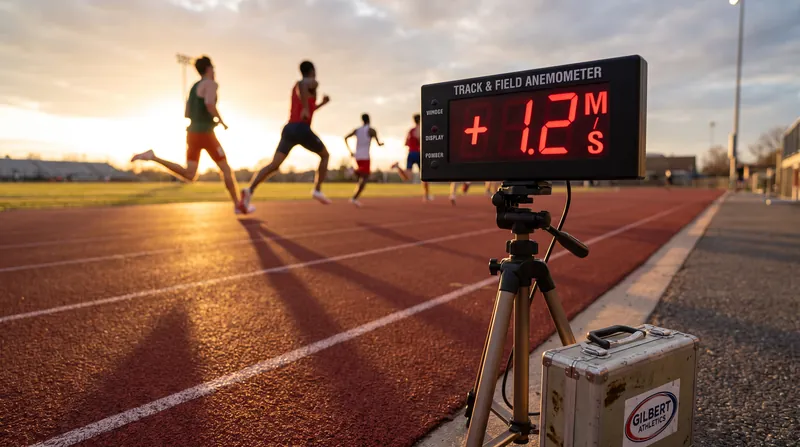
The environmental conditions at Hayward Field were ideal for a historic sprint. The race was run with a legal tailwind of +1.0 meters per second. In track and field, any tailwind above +2.0 meters per second renders a sprint time ineligible for record purposes. Tharp benefited from a gentle push that aided his momentum without invalidating his achievement.[1]
The ripple effects of the 12.75-second mark completely rewrite the collegiate and global record books. Tharp shattered the previous NCAA record of 12.98 seconds, set by Grant Holloway in 2019. He also pushed Chinese icon Liu Xiang's legendary 12.88-second run from 2006 down to the seventh-fastest time in history.[1]
Furthermore, Tharp ended a 50-year drought for collegiate athletics. His performance marked the first time a world record had been set at the NCAA Championships since Dwight Stones broke the high jump record in 1976. For Auburn University, it cemented Tharp's legacy as one of the most dominant athletes to ever wear their uniform.
Tharp's progression to this historic moment has been steep but steady. As an under-20 world champion, he had already proven his pedigree on the international stage. In August 2025, he ran a personal best of 13.01 seconds at the USATF Championships in Eugene, signaling that he was on the cusp of breaking the elusive 13-second barrier.[1][2]
During the 2026 indoor season, he captured the NCAA 60-meter hurdles title with a world-leading time of 7.32 seconds, elevating him to third on the all-time list for the indoor event. That indoor speed translated perfectly to the outdoor straightaway, giving him the explosive start necessary to attack the first hurdle with unprecedented velocity.
The track and field community is now recalibrating its expectations for the men's high hurdles. For over a decade, analysts believed that Merritt's 12.80 was a near-untouchable biomechanical limit, achieved during a single, magical season where Merritt refined his approach to seven steps to the first hurdle. Tharp has proven that a new generation, armed with advanced track surfaces and spike technology, can push the boundary further.
As the summer international season accelerates, Tharp transitions from a collegiate standout to the undisputed global target. He is scheduled to make his Diamond League debut, where he will face the world's seasoned professionals not as an underdog, but as the fastest man to ever clear the barriers.
The lingering question for analysts and competitors alike is how Tharp will perform when pushed by a world-class field in a high-stakes final. If a survive-and-advance semi-final with an iffy finish yields a 12.75, the sport may soon witness a race that fundamentally redefines human speed.
The essentials
- Auburn junior Ja'Kobe Tharp ran 12.75 seconds in the 110m hurdles at the NCAA Championships.
- The time shattered Aries Merritt's 14-year-old world record of 12.80 seconds.
- Tharp achieved the record during a semi-final heat, not a final.
- The race was run with a legal tailwind of +1.0 meters per second.
- It is the first track and field world record set at the NCAA Championships since 1976.
Timeline
Sept 2012
Aries Merritt sets the 110m hurdles world record at 12.80 seconds in Brussels.
June 2019
Grant Holloway sets the NCAA collegiate record at 12.98 seconds.
Aug 2025
Ja'Kobe Tharp runs a personal best of 13.01 seconds to win the USATF Championships.
March 2026
Tharp wins the NCAA Indoor 60m hurdles title with a world-leading 7.32 seconds.
June 10, 2026
Tharp shatters the world record with a 12.75-second run in the NCAA semi-finals.
- Track and Field Analysts
- Focusing on the technical execution and the biomechanical limits of the hurdles.
- Collegiate Athletics Advocates
- Celebrating the NCAA as a premier incubator for world-class talent.
- International Competitors
- Bracing for a disrupted global hierarchy in the high hurdles.
Perspectives this story doesn't cover
- Aries Merritt's reaction to his 14-year-old record being broken
- Sports biomechanists analyzing the exact stride length and ground contact time of the 12.75s run
Sources
Source coverage
2 outlets
3 viewpoints surfaced


- [1]The GuardianInternational Competitors
The World Cup is undressing the myth of Trump’s American homogeneity
Read on The Guardian → - [2]Olympics.comTrack and Field Analysts
Ja'Kobe Tharp sets a new 110m hurdles world record
Read on Olympics.com →
More in Sports
See all →Injury
Athletics Injury Report: Rojas, Crouser, and Jackson Navigate the Grueling Road Back to Global Dominance
7 sources

Anti-Doping Enforcement
Tokyo Marathon Champion Ruti Aga Receives Six-Year Ban Over Forged Medical Prescription
6 sources
Power ranking
NCAA Cross Country Power Rankings: Iowa State Disrupts the Men's Consensus as NC State Women Hold the Line
6 sources
Athletics Rules
The 2.0 Meters Per Second Tailwind Limit That Defines a Track and Field Record
6 sources
Comments
Every angle. Every day.
Get Sports stories with full source coverage and perspective breakdowns, free every day.