
Global Rhythmic Gymnastics Olympic Quota Standings: Germany, Spain, and Brazil Capture First LA28 Berths
The race to the Los Angeles 2028 Olympic Games has officially opened at the 2026 Rhythmic Gymnastics World Championships in Frankfurt, with Germany, Bulgaria, Italy, Spain, Japan, and Brazil securing the first six Olympic quota spots.
By Ryder James

Share this story
The race to the Los Angeles 2028 Olympic Games has officially opened, and the first six tickets are punched. At the 2026 Rhythmic Gymnastics World Championships in Frankfurt, the sport's elite gathered not just for world titles, but for the most coveted prize in the quadrennial cycle: automatic Olympic quota spots. With the stakes at their absolute highest, the global standings picture began to crystallize over five days of intense competition at the Festhalle.
A total of 343 gymnasts representing 73 countries converged on the German city, knowing that the top three finishers in both the individual and group all-around finals would secure early passage to LA28. For the world's top rhythmic gymnastics federations, securing an early Olympic berth relieves immense pressure for the next two years, allowing them to focus entirely on refining their routines and increasing difficulty rather than chasing qualification points across the globe.[2]
Understanding the mechanics of the Olympic qualification system is crucial to grasping the weight of the Frankfurt standings. The quota spots awarded at the World Championships belong to the National Olympic Committee (NOC), not the specific athletes who earned them. However, the nations that secure these early berths gain a massive strategic advantage.
Instead of peaking multiple times a year to grind out points in the upcoming FIG World Cup series, these federations can pace their athletes, test new choreography, and rest through minor injuries. The three individual and three group spots awarded in Germany represent the absolute pinnacle of the sport's current hierarchy, drawing a clear line between the locked-in frontrunners and the chasing pack that must now navigate a grueling two-year qualification gauntlet.[2]
In the individual all-around competition, the spotlight was fixed firmly on Germany's Darja Varfolomeev. Competing on home soil, the reigning Olympic champion carried the weight of a nation expecting nothing less than gold. Varfolomeev delivered a spectacular performance, capturing her third consecutive all-around crown with a massive total score of 119.500. The victory was far from a simple coronation, however.
The defending world champion was not immune to the pressure of the occasion, opening her evening with a surprisingly shaky hoop routine that earned 28.300 points. That early stumble opened the door for her rivals and forced the 19-year-old to execute her remaining three routines flawlessly to avoid being usurped in the standings.[1]
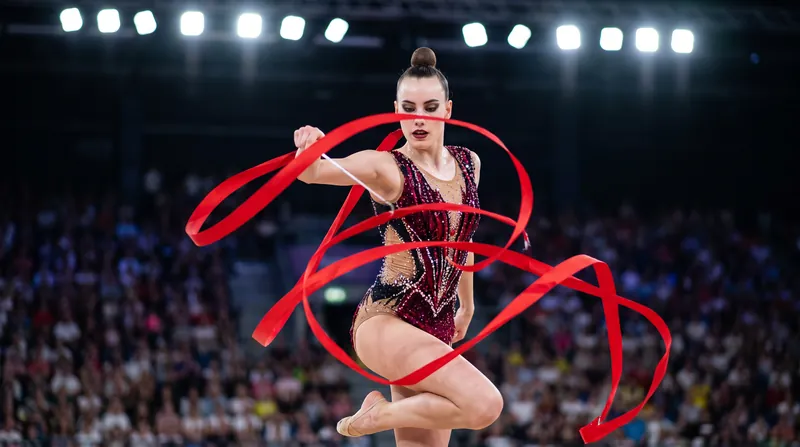
Responding to the early adversity, Varfolomeev quickly found her rhythm and demonstrated exactly why she sits atop the global rhythmic gymnastics standings. She posted a 30.050 with the ball to steady her campaign, then delivered a devastatingly precise clubs routine that earned a superb 31.500—the highest score of the evening.
Closing the night with a 29.650 on the ribbon, she sealed the gold medal and the first LA28 quota spot for Germany. Her coach, Yuliya Raskina, praised Varfolomeev's ability to manage the immense pressure and peak at the perfect moment, a testament to the resilience required to maintain dominance in a sport where a single dropped apparatus can erase years of preparation.[1]
While Varfolomeev captured the headlines, Bulgaria's Stiliana Nikolova and Italy's Sofia Raffaeli cemented their own positions at the top of the global standings. Nikolova gave the home favorite a relentless run for her money, producing a series of electric and charismatic performances to finish second with a total of 117.600.
Raffaeli, the Paris 2024 bronze medalist and 2022 world champion, closed her evening with an otherworldly hoop performance to secure bronze with 117.550. In a remarkable display of consistency at the highest level of the sport, the trio perfectly recreated the exact same all-around podium from the 2025 World Championships, proving that Germany, Bulgaria, and Italy remain the undisputed superpowers of the individual discipline.[1]
The group all-around competition delivered equally high stakes, with Spain capturing the world title and their own Olympic berth in dramatic fashion. Spain topped qualification in both the five balls and the mixed routines before delivering a masterclass in the final.
Performing to Roque Baños's "Welcome On Board," the Spanish squad finished 0.350 points ahead of defending champions Japan in the mixed routine, which featured three hoops and two pairs of clubs. Their subsequent five balls performance sealed the world title, crowning Ines Bergua Navales, Andrea Corral, Andrea Fernandez, Marina Cortelles, Lucia Munoz, and Salma Solaun as world champions and securing Spain's ticket to Los Angeles.
Japan dazzled the Frankfurt crowd with beautifully synchronized performances to secure the silver medal, successfully defending their status as a premier group powerhouse and locking in their LA28 quota. But it was Brazil that delivered the most historic breakthrough of the championships.
The Brazilian squad rounded out the podium with a bronze medal in the all-around, earning the final group quota spot available in Frankfurt. The performance marked a seismic shift in the global standings, proving that the traditional European and Asian dominance in rhythmic gymnastics is facing a fierce challenge from South America.
Brazil's extraordinary momentum did not stop at the all-around podium. The "Leoas" (Lionesses) returned for the apparatus finals and made history by capturing gold in both the group 5 balls final and the 3 hoops and 2 pairs of clubs final.
By defeating newly crowned all-around champions Spain and traditional heavyweights Bulgaria, Brazil became the first nation from the Americas to win a rhythmic gymnastics world title. The apparatus finals also saw Ukraine's Taisiia Onofriichuk claim her maiden world title in the individual hoop, edging out Raffaeli and Varfolomeev in a fiercely competitive field where all three medalists broke the 30-point barrier.
For the nations that missed the podium in Frankfurt, the global standings picture is now one of mounting pressure. Olympic group champions China, alongside traditional powerhouses like Israel and the United States, must now regroup after falling short of the automatic LA28 berths.
The U.S. individual contingent showed highly promising progress, with 17-year-old Rin Keys finishing 8th and Megan Chu finishing 11th in the all-around final. While their performances demonstrate that the American program is steadily climbing the international ranks, they will need to find another gear to secure qualification in the coming years.[1][3]
With the first six spots claimed, the rhythmic gymnastics world now turns its attention to the grueling qualification gauntlet ahead. The remaining Olympic berths will be fiercely contested through the 2026-2027 FIG World Cup series and the 2027 World Championships. For Germany, Bulgaria, Italy, Spain, Japan, and Brazil, the next two years will be a victory lap focused on perfection and innovation. For the rest of the world, every routine, every catch, and every pivot will carry the weight of Olympic survival as the race to Los Angeles intensifies.[2]
The essentials
- Germany, Bulgaria, and Italy secured the first three individual Olympic quota spots for LA28.
- Spain, Japan, and Brazil claimed the first three group Olympic quota spots.
- Darja Varfolomeev won her third consecutive individual all-around world title on home soil.
- Brazil made history by becoming the first nation from the Americas to win a rhythmic gymnastics world title.
- Remaining Olympic berths will be contested through the 2026-2027 World Cup series and 2027 World Championships.
Timeline
August 12-13, 2026
Individual qualifications determine the all-around finalists in Frankfurt.
August 14, 2026
Germany, Bulgaria, and Italy secure the first three individual LA28 quotas.
August 15, 2026
Spain, Japan, and Brazil secure the first three group LA28 quotas.
August 16, 2026
Apparatus finals conclude the 2026 World Championships.
- Olympic Frontrunners
- Focused on the advantage of early Olympic qualification to prioritize routine upgrades.
- Individual Champions
- Emphasizing the globalization of the sport and historic breakthroughs by non-European nations.
- Neutral Observers
- Focused on the remaining qualification pathways and the pressure to secure spots in 2027.
Perspectives this story doesn't cover
- Athletes from nations currently banned or competing as neutrals
- Host nation organizing committees preparing for the 2027 qualifiers
Sources
Source coverage
3 outlets
3 viewpoints surfaced



- [1]Gymnastics NowOlympic Frontrunners
Darja Varfolomeev wins third straight all-around title at 2026 Rhythmic Gymnastics World Championships as first Olympic tickets punched
Read on Gymnastics Now → - [2]WikipediaNeutral Observers
2026 Rhythmic Gymnastics World Championships
Read on Wikipedia → - [3]USA GymnasticsNeutral Observers
2026 Rhythmic Gymnastics World Championships
Read on USA Gymnastics →
More in Sports
See all →Recap
Kaylia Nemour Posts World-Leading All-Around Score to Sweep 2026 Mediterranean Games
7 sources
Trade
Jordan Chiles Joins UCLA Coaching Staff, Announces Bid for 2028 LA Olympics
5 sources
Trade
NCAA Gymnastics Offseason Reaches Finish Line: The Biggest Roster and Coaching Moves Ahead of 2027
6 sources
Storyline
Darja Varfolomeev Captures Historic Third Consecutive All-Around Title at 2026 Rhythmic Gymnastics World Championships
6 sources
Comments
Every angle. Every day.
Get Sports stories with full source coverage and perspective breakdowns, free every day.