
Global Handball Injury Desk: Elver’s Triumphant Return Highlights a Season of Complex Recoveries
As the 2026 handball calendar intensifies, stars like Helena Elver are proving that resilience pays off, while major names including Lucas Pellas, Oscar Bergendahl, and Aaron Mensing navigate critical rehabilitation milestones.
By Jackson Reed

Share this story
The gruelling pace of the global handball calendar routinely pushes the human body to its absolute limits, making injury management one of the most critical aspects of the modern game. As the 2026 season unfolds across domestic leagues and international tournaments, several high-profile stars are navigating complex rehabilitation journeys.
While the initial shock of a torn ligament or a fractured bone is always a heavy blow to both the athlete and their club, the narrative surrounding sports injuries is steadily shifting. Advances in surgical techniques, coupled with a more rigorous, data-driven approach to physical therapy, are enabling players to return to the court with greater confidence and stability than ever before. This season's injury report is less about the setbacks and more about the meticulous, triumphant roads to recovery.
No player exemplifies the spirit of athletic resilience quite like Danish national team standout Helena Elver. Currently plying her trade for the Hungarian powerhouse Győri ETO KC, Elver has endured a medical history that would have ended the careers of many lesser athletes.
Prior to this season, the dynamic playmaker had already survived the devastating physical and psychological toll of three separate anterior cruciate ligament (ACL) reconstructions. When she suffered a dislocated elbow during a club match in January 2026, the handball community collectively held its breath, fearing another massive disruption to her hard-fought career trajectory.[1]
However, Elver’s extensive experience with rehabilitation protocols paid immediate dividends. Because the elbow dislocation was not accompanied by secondary structural damage, she was able to attack her physical therapy with characteristic intensity. By late March 2026, Elver had shed her cast and made a triumphant return to the active roster for Győr.
Her remarkable perseverance was recently celebrated on a national scale when she was awarded the prestigious title of Danish Female Handball Player of the Year, a testament to the fact that strategic, patient recovery can successfully salvage an elite sporting career.[1]
While Elver celebrates her return, several prominent stars in the men's game are just beginning their own arduous rehabilitation cycles. Swedish national team winger Lucas Pellas, who plays his club handball for the French side Montpellier, suffered a severe setback when he tore his right Achilles tendon.
The injury occurred away from the competitive spotlight, striking while Pellas was training at home in Stockholm ahead of the French league's restart. For a player who relies heavily on explosive acceleration and leaping ability from the wing, an Achilles rupture is one of the most daunting hurdles to overcome.[2]
Pellas, who has been a staple of the Swedish national team through multiple medal-winning championship runs, took the diagnosis in stride, noting that the tendon had been causing him chronic discomfort for an extended period. Following a successful clinical surgery in Sweden, medical staff have outlined a recovery window spanning six to twelve months. The exact timeline will depend entirely on how his body responds to the incremental loading phases of his rehabilitation, highlighting the modern medical philosophy that biological healing cannot be rushed to meet calendar expectations.[2]
The Achilles tendon has proven to be a particularly vulnerable failure point for elite backcourt players this season. Aaron Mensing, the prolific shooter for German Bundesliga club MT Melsungen, suffered a similar fate during a high-stakes EHF European League main round match against THW Kiel.
Just twelve minutes into the contest, Mensing slipped awkwardly during an offensive attack and immediately went down in visible agony. Subsequent MRI examinations in Kassel confirmed a complete rupture of the Achilles tendon, ruling the Danish international out for a minimum of six months and abruptly halting what had been a stellar individual campaign.[3]
Mensing’s injury compounded an already severe medical crisis for MT Melsungen, forcing the club's management and coaching staff to drastically overhaul their tactical approach. The German side’s treatment room has been operating at maximum capacity, with Mensing joining teammates Amine Darmoul, who recently underwent surgery for a torn ACL, and David Mandic, who is recovering from an operation to repair a broken metacarpal. Navigating these simultaneous long-term absences requires immense squad depth and highlights the heavy rotational burden placed on the remaining healthy players during the grueling European club season.[3]
In Magdeburg, the medical staff has been carefully managing the recovery of Swedish pivot Oscar Bergendahl, who suffered a severe ankle ligament injury during a domestic clash against VfL Gummersbach. Initially, SC Magdeburg officials were optimistic that Bergendahl might only miss three months of action, hoping that conservative treatment could stabilize the joint. However, once the acute swelling subsided, further evaluations revealed that the structural damage was too extensive to heal naturally, prompting the club to pivot toward a surgical intervention.[3]
The successful operation officially ruled Bergendahl out for the remainder of the season, a difficult pill to swallow for the reigning Champions League contenders. Yet, by opting for surgery rather than risking a premature return on a compromised ankle, Magdeburg has prioritized the pivot's long-term joint health over short-term tactical needs. Coach Bennet Wiegert has subsequently leaned heavily on Magnus Saugstrup and Tim Zechel to anchor the line, allowing Bergendahl the necessary time to rebuild his strength and proprioception without the pressure of a looming playoff deadline.[3]
Soft tissue and muscle injuries have also disrupted the international stage, most notably affecting the French national team's preparations. Veszprém right back Nedim Remili was forced to withdraw from the French squad ahead of the 2026 EHF EURO due to a cascading series of muscular issues.
What began as a left thigh injury became significantly more complicated during his initial rehabilitation when Remili experienced acute pain in his calf on the same leg. Urgent medical tests confirmed that the secondary injury was severe enough to rule him out of the tournament entirely, forcing head coach Guillaume Gille to adjust his 18-man roster at the eleventh hour.[4]
Remili’s club teammate at Veszprém, Egyptian international Yehia El-Deraa, is navigating an even longer road back to the court. The standout left back suffered a torn ACL last October, an injury that prematurely ended his club season and ruled him out of critical international fixtures for Egypt.
El-Deraa's absence is a massive blow to the African champions, but his recovery protocol reflects the current gold standard in sports medicine: allowing the reconstructed ligament ample time to undergo the biological process of ligamentization before subjecting it to the violent pivoting forces of elite handball.[5]
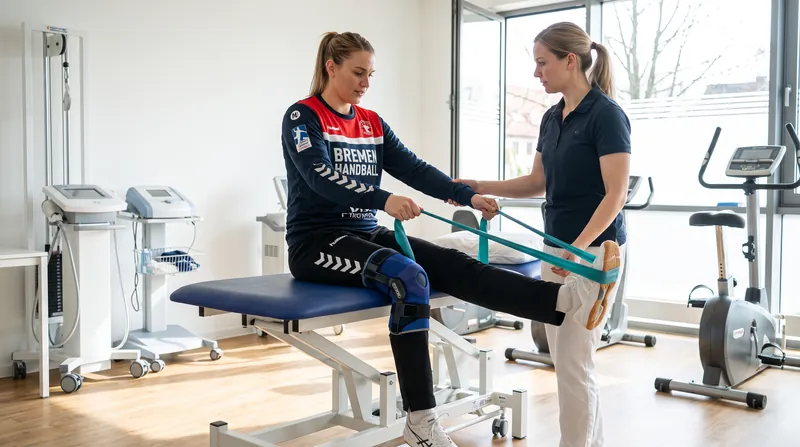
The overarching theme connecting these diverse injury profiles is a paradigm shift within sports physiotherapy. Clinics and club medical staffs are aggressively moving away from arbitrary, time-based clearance models—such as automatically clearing an ACL patient at the six- or nine-month mark. Instead, the focus has shifted entirely to objective, capacity-based testing. Specialists are increasingly utilizing advanced technology, such as isokinetic dynamometers and dual force plates, to measure the exact power output, landing control, and side-to-side symmetry of recovering athletes.[6]
By quantifying metrics like the quadriceps-to-hamstring strength ratio and plyometric ground contact time, medical teams can pinpoint hidden deficits that visual assessments often miss. This data-driven approach ensures that players like Pellas, Bergendahl, and El-Deraa will only return to the hardwood when their bodies are genuinely prepared to absorb the chaotic, high-impact demands of professional handball. Ultimately, while the initial diagnosis of a severe injury remains devastating, this modernized, patient-centric rehabilitation landscape is extending careers and allowing athletes to write their own triumphant comeback stories.[6]
Key points
- Helena Elver successfully returned from a dislocated elbow in March 2026, adding to her history of overcoming severe injuries.
- Lucas Pellas and Aaron Mensing are both facing 6-12 month absences following Achilles tendon ruptures.
- SC Magdeburg's Oscar Bergendahl underwent season-ending ankle surgery after conservative treatment was deemed insufficient.
- Nedim Remili withdrew from the French EURO 2026 squad due to an acute calf injury complicating a thigh issue.
- Sports physiotherapists are increasingly relying on objective force-plate testing rather than calendar timelines to clear players for return.
How we got here
October 2025
Yehia El-Deraa suffers a torn ACL, ending his club season and ruling him out of international play.
December 2025
Oscar Bergendahl sustains a severe ankle ligament injury against VfL Gummersbach.
January 2026
Helena Elver suffers a dislocated elbow; Nedim Remili withdraws from EURO 2026 with a calf and thigh injury.
February 2026
Lucas Pellas undergoes surgery for a torn right Achilles tendon.
March 2026
Aaron Mensing tears his Achilles in the EHF European League; Helena Elver makes her triumphant return to the court.
- Rehabilitation Specialists
- Focus on objective, criteria-based testing and biological healing rather than arbitrary calendar timelines to prevent re-injury.
- Players in Recovery
- Emphasize mental resilience, patience, and trusting the surgical and rehabilitation process to extend their careers.
- Club Management
- Concerned with adapting tactical rotations and managing squad depth when key players face long-term absences.
Perspectives this story doesn't cover
- Youth academy directors managing the psychological impact of severe injuries on developing players.
Sources
Source coverage
6 outlets
3 viewpoints surfaced






- [1]The Rookie ReportersPlayers in Recovery
From an elbow dislocation to multiple ACL injuries, Helena Elver has overcome it all
- [2]Sweden HeraldPlayers in Recovery
The Swede tore his Achilles tendon – could be out for a year
- [3]Handball-PlanetClub Management
Aaron Mensing tears Achilles tendon; Oscar Bergendahl to miss rest of the season
- [4]FlashscoreClub Management
Big blow for France as Veszprém star Remili pulls out of EURO squad with thigh injury
- [5]International Handball FederationClub Management
Egypt prepare for major tournaments without key injured stars
- [6]SB PhysioRehabilitation Specialists
ACL Rehab in 2026: Stop Guessing. Start Measuring.
More in Sports
See all →Standings
Four Teams Remain in Title Race as Men's 18 EHF EURO 2026 Semi-Finals Are Set
7 sources
Injury
Global Handball Injury Desk: Simić’s Triumphant Return and Gilme’s Non-Surgical Comeback Highlight a Summer of Resilience
6 sources
Standings
Las Vegas Mega Event Standings: Füchse Berlin and Győri ETO Surge in Race for Inaugural US Crown
3 sources
Injury
Handball Medical Report: Pytlick's Triumphant Return and the Evolving Science of Court Rehab
7 sources
Comments
Every angle. Every day.
Get Sports stories with full source coverage and perspective breakdowns, free every day.