
Global Equestrian Injury Report: Simon Delestre Begins Recovery as Elise Haas Completes Two-Decade Comeback
Show jumping star Simon Delestre faces weeks of recovery following a dislocated clavicle, while American Elise Haas makes a triumphant return to the sport after a 20-year hiatus.

Share this story
The equestrian summer season is in full swing, bringing both the triumph of elite competition and the inevitable physical toll of a high-impact sport. The latest global injury report highlights the immense resilience required to survive at the top levels, featuring major comebacks and critical updates on sidelined stars across show jumping, dressage, and eventing.
For professional riders and their equine partners, navigating the precarious line between peak performance and catastrophic injury is a daily reality. When a fall occurs, the road back to the arena is often paved with months of grueling rehabilitation, cutting-edge veterinary science, and an unwavering psychological drive to return to the saddle.[1]
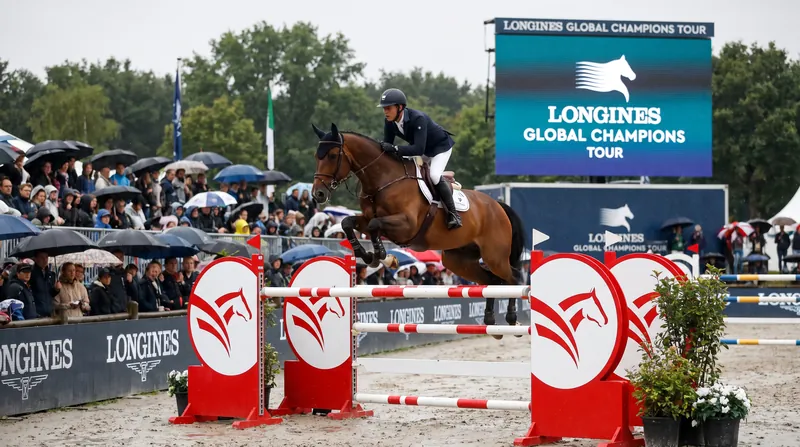
In the show jumping arena, France's Simon Delestre—the current overall leader of the prestigious Longines Global Champions Tour (LGCT)—is facing a sudden and forced hiatus. During the LGCT Grand Prix in Cannes, Delestre suffered a heavy fall with his mount, Gatsby, abruptly halting his dominant summer campaign.
The incident sent shockwaves through the tour, as Delestre had been riding a wave of momentum that positioned him as the clear favorite for the season title. The sudden absence of the tour leader dramatically reshapes the LGCT standings, opening the door for his closest rivals to close the gap while he focuses entirely on his physical recovery.[1]
While Gatsby thankfully escaped the incident uninjured, Delestre sustained a dislocated clavicle, severe ligament damage, and painful hematomas to his temple and the back of his head. He underwent successful surgery in France to stabilize his shoulder, confirming that there were no additional fractures to his collarbone.
However, the procedure requires complete immobilization of his left arm for several weeks. Despite the frustrating setback, Delestre remains highly optimistic, publicly thanking the global equestrian community for their outpouring of support and vowing to return to the tour as soon as his body allows.[1]
On the more uplifting side of the spectrum, American rider Elise Haas has completed one of the most remarkable and emotionally resonant comebacks in modern show jumping history. In her early twenties, after a stellar season in 2000, a mysterious and debilitating neck injury forced her to step away from a highly promising career in the saddle.
For over two decades, Haas watched from the sidelines, assuming her days of soaring over massive oxers and competing at the international level were permanently behind her. The prolonged absence makes her recent return to the sport an extraordinary testament to human endurance and the magnetic pull of equestrian competition.
Now 47 years old, Haas has triumphantly returned to the show ring, taking over the reins of the 13-year-old mare Is-Minka—a formidable former World Cup winner previously campaigned by Swiss Olympic champion Steve Guerdat. Riding across the rolling bluegrass hills of Kentucky, Haas described her return to the saddle as a miraculous chance to reach for a dream she thought was lost forever. Her partnership with Is-Minka proves that the fundamental desire to ride rarely fades, and that athletic chapters can be rewritten even after a twenty-year hiatus.
In the dressage arena, Belgian Olympian Domien Michiels is preparing for an emotional return of his own. Following a freak accident where he broke his shoulder falling down a flight of stairs, Michiels was entirely sidelined for months, halting his momentum after a stellar appearance at the Olympic Games.
The injury required extensive physical therapy to restore the mobility and precise micro-movements necessary for elite dressage, keeping him out of the saddle much longer than he initially anticipated. The sudden transition from the pinnacle of international sport to the slow, repetitive exercises of physical rehabilitation tested his mental fortitude, but his focus remained firmly fixed on returning to the international stage.
Michiels is now slated to make his official return to competition at the highly anticipated FEI Dressage World Cup in Mechelen, riding alongside his top mount, Intermezzo van het Meerdaalhof. Michiels noted that the extended break was heavily felt by Intermezzo, a fierce equine competitor who has been visibly eager to get back into the competition ring. The pair’s return in front of a passionate home crowd in Belgium is expected to be one of the emotional highlights of the winter indoor season.
The global injury report also highlights incredible equine recoveries, proving that advanced veterinary science is actively saving careers that would have previously been ended by a single misstep. Doug and Jess Payne’s elite show jumping horse, Quintessence (affectionately known as Quincy), suffered a severe tendon injury from a rogue splinter during a high-stakes Grand Prix event in Florida.
The tiny puncture compromised the entire back leg, presenting a massive rehabilitation challenge for the 13-year-old gelding. In decades past, such an injury would have mandated immediate retirement, but the Paynes turned to cutting-edge regenerative medicine to give Quincy a second chance at his athletic career.
Thanks to a patient-centered rehabilitation plan and innovative bone-marrow-derived stem cell therapy administered at the NC State College of Veterinary Medicine, the horse has made a miraculous full recovery. Quincy is now jumping flawlessly at the elite five-star level, with veterinary specialists noting that stem cell treatments not only accelerate healing but significantly reduce the likelihood of future reinjury. The success of Quincy’s year-long recovery offers a blueprint for how modern sports medicine can preserve the longevity of top-tier equine athletes.
Equine sports medicine experts emphasize that returning a horse to work after a major injury requires a highly systematic and disciplined approach. A gradual return-to-work program, often spanning months of controlled hand-walking, aquatic therapy, and progressive under-saddle trot sets, is absolutely essential to rebuild muscular strength and ensure long-term soundness.
Rushing the process can easily undo months of expensive veterinary care, making patience the most critical virtue for any owner or trainer managing a recovering horse. Baseline veterinary evaluations, including regular ultrasound imaging, are used to monitor tissue density and ensure the horse is genuinely ready to handle the concussive forces of jumping or the collected movements of dressage.
For human athletes, the focus on safety and recovery protocols continues to evolve alongside the sport. While the inherent risks of navigating a thousand-pound animal over massive obstacles cannot be entirely eliminated, governing bodies are pushing for better protective equipment.
The widespread adoption of advanced airbag vests, stricter helmet safety standards, and mandatory medical clearance protocols are actively protecting riders from catastrophic outcomes and ensuring they do not return to the saddle before their bodies are fully healed. Experts stress that riding while compromised not only endangers the athlete but also disrupts the delicate balance and communication required to safely guide the horse.
Experts stress that riding while compromised not only endangers the athlete but also disrupts the delicate balance and communication required to safely guide the horse.
Ultimately, whether it is a rider overcoming a broken bone or a horse returning from a career-threatening tendon tear, the deep bond between horse and human remains the driving force behind these inspiring comebacks. The immense patience required to heal is matched only by the determination to return to the arena. As the 2026 season progresses, the successful returns of athletes like Elise Haas and Quintessence serve as powerful reminders that setbacks are often just the prelude to the most rewarding chapters of an equestrian career.
The essentials
- LGCT leader Simon Delestre is recovering from a dislocated clavicle following a fall in Cannes.
- Elise Haas has returned to competitive show jumping after a 20-year hiatus caused by a neck injury.
- Belgian dressage rider Domien Michiels is returning to competition after breaking his shoulder in a freak accident.
- Doug Payne's horse Quincy made a full recovery from a severe tendon injury using stem cell therapy.
- Equine sports medicine experts stress the importance of a highly structured, gradual return-to-work program for injured horses.
Timeline
2000
Elise Haas steps away from competitive show jumping due to a mysterious and debilitating neck injury.
Spring 2023
Doug Payne's horse Quincy suffers a severe tendon injury from a splinter during a Grand Prix event in Florida.
Late 2025
Belgian dressage rider Domien Michiels breaks his shoulder in a freak accident, halting his post-Olympic momentum.
June 2026
Simon Delestre suffers a dislocated clavicle in a fall at the LGCT Grand Prix in Cannes, requiring surgery.
Summer 2026
Elise Haas makes her triumphant return to the show ring aboard Is-Minka, completing a two-decade comeback.
- Riders in Recovery
- Focuses on the physical and mental resilience required to return to the saddle after a traumatic fall or long hiatus.
- Equine Sports Medicine
- Prioritizes advanced veterinary therapies, stem cell treatments, and structured rehabilitation to ensure horses return to peak performance safely.
- Safety Advocates
- Emphasizes the importance of protective equipment, strict medical clearance protocols, and minimizing inherent risks in equestrian sports.
Perspectives this story doesn't cover
- Event organizers managing the logistics of on-site medical response teams.
Sources
Source coverage
1 outlets
3 viewpoints surfaced

- [1]World of ShowjumpingRiders in Recovery
Simon Delestre sidelined after a fall during LGCT Cannes
Read on World of Showjumping →
More in Sports
See all →Injury
Global Equestrian Injury Report: Innovative Surgeries and Fond Farewells Define the June Slate
2 sources
Standings
Tim Price Reclaims World No. 1 in FEI Eventing Rankings as Aachen World Championships Loom
4 sources
Standings
France Holds Eventing Nations Cup Lead as New Zero-Score Final Format Shakes Up Strategy
6 sources
Standings
Riesenbeck International Seizes Global Champions League Lead as Basel Cosmopolitans Surge
6 sources
Comments
Every angle. Every day.
Get Sports stories with full source coverage and perspective breakdowns, free every day.