
Global Cycling Injury Report: As Mid-Summer Crashes Mount, the Peloton Turns to New Airbag Tech and Rehab Science
While high-speed crashes at the Tour de France and Giro d'Italia Women have sidelined key riders, the cycling industry is responding with a revolutionary 70-gram spinal airbag system and advanced rehabilitation protocols.
By Xia Wu

Share this story
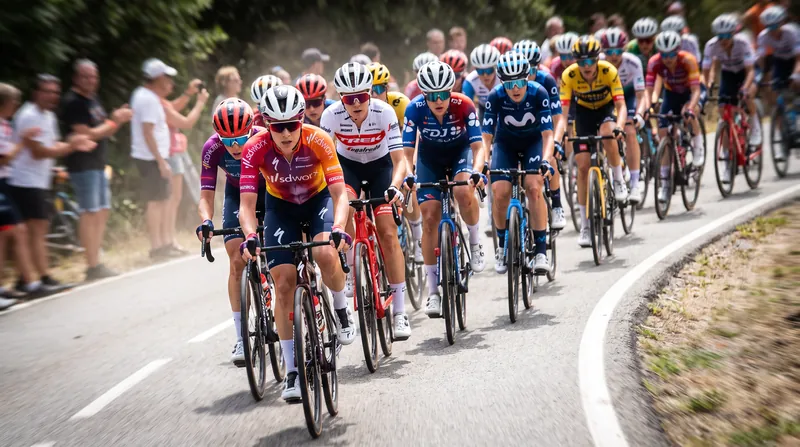
Mid-July represents the absolute crucible of the professional cycling calendar. As the men tackle the relentless pace of the Tour de France and the women navigate the grueling Giro d'Italia Women, the sport demands peak physical performance under extreme conditions. Predictably, as the peloton battles blistering heatwaves and high-speed sprint finales, the medical reports are lengthening.
Yet, the narrative of the 2026 season is shifting from sheer attrition to proactive protection. While high-profile crashes continue to reshape the general classification battles, the sport is simultaneously witnessing a quiet revolution in rider safety technology and methodical rehabilitation protocols.
At the men's Tour de France, the unforgiving nature of the race was evident from the opening weekend. Groupama-FDJ's Clément Berthet became the first official abandonment of the 2026 edition following a freak accident during the Stage 1 team time trial in Barcelona.
Video footage revealed that Berthet and several riders from the XDS Astana squad struck a marked manhole cover while traveling at nearly 60 kilometers per hour. The impact jolted their bikes, causing a high-speed pileup that left Berthet unable to start Stage 2.
The attrition continued into the first week. During the chaotic finale of Stage 5 in Pau, Caja Rural's Alex Molenaar was caught in a multi-rider crash just five kilometers from the finish line.
Though Molenaar managed to cross the line, he was immediately pulled for a concussion protocol after reportedly telling team staff he had no memory of the crash. Subsequent medical evaluations confirmed a fractured hand, forcing the Dutch rider to withdraw from his Tour debut.
The extreme weather has also played a role in the peloton's thinning ranks. Jayco-AlUla's Kelland O'Brien became the first rider to miss the time cut on Stage 4, succumbing to the severe southern French heatwave that has pushed the peloton to its physiological limits.
The Women's WorldTour has faced its own wave of mid-summer setbacks. British rising star Cat Ferguson of the Movistar Team has been officially ruled out of the upcoming Tour de France Femmes following a delayed injury diagnosis.[1]
Ferguson crashed on the opening stage of the Giro d'Italia Women. While she was initially cleared of a traumatic brain injury, her recovery stalled. Weeks later, further scans revealed two fractures in her ankle, abruptly halting a breakout season that had already netted her three victories.[1]
The Giro d'Italia Women also lost Lidl-Trek's Shirin van Anrooij, who was forced to abandon the race ahead of the Stage 4 mountain time trial due to a sudden viral illness, stripping the peloton of a key climbing talent.[2]
In response to this relentless wave of trauma, the cycling industry is accelerating its push for integrated safety equipment. This week, Italian apparel brand Castelli, in partnership with the Soudal Quick-Step team, unveiled a revolutionary prototype airbag system designed specifically for the professional peloton.
Unlike bulky commuter vests, the new system weighs just 70 grams—roughly the equivalent of two energy gels. Housed unobtrusively beneath the jersey pockets, the device is engineered to deploy in 200 milliseconds, providing targeted protection to the spinal column during high-speed impacts.
The UCI has expressed strong interest in creating a regulatory framework for these devices, signaling that wearable airbags could become a standard fixture in WorldTour racing as early as next season.
For the riders already sidelined, the focus remains on the grueling, unseen work of rehabilitation. The modern approach to cycling recovery has evolved significantly, prioritizing immediate, low-impact cardiovascular maintenance over total rest.
Stephen Williams of NSN Cycling provided a testament to this methodical approach, issuing a positive update on his year-long knee rehabilitation. By utilizing controlled, pain-free stationary cycling, riders like Williams are able to preserve their aerobic engines while allowing structural damage to heal, ensuring that when they finally return to the start line, they are ready to compete.
The essentials
- Groupama-FDJ's Clément Berthet and Caja Rural's Alex Molenaar have abandoned the Tour de France following severe high-speed crashes.
- British talent Cat Ferguson will miss the Tour de France Femmes after delayed scans revealed two ankle fractures from a Giro d'Italia Women crash.
- Castelli and Soudal Quick-Step have debuted a 70-gram prototype spinal airbag system designed to deploy in 200 milliseconds.
- Modern rehabilitation protocols are increasingly utilizing stationary cycling to preserve athletes' cardiovascular fitness while structural injuries heal.
Timeline
July 4, 2026
Clément Berthet crashes on a manhole cover during the Tour de France Stage 1 team time trial.
July 6, 2026
Castelli and Soudal Quick-Step unveil a 70g prototype spinal airbag system for the professional peloton.
July 7, 2026
Medical scans reveal two ankle fractures for Cat Ferguson, officially ruling her out of the Tour de France Femmes.
July 8, 2026
Alex Molenaar abandons the Tour de France following a high-speed crash and concussion protocol on Stage 5.
- Medical & Rehab Staff
- Focused on methodical recovery, conservative timelines, and preserving cardiovascular fitness during injury layoffs.
- Safety Innovators
- Equipment manufacturers and teams pushing for integrated airbag technology and better course hazard mitigation.
- Riders & Teams
- Balancing the immediate competitive losses of Grand Tour abandons with long-term career health.
Perspectives this story doesn't cover
- Race organizers responsible for course safety and hazard marking
Sources
Source coverage
2 outlets
3 viewpoints surfaced


- [1]ProCyclingUKRiders & Teams
Cat Ferguson ruled out of 2026 Tour de France Femmes after ankle fractures discovered
Read on ProCyclingUK → - [2]CyclingflashRiders & Teams
Shirin van Anrooij forced to abandon Giro d'Italia Women
Read on Cyclingflash →

More in Sports
See all →Power ranking
Post-Montreal Cycling Power Rankings: McNulty and Vollering Surge as Pogačar Holds the Throne
5 sources

UCI Regulations
World Champion Demi Vollering Fined and Docked Points for Illegal Bike Position After Montreal Win
4 sources

Pro Cycling Rules
UCI Approves Major 2027 Calendar and Safety Overhaul, Moving Vuelta Femenina and Mandating New Finish-Line Barriers
3 sources
Equipment Rules
The 6.8-Kilogram Minimum Weight Limit Governing UCI Race Bicycles
8 sources
Comments
Every angle. Every day.
Get Sports stories with full source coverage and perspective breakdowns, free every day.