
Global Container Port Congestion Reaches 4.3 Million TEU, Surpassing COVID-19 Peak
Severe weather in East Asia and ongoing Red Sea rerouting have stranded a record 4.3 million TEU of container capacity worldwide. While the absolute volume exceeds the 2022 pandemic peak, it represents a smaller percentage of today's larger global shipping fleet.
By Marina Lopez

Share this story
Global container shipping has hit a milestone nobody wanted: 4.31 million TEU of capacity is currently stranded outside congested ports worldwide. This absolute figure surpasses the previous peak of 4 million TEU recorded during the height of the COVID-19 pandemic supply chain crisis in 2022.[1][2]
However, the headline number requires context to understand its true impact on the global supply chain. Because ocean carriers have introduced a massive wave of new ships over the past four years and delayed the retirement of older vessels, the global container fleet has grown significantly since the pandemic. The 4.31 million TEU currently tied up in congestion represents 12.6 percent of today's 34.4 million TEU global fleet.
In contrast, the 2022 peak consumed 15.7 percent of a much smaller 25.3 million TEU fleet. This means that while the absolute number of stranded containers is higher today than during the worst of the COVID-19 crisis, the percentage of the total fleet affected is actually lower. The industry technically possesses the physical tonnage to handle the current cargo volumes, but those vessels are increasingly caught in localized geographic bottlenecks rather than suffering from a systemic global shortage of ships.[1][2]
The primary driver of the current bottleneck is severe weather in East Asia, which has battered the region's maritime infrastructure. A succession of powerful tropical storms—including typhoons Bavi, Noul, Dolphin, and Narra—have repeatedly forced terminal closures at major Chinese export gateways over the past two months. Each storm requires ports to halt operations, secure massive gantry cranes, and order vessels to seek shelter offshore.
When the weather clears, the sudden return of delayed ships creates a severe bunching effect, overwhelming terminal capacity and yard space. The situation is unlikely to be relieved in the immediate term, with additional storm systems forecast to make landfall along the coast from central Zhejiang to central Fujian provinces, home to the critical Ningbo and Xiamen port complexes.[4][6]
The disruption in North Asia has been highly concentrated, creating massive localized backlogs. In the immediate aftermath of Typhoon Dolphin, roughly 2.4 million TEU of containership capacity was effectively immobilized in the region. At Shanghai's Yangshan terminals, one of the busiest export hubs in the world, waiting times have stretched between five and twelve days for arriving vessels.
Currently, over 1.5 million TEU of capacity is anchored off the coast of Shanghai alone, waiting for a berthing window. The cascading delays have forced strategic reversals for some ocean carriers, with several major lines opting to omit Shanghai port calls entirely to protect the integrity of their broader network schedules, leaving export cargo stranded on the docks.[3][6]
The cascading effect of these localized delays is systematically stripping effective capacity from the global maritime network. When ships are stuck waiting outside congested ports, they cannot complete their normal roundtrip schedules, meaning a vessel that typically completes six round trips a year might only manage five.
Maritime consultancy Sea-Intelligence estimates that the current congestion is removing approximately 1.7 million TEU of effective vessel capacity from active service. This phantom capacity—ships that exist but are functionally useless because they are trapped in queues—tightens the supply of available slots for new cargo, creating a ripple effect that delays shipments across trade lanes that are not directly impacted by the initial weather events.[1][6]
As a direct result of these bottlenecks, global schedule reliability has plummeted to between 60 and 65 percent, erasing much of the operational recovery achieved since the pandemic. Late-arriving vessels are currently averaging delays of five to five-and-a-half days behind their published schedules, a significant deterioration from the pre-pandemic norm of three to four days.
For supply chain managers and freight forwarders, this unpredictability makes inventory planning exceptionally difficult. A single delay at a major hub like Shanghai or Ningbo can affect subsequent voyages across an entire service loop, meaning that even if a destination port in Europe or North America is operating normally, the cargo will still arrive days or weeks late.[1][3]
The capacity squeeze in Asia is compounding existing structural pressures that have already stretched the global shipping network thin. Widespread rerouting of container vessels away from the Red Sea and around the Cape of Good Hope—a response to the ongoing security crisis and attacks on commercial shipping—had already absorbed significant excess capacity earlier in the year.
The longer transit times required for the African routing demand more ships to maintain the same weekly service frequency. With so much tonnage already diverted to keep the Europe-Asia lanes functioning, the sudden immobilization of vessels in Chinese ports has left the industry with virtually no slack to absorb the weather-related shocks.[1][5]
Further complicating the global picture, the Panama Canal Authority is preparing to implement new draft restrictions and reduce daily transit slots in September due to watershed rainfall running 34 percent below average. The canal will reduce daily transits from 36 to 34, and eventually to 32, while also postponing planned draft increases.
Because more than 70 percent of canal cargo originates in or moves toward the United States, this impending reduction is pushing more cargo toward the US West Coast. The shift in routing strategies adds further pressure to transpacific lanes, forcing shippers to secure space on vessels departing the already-congested Asian ports before the canal restrictions tighten further.[6]
The combination of stranded capacity, extended transit times, and resilient consumer demand has provided a massive prop beneath global freight markets. The Shanghai Containerized Freight Index (SCFI), a key benchmark for spot rates, has surged 156 percent since the onset of the Red Sea diversions, recently climbing to approximately 3,355 points.
Other industry indicators reinforce the strain, with the S&P Global Platts Container Index jumping to its highest level this year. For cargo owners, this translates to thousands of dollars in additional costs per container, forcing businesses to absorb massive transportation price increases just as the traditional peak shipping season for holiday inventory begins.[1][5]
Charter rates are also firming rapidly as ocean carriers scramble for any available additional tonnage to maintain their weekly schedules. The intense demand for ships has effectively drained the charter market of excess supply. According to recent data, the shortage of available vessels has left only about 55 ships idle globally—representing a mere 0.5 percent of the total active fleet and a capacity of just 164,000 TEU.
Key points
- Global port congestion has stranded 4.31 million TEU of capacity, surpassing the 2022 pandemic peak.
- The stranded volume represents 12.6% of the current global fleet, lower than the 15.7% peak in 2022.
- Severe typhoons in East Asia are the primary cause, heavily impacting major Chinese export hubs.
- The delays are removing 1.7 million TEU of effective capacity, pushing freight rates up 156%.
What we don’t know
- How long it will take for East Asian ports to clear the current backlog of 1.5 million TEU waiting off Shanghai.
- Whether the upcoming Panama Canal draft restrictions will trigger a secondary congestion crisis on the US West Coast.
How we got here
Early 2026
Widespread rerouting of container vessels away from the Red Sea absorbs excess global shipping capacity.
July 2026
Successive typhoons begin striking East Asia, forcing intermittent closures at major Chinese export hubs.
August 9, 2026
Typhoon Dolphin makes landfall near Ningbo, immobilizing roughly 2.4 million TEU of capacity in North Asia.
Late August 2026
Global stranded container capacity reaches a record 4.31 million TEU, surpassing the 2022 pandemic peak.
September 2026
The Panama Canal Authority is scheduled to reduce daily transit slots and implement new draft restrictions due to low water levels.
- Trade and Logistics Press
- Focuses on the operational causes of the congestion, particularly the compounding effects of East Asian typhoons and Panama Canal restrictions.
- Maritime Data Analysts
- Focuses on quantifying the exact volume of stranded capacity and contextualizing it against total fleet growth.
- Port and Terminal Observers
- Focuses on the localized impacts at major hubs like Shanghai and the resulting pressure on global freight rates.
Perspectives this story doesn't cover
- Retail Consumers
- Export Manufacturing Workers
Sources
Source coverage
6 outlets
3 viewpoints surfaced






- [1]Splash247Trade and Logistics Press
Global container port congestion climbs beyond Covid peak
Read on Splash247 → - [2]LinerlyticaMaritime Data Analysts
Market Pulse 2026 Week 34
Read on Linerlytica → - [3]The Maritime ExecutivePort and Terminal Observers
Port Congestion Sets New Record at 4.3M TEU in Stranded Volume
Read on The Maritime Executive → - [4]The LoadstarTrade and Logistics Press
Global port congestion at new high as more typhoons hit China
Read on The Loadstar → - [5]Port Technology InternationalPort and Terminal Observers
Global port congestion hits record 4.3 million TEUs
Read on Port Technology International → - [6]Breakbulk NewsTrade and Logistics Press
Global Port Congestion Hits 4.3 Million TEU, Surpassing COVID Peak as Panama Cuts Slots
Read on Breakbulk News →
More in Transportation
See all →Maritime Trade
Suez Canal Authority Declares Waterway Safe, Reports 57% Revenue Surge in August as Traffic Recovers
4 sources
Ammonia Bunkering
World's First Ammonia Ship-to-Ship Bunkering Completed in Japan
7 sources
Fluid Dynamics
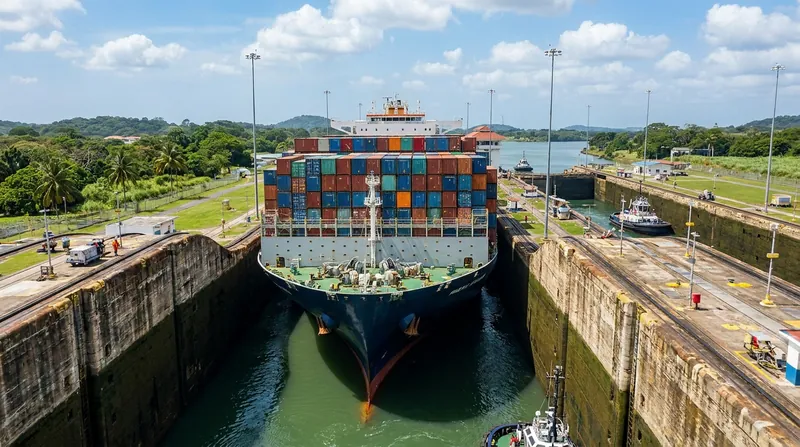
The 1.025 Specific Gravity and the 20-Foot Draft That Define the Panama Canal's Neopanamax Limits
5 sources
Maritime Trade
Maersk Reverses Strategy With $5 Billion Order for 26 New Container Ships
7 sources
Comments
Every angle. Every day.
Get Transportation stories with full source coverage and perspective breakdowns, free every day.