
From Relearning to Walk to Double Gold: Sam Williamson's Historic Commonwealth Games Comeback
Australian breaststroker Sam Williamson captured double gold at the 2026 Commonwealth Games in Glasgow, completing a miraculous 13-month recovery from a ruptured patellar tendon. His triumph over a career-threatening knee injury highlights a broader wave of resilient swimming comebacks this season.
By Jackson Reed

Share this story
When Australian breaststroker Sam Williamson touched the wall to win the 50-meter sprint at the 2026 Commonwealth Games in Glasgow, the gold medal was almost secondary to the fact that he was in the pool at all. Just 13 months earlier, the 28-year-old former world champion was lying on a pool deck with a displaced kneecap, facing a career-ending diagnosis. His triumphant double-gold performance in Scotland—sweeping both the 100-meter and 50-meter breaststroke titles—caps off one of the most remarkable medical and psychological comebacks in modern aquatic sports.[1][2][3]
The ordeal began in April 2025 during what should have been a routine warm-up jump session. Williamson suffered a catastrophic ruptured patellar tendon, tearing it completely off the vastus medialis oblique muscle. The injury immediately forced him out of the 2025 World Championship Trials, stripping him of the chance to defend his 50-meter world title in Singapore. "I didn't really think I'd be able to get back on the blocks," Williamson admitted. "I didn't even think I was going to be able to swim again."[1][2][5]
The turning point arrived just 36 hours after the accident, when a surgeon intervened with a bold promise. Following immediate reconstructive surgery, the medical team assured Williamson that they would get him back on the Australian national team in time for the Glasgow Games. What followed was a grueling 278-day rehabilitation journey. Williamson was forced to completely relearn how to walk before he could even consider the complex, knee-heavy mechanics of the breaststroke kick.[2][5]
The psychological toll of the recovery was immense. The isolation of rehabilitation, coupled with the uncertainty of ever returning to elite speed, pushed Williamson to the brink. "Every single day since I did the injury, I wanted to throw in the towel," he confessed after his Glasgow victory. He credited his support system, particularly his twin brother, for keeping him anchored when his pain tolerance was tested to its absolute limits.[2]
The first undeniable proof that Williamson's speed had survived the surgeon's knife came at the Victorian Open in February 2026, where he comfortably won the 100-meter breaststroke. He then sent a shockwave through the swimming world at the Australian Swimming Trials in June, clocking a blistering 59.11 seconds—the fastest time of the day and a top-eight global time for 2026. That swim officially punched his ticket to Scotland, validating the surgeon's 36-hour promise.[1][4]
In Glasgow, Williamson's execution was flawless. In the 100-meter final, he surged through the second 50 meters to claim gold in 59.17 seconds, defeating Jersey teenager Filip Nowacki and English triple-Olympic champion Adam Ramsay-Peaty. Days later, carrying the heavy expectations of a newly crowned champion, Williamson returned for the 50-meter sprint. He unleashed an extraordinary final 25 meters to touch the wall in 26.50 seconds, edging out South Africa's Michael Houlie and securing the sprint double.[2][3]
"Coming off the 100, knowing there was going to be a target on my back and a little more pressure—that's something I thrive under," Williamson said. Yet, the hardware was ultimately a bonus. For an athlete who spent months wondering if his career was over, the true victory was simply wearing the Australian uniform again. "Just having the opportunity to put the green and gold on again was something I didn't think I'd ever have the opportunity to do," he reflected.[3]
Williamson's resilience was mirrored by other spectacular injury comebacks at the Glasgow Games. South African breaststroker Lara van Niekerk successfully defended her 50-meter title after enduring four years of severe health setbacks, including a debilitating back injury, a herniated disc, and foot surgery. Like Williamson, van Niekerk spent months away from the sport, using the forced break to reignite her competitive fire. "With everything I've been through, I feel like I owed this one to myself," she said after her gold-medal swim.[6][7]
Sports medicine professionals note that returning to elite swimming after major structural injuries is statistically fraught. Re-injury rates are exceptionally high for swimmers who rush back to full training without a structured reintegration protocol. The breaststroke kick, in particular, places immense torque on the knee joints and lower back. The successful returns of athletes like Williamson and van Niekerk highlight the evolving sophistication of aquatic physical therapy, where load progression is meticulously matched to tissue tolerance.[8]
As the 2026 swimming season pivots toward the next Olympic cycle, these comeback narratives have injected a profound sense of perspective into the international circuit. The podiums in Glasgow were not just a measure of raw speed, but a testament to the invisible, agonizing hours spent in empty rehabilitation clinics. For Williamson, the double gold represents the closing of a painful chapter and the ultimate reward for refusing to throw in the towel.[2][5][7]
The essentials
- Australian breaststroker Sam Williamson won double gold at the 2026 Commonwealth Games in Glasgow.
- The victory completes a 13-month recovery from a ruptured patellar tendon and displaced kneecap.
- Williamson underwent 278 days of rehabilitation, having to relearn how to walk before swimming again.
- South Africa's Lara van Niekerk also defended her 50m breaststroke title following a severe back injury.
Timeline
April 2025
Sam Williamson suffers a ruptured patellar tendon and displaced kneecap during a routine warm-up.
May 2025
Williamson undergoes reconstructive knee surgery within 36 hours of the injury.
February 2026
Williamson makes his competitive return at the Victorian Open, winning the 100m breaststroke.
June 2026
Williamson clocks a world-leading 59.11s at the Australian Swimming Trials to secure his Commonwealth Games spot.
July 2026
Williamson wins double gold in the 100m and 50m breaststroke at the Glasgow 2026 Commonwealth Games.
- Rehabilitating Athletes
- Focuses on the grueling physical and psychological toll of severe injuries, emphasizing the daily battle to avoid quitting.
- Medical & Coaching Consensus
- Highlights the critical role of immediate surgical intervention and structured reintegration protocols to prevent re-injury.
- International Competitors
- Views these comebacks through the lens of international rivalry, noting how returning athletes disrupt established podium hierarchies.
Perspectives this story doesn't cover
- National Swimming Federation Selectors
- Sponsors and Endorsement Partners
Sources
Source coverage
8 outlets
3 viewpoints surfaced








- [1]Swimming World MagazineInternational Competitors
Aussie Selection Trials: Sam Williamson's Impressive 59.11 To Confirm He's Well And Truly Back After Horrific Training Accident
- [2]Glasgow 2026 OfficialRehabilitating Athletes
Williamson storms to gold as Australia's golden Swimming start continues
- [3]Olympics.comRehabilitating Athletes
Commonwealth Games 2026: Sam Williamson adds 50 metre breaststroke title to Glasgow haul
- [4]SwimSwamMedical & Coaching Consensus
Sam Williamson Wins Again In Post-Knee Injury Comeback At 2026 Vic Open
- [5]Swimming AustraliaRehabilitating Athletes
This comeback story is not one for the faint hearted
- [6]Just Plain SportInternational Competitors
Lara van Niekerk Defends 50m Breaststroke Gold
- [7]The CitizenInternational Competitors
After injuries, illness and the heartbreak of missing the Paris Olympics, a Pretoria swimmer reflects on the setbacks
- [8]PadlieMedical & Coaching Consensus
Return to swimming after injury: a reintegration protocol for coaches

More in Sports
See all →Recap
Ludovica Terlizzi and Mate Karpati Capture 10km Titles at Junior Open Water World Championships
7 sources
Power ranking
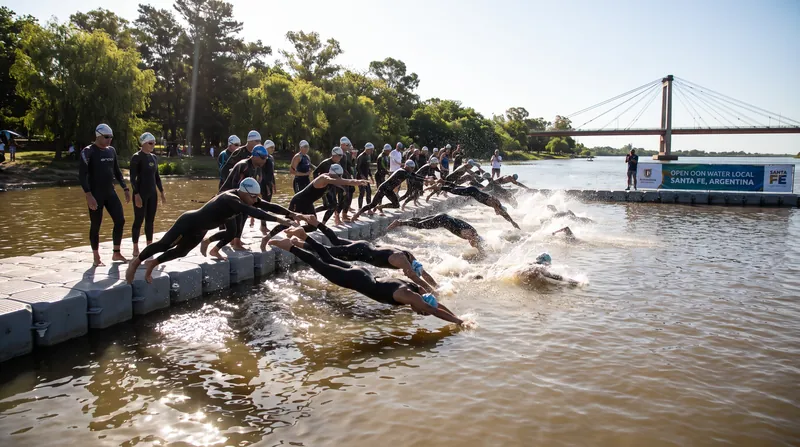
Global Open Water Power Rankings: Hungary's Reign, France's Surge, and the Youth Movement Descending on Santa Fe
4 sources
Trade
USA Swimming Unveils 2026-27 National Team Roster Featuring 101 Athletes
6 sources
Power ranking
Global Women's Backstroke Power Rankings: Berkoff and Smith Set the Standard as Short Course Season Looms
5 sources
Comments
Every angle. Every day.
Get Sports stories with full source coverage and perspective breakdowns, free every day.