
Ferrari Dominates Hungarian Grand Prix Friday Practice as Leclerc and Hamilton Set the Pace
Charles Leclerc and Lewis Hamilton secured a Ferrari 1-2 in Friday practice at the Hungaroring, signaling a formidable challenge to championship leaders Mercedes. Rival teams struggled with setup issues and the track's newly resurfaced, bumpy layout.

Share this story
The tight, twisty confines of the Hungaroring have historically rewarded aerodynamic precision over sheer straight-line speed. On Friday, that dynamic played perfectly into the hands of Ferrari, as the Scuderia delivered a commanding 1-2 performance during practice for the 2026 Hungarian Grand Prix.[3]
Charles Leclerc set the tone early, dominating Free Practice 1 with a blistering lap of 1:19.075 on the soft compound tires. His benchmark was nearly half a second clear of Red Bull's Max Verstappen, establishing Ferrari as the immediate favorite for the weekend.[4][6]
The momentum continued into the late afternoon. In Free Practice 2, seven-time world champion Lewis Hamilton—now in his second season with the Italian marquee—eclipsed his teammate by 0.148 seconds, posting a 1:18.729 to secure the top spot. Leclerc slotted into second, cementing a dominant Friday for the Maranello squad.[2]
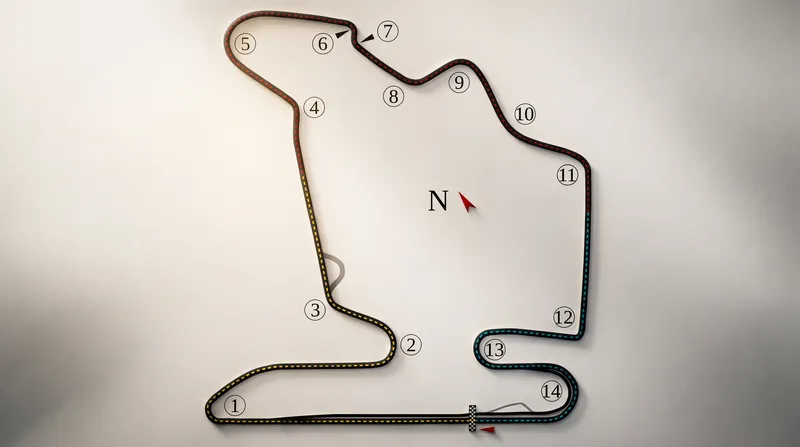
The mechanism behind Ferrari's sudden surge lies in the specific demands of the Budapest circuit. Often dubbed "Monaco without the walls," the Hungaroring requires maximum downforce. Ferrari arrived with circuit-specific aerodynamic options, including an eye-catching three-piece winglet mounted atop the rear-wing actuator.[6]
This high-downforce configuration allowed the SF26 to navigate the track's newly resurfaced and notoriously bumpy sections with a stability that eluded their rivals. While other cars looked nervous on corner entry, the Ferraris were able to attack the apexes with confidence.[2][5]
However, the day was not entirely without concern for the Italian team. In the closing minutes of FP1, Leclerc was forced to coast back to the pit lane after reporting that "something broke" in the rear of his car. The apparent mechanical issue—suspected to be related to the gearbox or power unit—served as a stark reminder that raw pace must be paired with reliability.[4][5]
Across the paddock, the mood at championship leaders Mercedes was noticeably more subdued. George Russell, who finished fifth in both sessions, admitted that the team's single-lap pace "didn't look great" and warned that Ferrari appeared "very strong."[3]
Russell complained that his W17 was badly out of balance, struggling to cope with the gusting winds and the super-stiff setup required for the bumpy asphalt. While he noted that their long-run data looked slightly more competitive, the gap to Ferrari over a single flying lap was a glaring concern for the Brackley-based squad.[2][3]
The situation was even more challenging for Mercedes' championship leader, Kimi Antonelli. The young Italian sat out FP1 to allow reserve driver Fred Vesti to fulfill mandatory rookie running requirements. When Antonelli finally took the wheel in FP2, he struggled to find a rhythm, complaining of severe rear locking under braking.[2][3]
Antonelli ultimately finished the second session in 13th place, nearly two seconds off Hamilton's benchmark. His qualifying simulation was further hampered by a red flag and a snap of oversteer on his second flying lap, leaving the title leader with a mountain to climb ahead of Saturday.[1][3]
Red Bull Racing also found themselves wrestling with a recalcitrant car. Max Verstappen finished FP1 in second and FP2 in fourth, but the reigning world champion was highly vocal about his dissatisfaction over the team radio.
Verstappen complained of "horrendous" downshifts and described the rear axle as "super stiff," noting that the car was "jumping like crazy" over the bumps. Despite bringing back their rotating rear wing concept for this weekend, Red Bull appeared to lack the rear grip necessary to challenge Ferrari's traction out of the slow corners.[1][4]
Beyond the battle at the front, the Hungarian Grand Prix practice sessions served as a massive testing ground for mid-season upgrades. McLaren arrived with a wholesale floor revision aimed at closing the cornering-performance gap to the top teams.[6]
The early data for McLaren looked promising. Lando Norris clocked the third-fastest time in FP2, finishing just under half a second behind the leading Ferraris. His teammate Oscar Piastri, whose car was tested by F2 champion Leonardo Fornaroli in FP1, also showed flashes of competitive pace.[6]
Aston Martin took an even more aggressive approach, debuting what amounted to a heavily revised B-spec AMR26. The new package featured a lighter chassis, entirely new aerodynamic surfaces, and a redesigned rear suspension.[6]
Unfortunately for the Silverstone squad, the debut was marred by disaster. Just 36 minutes into FP1, Lance Stroll suffered a catastrophic rear suspension failure exiting Turn 2, pitching his car into a 360-degree spin and bringing out the red flags. The damage was severe enough to rule Stroll out of FP2 entirely.[2][6]
The second session was also interrupted by a red flag when Alpine's Franco Colapinto spun on the entry to the final corner, backing his car into the barriers. The incident truncated the qualifying simulations for several drivers, leaving teams with incomplete data heading into the weekend.[1][2]
As the paddock regroups for Saturday, the narrative is clear: Ferrari has the raw speed to dictate terms in Budapest. But with Mercedes desperately analyzing setup data, Red Bull searching for drivability, and the ever-present threat of mechanical gremlins, the battle for pole position remains a complex, high-stakes puzzle.[3]
The essentials
- Charles Leclerc and Lewis Hamilton secured a dominant 1-2 finish for Ferrari in Friday practice at the Hungarian Grand Prix.
- Mercedes struggled with balance and rear locking on the bumpy track, with championship leader Kimi Antonelli finishing 13th in FP2.
- Red Bull's Max Verstappen expressed frustration over a stiff rear axle and poor downshifts, finishing fourth in the second session.
- Aston Martin debuted a heavily revised B-spec car, but Lance Stroll's running was cut short by a severe suspension failure.
- McLaren's wholesale floor revision showed early promise, with Lando Norris clocking the third-fastest time of the day.
Timeline
July 24, 13:30 Local
Free Practice 1 begins, with five rookie drivers taking to the track.
July 24, 14:06 Local
Lance Stroll suffers a catastrophic rear suspension failure, bringing out the red flags.
July 24, 14:23 Local
Charles Leclerc sets the fastest time of FP1 but suffers a mechanical issue shortly after.
July 24, 17:00 Local
Free Practice 2 commences, with Kimi Antonelli and other regular drivers returning to their cars.
July 24, 17:28 Local
Franco Colapinto crashes his Alpine, interrupting qualifying simulations with a second red flag.
July 24, 18:00 Local
Lewis Hamilton finishes FP2 fastest, securing a Ferrari 1-2 to end the day.
- Ferrari Optimists
- Focuses on Ferrari's raw pace and dominant 1-2 finish as a sign of a major weekend advantage.
- Technical Analysts
- Examines the massive upgrade packages, Red Bull's drivability woes, and the impact of the newly resurfaced track.
- Championship Defenders
- Highlights Mercedes' setup struggles and the potential threat to their championship lead.
Perspectives this story doesn't cover
- Pirelli Tire Engineers
- Rookie Drivers
Sources
Source coverage
6 outlets
3 viewpoints surfaced






- [1]The RaceChampionship Defenders
Ferrari set the fastest times of FP2 for the 2026 Hungarian Grand Prix
Read on The Race → - [2]FIATechnical Analysts
Lewis Hamilton set the pace in Free Practice 2 for the 2026 FIA Formula 1 Hungarian Grand Prix
Read on FIA → - [3]Formula 1Championship Defenders
George Russell wary of Ferrari threat in 2026 Formula 1 Hungarian Grand Prix
Read on Formula 1 → - [4]RacerFerrari Optimists
Leclerc fastest before hitting trouble in opening Hungarian GP practice
- [5]Crash.netTechnical Analysts
Charles Leclerc set the fastest time in first practice for the Hungarian Grand Prix
- [6]AutosportTechnical Analysts
Leclerc tops FP1, Stroll suffers suspected suspension failure with upgraded Aston Martin
More in Sports
See all →F1 Leadership
Cadillac F1 Team Replaces Team Principal Graeme Lowdon With Former Alpine Boss Marcin Budkowski
7 sources
Power Unit Rules
F1 Agrees to 60/40 Power Split for 2027 and 2028 to Fix Unpopular Engine Rules
5 sources
F1 Strategy
Red Bull Halts Aggressive 2026 Car Development to Focus on 2027 Season
7 sources
McLaren Resurgence
McLaren's Hungarian GP Victory Blows Open 2026 Formula 1 Championship Race
2 sources
Comments
Every angle. Every day.
Get Sports stories with full source coverage and perspective breakdowns, free every day.