
Fact Check: Evaluating Claims That Pope Leo XIV Supports Iran's Nuclear Weapons Program
President Trump has repeatedly asserted that the Pope endorsed Iran having a nuclear weapon. A review of the pontiff's statements and Vatican doctrine reveals a consistent, long-standing opposition to all nuclear arms.
By Hailey Scott

Share this story
The intersection of geopolitics and religion has sparked a direct public dispute between the White House and the Vatican, centering on claims regarding Iran's nuclear capabilities. President Donald Trump has repeatedly asserted that Pope Leo XIV—the first American-born pontiff—supports Iran possessing a nuclear weapon. The allegations emerged amid escalating military actions between the United States, Israel, and Iran, prompting widespread scrutiny from fact-checking organizations and religious scholars.[1][3]
The controversy began in early April 2026, when the President utilized his social media platform to criticize the Pope's foreign policy stances. Trump wrote that he did not want a pontiff who "thinks it's OK for Iran to have a Nuclear Weapon," later expanding on the claim in remarks to reporters on the White House South Lawn. He explicitly stated, "The pope made a statement. He says Iran can have a nuclear weapon," framing the administration's military campaign as a necessary countermeasure to prevent nuclear proliferation.
Evaluating the primary claim requires examining the public statements and official encyclicals of Pope Leo XIV since his election in May 2025. A comprehensive review of Vatican transcripts, public addresses, and papal social media accounts yields no evidence that the Pope has ever endorsed Iran—or any other nation—acquiring nuclear weapons. Fact-checking divisions across major news organizations have unanimously rated the President's assertion as false, noting a complete absence of the alleged statement in the public record.[1][3]
Conversely, the evidentiary record demonstrates that Pope Leo XIV has made nuclear disarmament a central pillar of his papacy. In June 2025, as regional tensions escalated, the Pope explicitly called for a world free from the nuclear threat, stating that security should be pursued through "respectful encounter and sincere dialogue" rather than mutually assured destruction. He reiterated this stance during the 80th anniversary of the atomic bombings of Hiroshima and Nagasaki, describing nuclear weapons as instruments of "profound horrors."
The timeline of the dispute suggests that the administration's claims were catalyzed by the Vatican's vocal opposition to the ongoing military conflict. Prior to the President's allegations, Pope Leo XIV had publicly condemned threats to annihilate Iranian civilization as "truly unacceptable" and urged international leaders to abandon "projects of death." The Pope's appeals for a ceasefire and his criticism of the "delusion of omnipotence" fueling the war were interpreted by the White House as a direct challenge to U.S. military strategy.[1][2]
The administration's framing appears to conflate the Pope's opposition to the war with an endorsement of Iran's geopolitical ambitions. By advocating for a cessation of hostilities, the Vatican inherently opposes the preemptive military strikes that the U.S. and Israel argue are necessary to dismantle Iran's nuclear infrastructure. However, equating a call for diplomatic resolution with support for nuclear armament represents a logical leap that is not supported by the Vatican's diplomatic history or the Pope's explicit theological teachings.
The Catholic Church's institutional stance on nuclear weapons further contradicts the President's claims. The Holy See has long advocated for global nuclear disarmament, a position solidified long before Pope Leo XIV's tenure. The Vatican was one of the first state entities to sign and ratify the United Nations' Treaty on the Prohibition of Nuclear Weapons in 2017. The current pontiff has actively continued this legacy, dedicating his March 2026 global prayer intention specifically to the abolition of the nuclear threat.[1]
In response to the escalating rhetoric from Washington, Pope Leo XIV addressed the controversy directly during a papal flight. While declining to engage in a personalized political debate, the pontiff clarified that his appeals for peace reflect the broader Gospel message rather than a specific endorsement of any nation's military policies. He emphasized that the Church has spoken out against all nuclear weapons for years, asking that any criticism of his ministry be grounded in truth.[2]
The Vatican's Secretariat of State has also expressed puzzlement over the allegations, with senior officials describing the President's characterization as "strange, to say the least." The diplomatic friction arrives at a sensitive moment, as U.S. Secretary of State Marco Rubio is scheduled to meet with Vatican officials to discuss a range of international issues, including the status of Cuba and the broader Middle East conflict.[2][3]
The dispute highlights a profound philosophical divergence between the current U.S. administration and the Holy See regarding the mechanics of global security. The White House maintains that overwhelming military force is the only reliable mechanism to prevent nuclear proliferation in hostile states. In contrast, the Vatican argues that true peace cannot be built on the threat of mass annihilation, advocating instead for multilateral diplomacy and international arms control treaties.
While the administration's supporters argue that the Pope is naive about the realities of geopolitics and the specific threats posed by Tehran, the factual core of the President's claim remains unsupported. The assertion that Pope Leo XIV stated "Iran can have a nuclear weapon" is a fabrication that contradicts both the documented words of the pontiff and the established diplomatic doctrine of the Catholic Church.[1][3]
Ultimately, the evidence pack reveals a stark asymmetry in the dispute. The claims emanating from the White House lack primary source documentation and rely on a mischaracterization of the Pope's anti-war advocacy. Meanwhile, the Vatican's position is extensively documented across dozens of public addresses, encyclicals, and international treaties, all of which uniformly condemn the development, possession, and use of nuclear weapons by any state.[3]
Key points
- President Trump has repeatedly claimed that Pope Leo XIV supports Iran possessing a nuclear weapon.
- Fact-checking organizations have unanimously rated the claim as false, finding no public record of the Pope making such a statement.
- Pope Leo XIV has consistently advocated for global nuclear disarmament since assuming the papacy in May 2025.
- The Vatican was among the first entities to sign the UN Treaty on the Prohibition of Nuclear Weapons in 2017.
Open questions
- It remains unclear if the diplomatic friction will affect upcoming meetings between U.S. State Department officials and the Vatican.
- It is unknown whether the administration will retract or clarify the statements in light of the unanimous fact-checks.
Timeline
May 2025
Cardinal Robert Francis Prevost is elected Pope Leo XIV, becoming the first American-born pontiff.
June 2025
Pope Leo XIV calls for a world free from the nuclear threat amid rising tensions between Israel and Iran.
March 2026
The Pope dedicates his monthly global prayer intention to nuclear disarmament and peace.
Early April 2026
Pope Leo XIV criticizes threats to annihilate Iranian civilization as 'truly unacceptable.'
April 12, 2026
President Trump posts on social media that he does not want a Pope who thinks it is 'OK for Iran to have a Nuclear Weapon.'
April 16, 2026
The President repeats the claim to reporters, falsely stating the Pope explicitly endorsed Iran having a nuclear weapon.
- Political & Fact-Checking Desks
- Mainstream media and fact-checkers focus on the lack of empirical evidence for the President's claims.
- Vatican & Religious Observers
- Catholic media and Vatican officials emphasize the Church's long-standing theological opposition to nuclear arms.
Perspectives this story doesn't cover
- Independent arms control experts
- Iranian diplomatic officials
Sources
Source coverage
3 outlets
2 viewpoints surfaced



- [1]PBS NewsHourPolitical & Fact-Checking Desks
Fact-checking Trump's claim that Pope Leo supports nuclear weapons in Iran
Read on PBS NewsHour → - [2]The GuardianVatican & Religious Observers
US supreme court rejects Trump’s bid to appeal $5m E Jean Carroll verdict
Read on The Guardian → - [3]ForbesPolitical & Fact-Checking Desks
Trump Cancels Iran Bombings And Claims Peace Deal Is Approved
Read on Forbes →

More in News & Politics
See all →Wildfire Science
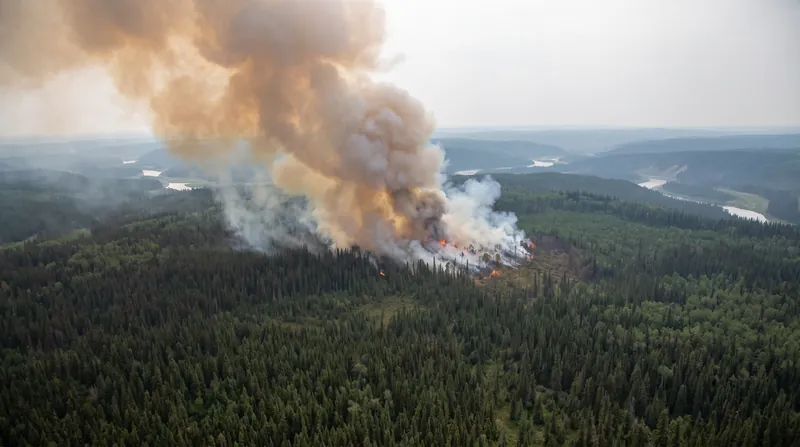
Fact-Check: Climate Change, Not 'Debris Removal,' Is Main Driver of Worsening Canadian Wildfires
7 sources
Reflecting Pool Saga
DOJ Drops Reflecting Pool Vandalism Charges, Citing 'Botched Installation' Over Sabotage
6 sources
Election Law
Fact-Check: What the Appeals Court Ruling on Mail-In Voting Actually Means for the 2026 Midterms
3 sources

Military Readiness
Fact-Check: Did the Biden Administration Deplete U.S. Military Stockpiles?
6 sources
Comments
Every angle. Every day.
Get News & Politics stories with full source coverage and perspective breakdowns, free every day.