
Consistency Over Gold: Zhang and Khalkevych Lead Wide-Open Women's Speed Standings
With top stars missing events, China's Shaoqin Zhang and Ukrainian teenager Polina Khalkevych have seized control of the 2026 Women's Speed standings through sheer consistency.
By Meera Iyer
Share this story
The 2026 Women's Speed climbing season was supposed to be a coronation for the discipline's established titans. Instead, it has become a masterclass in the power of consistency. As the IFSC World Climbing Series hits its midseason break before the European leg, the top of the leaderboard is remarkably devoid of the year's gold medalists. China's Shaoqin Zhang currently holds the number one spot with 1,235 points, closely followed by Ukrainian teenage sensation Polina Khalkevych with 1,155 points.
The unusual standings are the direct result of a grueling, compressed 2026 calendar and the unforgiving math of the World Climbing Series points system. Heavyweights like the United States' Emma Hunt and Poland's Aleksandra Kalucka have both captured gold medals this season, but strategic absences and missed finals at other stops have kept them entirely outside the top five. In the World Climbing Series, where advancing to the knockout bracket yields massive point differentials, skipping a single event can severely dent a climber's overall title hopes.
Zhang has capitalized on this dynamic perfectly. While she hasn't stood on the top step of the podium yet this year, her relentless consistency—highlighted by a crucial bronze medal finish in Madrid—has allowed her to steadily accumulate points. In a discipline where a single slip or a fraction-of-a-second hesitation means instant elimination, Zhang's ability to reliably navigate the chaotic early knockout rounds has proven more valuable than raw, record-breaking speed.
Zhang's position at the top is also a testament to the terrifying depth of the Chinese speed climbing program in 2026. The team frequently places three or four climbers into the final phases of competition, creating a gauntlet for international challengers. By training against the deepest roster in the world, Zhang has developed a steady nerve under pressure that has earned her the series lead.[2]
Right on Zhang's heels is the breakout star of the season: Polina Khalkevych. The Ukrainian teenager has been on an absolute tear, shattering her personal bests and securing her first-ever senior medal with a silver in Madrid. Her rapid rise has injected a thrilling underdog narrative into the speed climbing circuit, proving that the next generation of athletes is already capable of disrupting the established hierarchy.
Sitting in third place is Poland's Natalia Kalucka with 1,105 points. Much like Zhang, Kalucka has built her campaign on reliability rather than outright victories. Fourth- and sixth-place finishes have kept her firmly in the hunt, ensuring that the legendary Polish speed climbing dynasty remains represented at the top of the leaderboard even as other stars rotate in and out of the circuit to manage fatigue.[2]
The championship race is rounded out by Indonesia's Desak Made Rita Kusuma Dewi with 1,070 points and China's Yuju Mou with 1,065 points. This makes the top five a remarkably tight cluster, separated by a mere 170 points from first to fifth. With the margins so razor-thin, a single slip on the 15-meter wall or a false start in the upcoming rounds could completely scramble the standings.
The absence of the gold medalists from the top of the board highlights a growing strategic divide in the sport. Climbers like Hunt are increasingly prioritizing peaking for specific flagship events or national trials over the grueling grind of the full World Cup circuit. While this approach yields spectacular individual times and gold medals, it leaves the door wide open for the "ironwomen" of the circuit to dominate the overall standings.[2]
Adding another layer of volatility to the 2026 season is the introduction of four-lane speed walls at select events. The format, tested in Madrid ahead of its wider rollout, increases the visual spectacle for fans but amplifies the psychological pressure on the athletes, who must now block out the peripheral movement of three competitors instead of one.
As the circuit prepares to move through Krakow and Chamonix before heading to the Asian stops and ultimately the season finale in Santiago, Chile, the strategy for the frontrunners is clear. Zhang, Khalkevych, and Kalucka don't necessarily need to break the sub-6.2 second barrier to win the overall title; they just need to keep hitting the buzzer in the final rounds. In a sport defined by explosive, sub-seven-second bursts, the 2026 championship is turning into a fascinating marathon of endurance.[1][2]
Key points
- China's Shaoqin Zhang leads the 2026 Women's Speed standings with 1,235 points.
- Ukrainian teenager Polina Khalkevych sits in second place following a breakthrough silver medal in Madrid.
- Gold medalists like Emma Hunt and Aleksandra Kalucka are outside the top five due to missed events.
- The top five climbers are separated by just 170 points, making it one of the tightest races in years.
- The introduction of four-lane speed walls has added a new layer of unpredictability to the 2026 season.
How we got here
May 2026
Emma Hunt and Aleksandra Kalucka secure early-season golds but miss subsequent events, dropping out of the top five.
May 31, 2026
Polina Khalkevych wins her first senior medal (silver) in Madrid, surging up the overall standings.
June 2026
Shaoqin Zhang takes the overall lead at the midseason break following a string of consistent top-four finishes.
October 2026
The World Climbing Series will conclude in Santiago, Chile, crowning the overall champion.
- Consistency Advocates
- Argue that the true measure of a champion is the ability to navigate the chaotic knockout rounds at every single event without slipping.
- Peak Performers
- Believe that setting world records and winning individual golds at flagship events is more prestigious than accumulating points across the full circuit.
- Youth Movement Watchers
- Focus on how teenage climbers are rapidly closing the gap with established veterans, proving the sport's talent pool is deepening.
Perspectives this story doesn't cover
- Athletes recovering from injury who are forced to skip events
- National federation coaches balancing athlete workloads
Sources
Source coverage
2 outlets
3 viewpoints surfaced


- [1]Olympics.comPeak Performers
2026 World Climbing Series: Midseason Standings and Highlights
Read on Olympics.com → - [2]8a.nuYouth Movement Watchers
Chinese Speed Team Dominates 2026 Standings as Kalucka Stays in the Hunt
Read on 8a.nu →
More in Sports
See all →Injury
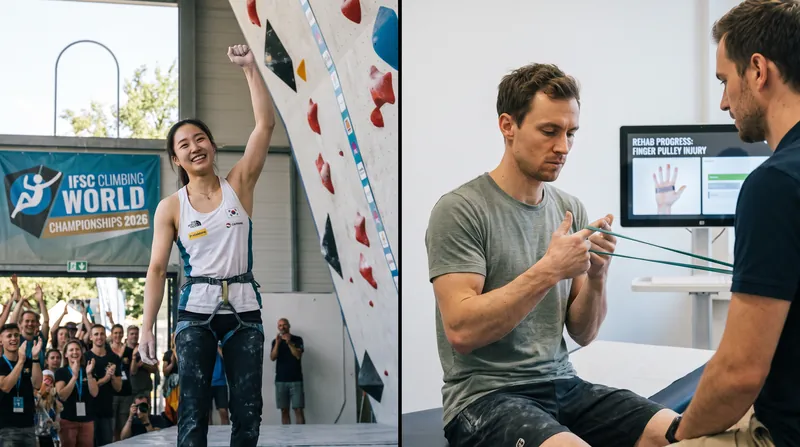
2026 Sport Climbing Injury Report: Chaehyun Seo's Miraculous Return and Jakob Schubert's Lingering Finger Rehab
6 sources
Standings
The New Vanguard: Mao Nakamura and Naïlé Meignan Shake Up the 2026 Women's Boulder Standings
6 sources
Injury
2026 Sport Climbing Injury Report: Milne, Richardson, and Dörffel Navigate the Grueling Return to the Wall
7 sources
Standings
Matteo Zurloni and Ludovico Fossali Propel Italy Into the Top Tier of the 2026 Men's Speed Standings
3 sources
Comments
Every angle. Every day.
Get Sports stories with full source coverage and perspective breakdowns, free every day.