
Beyond the Turf: How Data, Rule Changes, and Advanced Rehab Are Reshaping Field Hockey Injury Recoveries
A landmark injury assessment study and new 2026 safety rules are transforming how field hockey players recover from severe setbacks. With advanced surgical techniques and data-driven rehab, athletes are returning to the pitch stronger than ever.
By Omar Haddad

Share this story
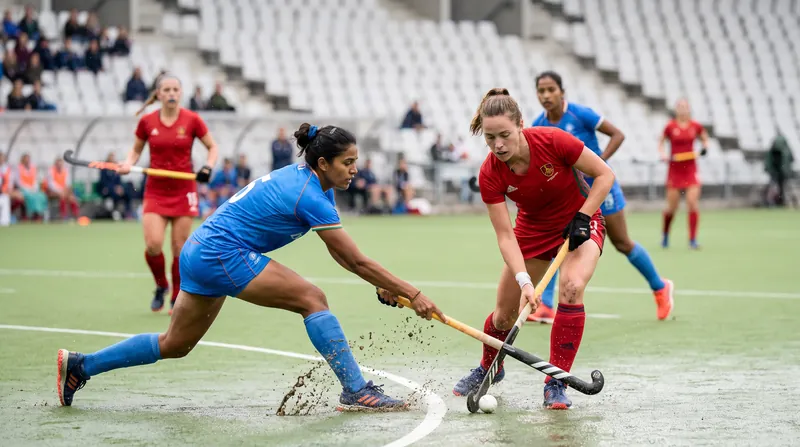
The modern game of field hockey is a masterclass in kinetic intensity. Athletes sprint, pivot, and change direction at blistering speeds, all while maintaining a semi-crouched posture to manipulate a dense, high-velocity ball. For decades, this unique biomechanical demand fostered a grim narrative: that the sport was a minefield for devastating knee ligament tears and facial fractures. But as the 2026 season unfolds across international and collegiate pitches, a new reality is taking hold. The conversation around field hockey injuries has shifted from career-ending anxiety to structured, data-backed resilience.[2][3]
A landmark study recently published in the British Journal of Sports Medicine has fundamentally altered how the sport views its own dangers. By analyzing data from elite international competitions—including the Olympic Games and the Women's FIH World Cup—researchers utilized the International Hockey Federation's (FIH) new Injury Assessment Protocol (IAP). The findings offer a highly uplifting perspective: severe injuries, defined as those requiring more than 28 days of absence, are remarkably rare at the highest levels of the game.[1]
According to the IAP data, severe injuries occur at a rate of just 1.3 per 1,000 player match hours for men, and an even lower 0.3 per 1,000 hours for women. The vast majority of recorded incidents—nearly 88 percent for men and 85 percent for women—were classified as "no time-loss" or mild injuries, allowing athletes to return to the pitch within a week. While head injuries and penalty corner impacts remain areas of clinical focus, the overarching data proves that the sport's protective measures and physical conditioning programs are working.[1]
To further drive down those severe injury rates, governing bodies are implementing proactive rule changes for the 2026 season. The National Federation of State High School Associations (NFHS) recently rolled out strict new mandates aimed at player safety. Among the most notable updates are stringent mouthguard regulations, which now explicitly prohibit any decorative or non-functional attachments that could pose a hazard upon impact.
The NFHS has also revamped the rules surrounding penalty corners—statistically one of the most dangerous set pieces in the sport. Under the 2026 guidelines, if a defending goalkeeper is injured or suspended, they must be replaced by a properly equipped substitute, and the team must play short if it stems from a penalty. Furthermore, no field player substitutions are permitted during a penalty corner for any reason, including injury, ensuring that the defensive structure remains predictable and safe amid the chaos of a 90-mph drag flick.
When severe injuries like anterior cruciate ligament (ACL) tears do occur, the rehabilitation landscape in 2026 looks vastly different than it did a decade ago. Sports medicine specialists emphasize that recovery is no longer a passive waiting game. Modern protocols integrate field hockey-specific movements—such as multi-planar cutting and stick-handling on unstable surfaces—much earlier in the recovery timeline. This ensures that the athlete's neuromuscular control adapts to the specific demands of the semi-crouched playing stance long before they are cleared for full contact.[2][3]
Technology and sports psychology are also playing unprecedented roles in the modern comeback. Wearable GPS and heart-rate monitors, once reserved for the elite FIH Pro League, are now standard at the collegiate and club levels. These devices track cumulative stress and fatigue, allowing trainers to use objective data rather than guesswork when clearing an athlete to return. Simultaneously, mental performance coaching has become a staple of injury rehab, helping athletes overcome the psychological hurdle of trusting a surgically repaired knee during a high-stakes match.
The human impact of these advancements is visible on rosters across the globe. At the collegiate level, players who previously saw their seasons derailed by severe trauma are making triumphant returns. Katelyn Dulin, whose freshman campaign at Michigan State was abruptly cut short by injury, has successfully navigated the grueling rehab process and transferred to American University, where she is slated to be a key contributor for the Eagles' 2026 season. Her trajectory mirrors that of countless athletes who are proving that a major injury is merely an intermission.[3]
Ultimately, the 2026 field hockey landscape is defined by empowerment. Through the FIH's rigorous data tracking, the NFHS's safety-first rule adjustments, and a holistic approach to physical and mental rehabilitation, the sport is actively protecting its players. For athletes facing the daunting road of injury recovery, the message is clear: the science, the rules, and the community are entirely aligned to get them back on the turf, stronger and more capable than before.[1][3]
The essentials
- A landmark FIH study reveals that severe injuries in elite field hockey are exceedingly rare.
- Over 85 percent of recorded match injuries require one week or less of recovery time.
- New 2026 NFHS rules mandate safer mouthguards and stricter penalty corner substitution protocols.
- Modern rehabilitation integrates sport-specific movements and mental conditioning much earlier in the recovery process.
- Wearable technology is now widely used to manage training loads and safely guide athletes back to full contact.
Timeline
2021
The International Hockey Federation (FIH) introduces the new Injury Assessment Protocol (IAP) at the Tokyo Olympic Games to better track injury severity.
Late 2025
The British Journal of Sports Medicine publishes comprehensive IAP data, proving that severe injuries in elite field hockey are statistically rare.
Feb 2026
The NFHS approves new safety-focused rule changes regarding mouthguards and penalty corner substitutions for the upcoming season.
Summer 2026
Athletes across collegiate and international leagues return to the pitch utilizing advanced, data-driven rehabilitation protocols.
- Sports Medicine Researchers
- Focuses on utilizing empirical data from the pitch to accurately track injury severity and inform future rule changes.
- Rules & Safety Officials
- Prioritizes preventative measures, equipment mandates, and structured protocols to mitigate risks during high-danger plays.
- Coaches & Athletes
- Emphasizes the physical resilience, mental conditioning, and wearable technology required to successfully return to elite competition.
Perspectives this story doesn't cover
- Grassroots players lacking access to high-end wearable technology
- Goalkeepers managing the psychological impact of high-velocity impacts
Sources
Source coverage
3 outlets
3 viewpoints surfaced



- [1]British Journal of Sports MedicineSports Medicine Researchers
Incidence of moderate and severe injuries in elite field hockey tournaments
Read on British Journal of Sports Medicine → - [2]Rady Children's HospitalRules & Safety Officials
Field Hockey Injury Risks Go Back 4,000 Years
Read on Rady Children's Hospital → - [3]Factlen Editorial TeamCoaches & Athletes
Synthesis by Factlen editorial team
Read on Factlen Editorial Team →
More in Sports
See all →Standings
2026 FIH Hockey World Cup: Final Power Rankings and Group Stage Stakes as 16 Nations Converge
5 sources
Standings
Cuba Sweeps CAC Games Hockey5s Qualifiers as Lima 2027 Playoff Picture Finalizes
6 sources
Injury
Ireland Names 2026 Field Hockey World Cup Squad Amid Key Injury Shifts
5 sources

Standings
Euro Hockey League Finalizes 2026/2027 Rankings: Scotland Women and Switzerland Men Secure Final Berths
6 sources
Comments
Every angle. Every day.
Get Sports stories with full source coverage and perspective breakdowns, free every day.