
2026 World Open Standings: Grandmasters Clash in Washington D.C. as $208,000 Tournament Enters Final Day
The 54th Annual World Open heads into its decisive final rounds on Sunday, with a crowded leaderboard of international Grandmasters vying for the prestigious title and a share of the $208,000 prize fund.
By Ryder James
Share this story
The 54th Annual World Open has transformed the Omni Shoreham Hotel in Washington, D.C., into the epicenter of the global chess circuit this Independence Day weekend. Moving from its traditional long-time home in Philadelphia, the 2026 edition has drawn thousands of competitors ranging from elite international Grandmasters to ambitious local club players. As the tournament heads into its decisive final day on Sunday, July 5, the standings in the premier Open section remain a tense, crowded battleground.[1]
At stake is a massive $208,000 guaranteed prize fund, one of the largest purses in open-Swiss chess. Unlike closed invitational tournaments where appearance fees cushion the players, the World Open is a pure meritocracy. The top boards are currently locked in a high-stakes sprint, where a single victory in the final two rounds can mean the difference between a career-defining five-figure payday and going home empty-handed.[1][2]
The tournament's unforgiving nine-round Swiss format is notorious for producing chaotic, unpredictable finishes. Because winners are paired against winners, the leaders inevitably cannibalize each other's scores in the late rounds. This dynamic allows players lurking just a half-point behind the leaders to suddenly leapfrog into championship contention with a well-timed Sunday surge.[1]
Among the heavy hitters navigating the treacherous top boards are Grandmasters Jianchao Zhou, Karthik Venkataraman, and Prraneeth Vuppala. Zhou, who demonstrated razor-sharp tactical form by dominating the preliminary Game/50 and Action side events earlier in the week, has carried that momentum into the classical main event. However, the depth of the field means that no top seed is safe from the hungry International Masters and FIDE Masters seeking their own breakthrough moments.[2]
Indeed, the World Open is one of the premier hunting grounds for title norms. For rising stars, the standings represent more than just prize money; they are a roadmap to achieving the coveted Grandmaster or International Master titles. A strong performance against the tournament's international contingent can secure a norm, adding an intense secondary layer of pressure to the Sunday pairings.[1]
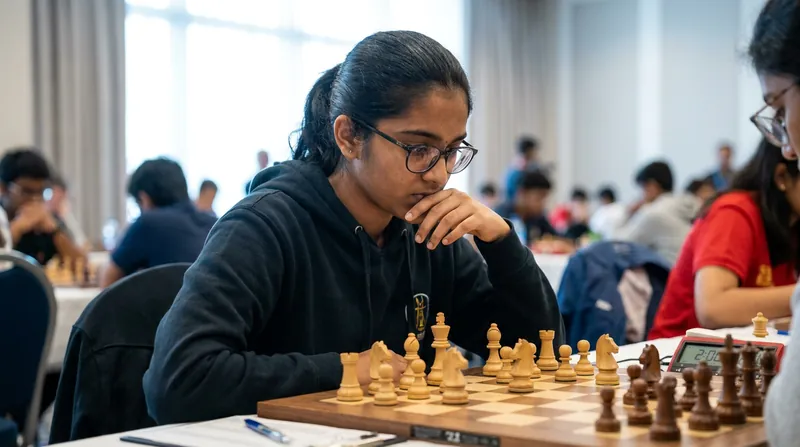
The physical toll of the World Open is legendary within the chess community. Competitors face a grueling schedule of two classical games per day, with each bout potentially lasting up to five or six hours. The time control—40 moves in 90 minutes, followed by 30 minutes to finish, plus a 30-second increment per move—demands absolute sustained focus. By the time Round 8 begins on Sunday morning, fatigue becomes as dangerous an opponent as the player sitting across the board.[1]
The venue shift to Washington, D.C., has added a fresh backdrop to the historic event. While Philadelphia's Center City hosted the tournament for decades, the Omni Shoreham Hotel has provided a sprawling, elegant arena for the 2026 clashes. The sprawling ballrooms are filled with the synchronized clicking of chess clocks, creating an atmosphere of intense, quiet gladiatorial combat.
Beyond the elite Open section, the World Open's class divisions—ranging from Under 2200 down to Under 1400—are experiencing their own dramatic standings races. These sections, strictly capped by US Chess ratings, offer massive class prizes that often exceed the payouts of professional round-robins. For many amateur players, winning their section at the World Open is the pinnacle of their competitive chess journey.[1][2]
As the pairings are posted for the penultimate round, the psychological warfare begins. Players sitting on plus-scores must calculate the tournament math: push for a risky, complicated win with the black pieces to chase the championship, or secure a solid draw to guarantee a share of the prize money. The tension is palpable, with every board in the top ten capable of shifting the entire tournament trajectory.[2]
By Sunday evening, the 2026 World Open champion will be crowned, surviving one of the deepest and most unforgiving fields in the American chess calendar. Whether the title goes to an established Grandmaster executing a flawless endgame or a surging underdog catching fire at the perfect moment, the final standings will reflect a grueling triumph of endurance, preparation, and nerve.
Key points
- The 54th Annual World Open has shifted to Washington, D.C., drawing thousands of competitors for the Independence Day weekend.
- The tournament features a massive $208,000 prize fund distributed across six main rating sections.
- Elite Grandmasters are currently battling through the grueling nine-round Swiss format to secure the championship.
- The final two rounds on Sunday will decide the ultimate standings and award career-defining payouts and title norms.
How we got here
June 25, 2026
The World Open festival begins with preliminary side events, including the Action and Game/50 tournaments.
July 1, 2026
The main 5-day schedule for the Open section officially commences at the Omni Shoreham Hotel.
July 4, 2026
The grueling middle rounds force the top Grandmasters to face off, thinning the ranks of undefeated players.
July 5, 2026
Rounds 8 and 9 take place, deciding the final standings and the ultimate champion of the 2026 World Open.
- Elite Grandmasters
- Focused on navigating the chaotic Swiss format to secure the top share of the $208,000 prize fund without suffering rating-damaging upsets.
- Title-Seeking Masters
- Prioritizing strong performances against international Grandmasters to secure lifetime FIDE title norms.
- Class Section Amateurs
- Emphasizing the democratic, grueling nature of the tournament and the pursuit of massive rating-capped prizes.
Perspectives this story doesn't cover
- Tournament Arbiters
- Local D.C. Chess Clubs
Sources
Source coverage
2 outlets
3 viewpoints surfaced


- [1]Continental Chess AssociationClass Section Amateurs
54th Annual World Open 2026
- [2]ChessResults.proClass Section Amateurs
2026 World Open Pairings and Standings
Read on ChessResults.pro →
More in Sports
See all →Grand Chess Tour
Grand Chess Tour's Saint Louis Rapid & Blitz Underway, Setting Stage for Sinquefield Cup Showdown
7 sources
Injury
Chess Health Report: World Champion Gukesh Withdraws From Tata Steel India to Focus on Mental Recovery
3 sources
Injury
From Medical Blunder to World No. 4: How India's Shubhi Gupta Overcame a Vision Scare to Conquer the Chess Board
3 sources
Standings
Grand Chess Tour 2026 Standings: Caruana Holds Lead as Keymer and Firouzja Surge Ahead of Saint Louis Finale
3 sources
Comments
Every angle. Every day.
Get Sports stories with full source coverage and perspective breakdowns, free every day.