
Guidemachine unlearningRevision 1Updated
Machine Unlearning: How AI Models Are Taught to Forget
As privacy laws and copyright disputes challenge the foundation of generative AI, researchers are developing mathematical techniques to surgically erase specific data without retraining models from scratch.
By Sofia Matos

Share this story
In short
- Machine unlearning allows AI models to forget specific data without the massive cost of retraining from scratch.
- The technology is driven by privacy laws like the GDPR and high-profile copyright infringement lawsuits.
- Exact unlearning guarantees data removal but is computationally heavy, while approximate unlearning is faster but harder to verify.
Next time you forget a name or a face, take a moment to appreciate the fallibility of human memory. Selective forgetting is something that humans do naturally, but it turns out to be exceptionally difficult to recreate in artificial intelligence. Once a machine learning model memorizes a piece of data, erasing it is a monumental mathematical challenge.[12]
For years, the standard approach to removing unwanted information from an AI system was brute force. If a model ingested sensitive personal data or copyrighted text, engineers had to delete the offending files from the training dataset and retrain the entire system from scratch. That process was manageable when models were small and training took hours.[1]
Today, the landscape has fundamentally changed. Modern large language models are trained on terabytes of raw, internet-scale data and contain tens of billions of weights. Retraining a foundation model from scratch can cost tens of millions of dollars and take months of continuous computation. As legal and ethical pressures mount, the AI industry desperately needs a surgical alternative.[3]
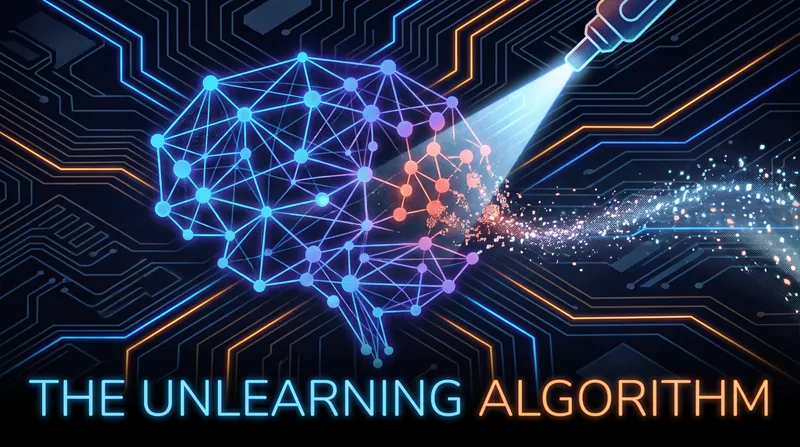
That alternative is a rapidly growing field known as machine unlearning. The discipline focuses on selectively removing the influence of specific training data points from an already trained model, without degrading its overall capabilities or requiring a complete rebuild. It is the algorithmic equivalent of removing a single drop of dye from a swimming pool.[7]
The stakes for mastering this technology are existential for generative AI. Regulators are increasingly demanding that AI companies comply with privacy laws, while publishers are suing over copyright infringement. If developers cannot prove their models can forget specific data, courts and agencies have the power to order the destruction of the models entirely.[5]
The Right to Be Forgotten Meets Billion-Parameter Models
The legal foundation driving this research dates back to 2014, when the European Union introduced the General Data Protection Regulation. Article 17 of the GDPR enshrined the "right to be forgotten," allowing citizens to demand the deletion of their personal data from corporate servers.[11]
At the time, lawmakers envisioned data deletion as a simple database operation—locating a row in a spreadsheet and pressing delete. They did not anticipate the rise of billion-parameter neural networks that internalize data into abstract mathematical weights. Deleting the original file does nothing to remove the knowledge already baked into the model.[8]
The tension between static privacy laws and dynamic AI models has sparked a wave of litigation. High-profile copyright lawsuits, such as the 2023 case brought by The New York Times against OpenAI, center on whether generative models are illegally memorizing and reproducing protected intellectual property.[8]
When companies fail to manage this data properly, regulators are increasingly turning to a severe penalty known as machine disgorgement. The Federal Trade Commission has repeatedly forced companies to destroy algorithms that were trained on improperly acquired data, effectively wiping out millions of dollars of research and development.[5]
To avoid disgorgement, companies must demonstrate that they can surgically excise the offending data. However, retraining a massive language model every time a user submits a deletion request is economically and environmentally impossible. The energy consumption and financial cost of continuous retraining would bankrupt even the largest technology firms.[2]
Consequently, machine unlearning has transitioned from a niche academic curiosity into a critical compliance tool. The International Association of Privacy Professionals notes that reconciling human rights with generative systems will require robust, verifiable unlearning mechanisms that can operate at an industrial scale.[8]
How Machine Unlearning Actually Works
The National Institute of Standards and Technology defines machine unlearning as "a technique that involves selectively removing the influences of specific training data points from a trained machine learning model." Achieving this requires complex mathematical interventions that fall into two broad categories: exact and approximate unlearning.[7]
Exact unlearning methods guarantee that the final model is statistically indistinguishable from one that was trained from scratch on a dataset lacking the forgotten data. This provides absolute certainty for legal compliance, but it is computationally demanding. The canonical framework for exact unlearning is known as SISA training.[11]
Introduced by researchers in 2021, SISA stands for Sharded, Isolated, Sliced, and Aggregated. The strategy reorganizes how models are trained to make future unlearning requests vastly more efficient. It begins by dividing the massive training dataset into multiple disjoint subsets, known as shards.[11]
Each shard is used to train a completely separate sub-model in isolation. Because the sub-models never interact during training, a piece of data located in one shard has absolutely no influence on the models trained on the other shards. This isolation is the key to the framework's efficiency.[11]
Furthermore, the data within each shard is divided into slices. The training process saves a snapshot of the model's parameters before each new slice is introduced. When a deletion request arrives, the system only needs to locate the specific shard and slice containing the data.[6]
The engineers can then revert that specific sub-model to the checkpoint saved just before the unwanted data was ingested, and retrain it only on the remaining slices. If a dataset is divided into ten shards, retraining one sub-model costs roughly one-tenth of what it would cost to retrain a monolithic model.[6]
During inference, the predictions from all the separate sub-models are aggregated to produce a final output. While SISA provides a mathematically rigorous guarantee of unlearning, maintaining multiple sub-models increases the storage and memory requirements, making it difficult to scale for the largest foundation models.[6]
For massive systems, researchers often turn to approximate unlearning. Instead of retraining any part of the model, approximate methods use advanced calculus, such as influence functions, to estimate exactly how much a specific data point shifted the model's parameters during the original training run.[10]
Once the algorithm calculates the mathematical contribution of the unwanted data, it subtracts that value directly from the model's weights. This process effectively undoes the learning in a fraction of the time, but it introduces a margin of error. It is incredibly difficult to prove that every trace of the data has been eradicated.[10]
The Challenge of Catastrophic Forgetting
The fundamental problem with approximate unlearning is that knowledge inside a neural network is not stored in neat, isolated boxes. A large language model builds a dense, interconnected knowledge graph where concepts, facts, and linguistic patterns are deeply entangled with one another.[3]
Removing a single piece of knowledge can cause unintended ripple effects throughout the entire network. If an algorithm aggressively scrubs a specific fact, the model might suffer from catastrophic forgetting—a phenomenon where it abruptly loses related information or experiences a severe degradation in its general reasoning capabilities.[4]
Consider the challenge of unlearning a prominent public figure. If a model is instructed to forget everything about the 44th President of the United States, it must remove his name, his speeches, and his biographical details. But this creates a massive contradiction in the model's internal timeline of American history.[12]
When asked who was president in 2010, the unlearned model might hallucinate a fictitious leader or simply break down, because the surrounding context relies on the missing node. Adjusting the rest of the knowledge graph to resolve these internal contradictions without destroying the model's utility is an unsolved problem.[12]
A 2025 review in Nature Machine Intelligence highlighted that current unlearning methods often result in significant utility loss. While the algorithms successfully prevent the model from reciting the forgotten data verbatim, they frequently damage the model's performance on benign, retained data that was never meant to be erased.[3]
This degradation compounds over time. A model might survive one or two unlearning requests with minimal damage, but processing thousands of sequential deletion requests progressively erodes the network's stability. Eventually, the model becomes so degraded that it must be entirely retrained anyway.[3]
Removing Dangerous Capabilities
While privacy and copyright dominate the legal conversation, the most critical application of machine unlearning lies in artificial intelligence safety. Researchers are actively exploring how to use these techniques to surgically remove dangerous capabilities from open-source foundation models before they are released to the public.[4]
Modern language models ingest vast amounts of scientific literature, which inadvertently includes dual-use knowledge. A model trained on biology textbooks might be capable of providing step-by-step instructions for synthesizing a dangerous pathogen. Unlearning offers a way to scrub this specific hazard without losing the model's general biological expertise.[4]
Similarly, unlearning algorithms are being deployed to remove toxic language, systemic biases, and harmful stereotypes from training data. Rather than relying solely on external filters or safety guardrails that can be bypassed by clever prompting, unlearning attempts to eradicate the harmful concepts from the model's foundational weights.[4]
However, unlearning a broad concept is vastly more difficult than unlearning a specific data point. A copyrighted article is a discrete string of text, but "toxicity" or "bias" are abstract concepts distributed across millions of parameters. Identifying exactly which weights to adjust requires unprecedented interpretability.[11]
This has led to the emergence of specialized subfields like concept editing and knowledge unlearning. These disciplines focus on mapping abstract ideas to specific neural pathways, allowing engineers to dampen a model's ability to generate hate speech without accidentally degrading its ability to discuss historical discrimination.[11]
Why Unlearning Is Harder Than It Sounds
Despite the rapid algorithmic advancements, a significant gap remains between what policymakers believe machine unlearning can achieve and what the technology can actually deliver. A prominent paper from the Stanford Law School RegLab warned that machine unlearning "doesn't do what you think," highlighting the severe limitations of current methods.[9]
The most pressing issue is verification. When a user exercises their right to be forgotten, how can a regulator mathematically verify that the data has actually been removed from the model? Unlike a traditional database, you cannot simply run a search query to prove the data is gone.[9]
Researchers currently rely on familiarity scores and membership inference attacks to test unlearned models. They bombard the model with prompts related to the forgotten data and measure whether the model's responses indicate any lingering memory. However, these tests are probabilistic and cannot guarantee absolute erasure.[6]
Furthermore, poorly executed unlearning can inadvertently introduce privacy leakage. If an unlearning algorithm over-corrects, the model's sudden, unnatural ignorance about a specific topic can actually signal to an attacker that the data was present in the original training set, ironically confirming the existence of the sensitive information.[9]
To address these evaluation shortcomings, researchers have developed comprehensive testing frameworks like MUSE (Machine Unlearning Six-Way Evaluation). These frameworks stress-test unlearning algorithms against scalability, sequential requests, and privacy leakage, revealing that most current methods fail to balance forgetting with model utility.[6]
The field is also grappling with adversarial attacks. Malicious actors can intentionally inject poisoned data into a training set to manipulate the model's behavior. While machine unlearning is proposed as a defense mechanism to remove this poisoned data, attackers are simultaneously developing techniques to make their poisoned data resistant to unlearning.[6]
Ultimately, machine unlearning is not a magic wand that can instantly resolve the tension between massive data collection and individual privacy. It is a complex, fragile, and computationally expensive mitigation strategy that is still in its infancy.[12]
As global legislation continues to demand stricter control over artificial intelligence, the pressure to perfect these algorithms will only intensify. The future of generative AI depends entirely on whether engineers can teach these sprawling neural networks how to reliably and safely forget.[8]
Until that mathematical breakthrough arrives, organizations deploying foundation models must rely on proactive strategies. Data minimization, strict curation, and federated learning remain the most effective ways to ensure that a model never learns what it might eventually be forced to unlearn.[2]
Terms to know
- Machine Unlearning
- A technique that selectively removes the influence of specific training data points from a trained machine learning model without retraining it from scratch.
- Machine Disgorgement
- A regulatory penalty requiring a company to destroy algorithms or AI models trained on improperly acquired data.
- SISA Training
- A framework (Sharded, Isolated, Sliced, and Aggregated) that divides data into subsets to make unlearning faster by only retraining affected portions.
- Catastrophic Forgetting
- A phenomenon where an AI model abruptly loses previously learned information upon learning new data or undergoing an unlearning process.
- Influence Functions
- Mathematical tools used in approximate unlearning to estimate how much a specific data point affected the model's final parameters.
Questions readers ask
Can you just delete the data from the database?
Deleting data from the original database does not remove it from the trained AI model. The model has already internalized the patterns and facts, requiring specialized unlearning algorithms to erase the influence.
Is machine unlearning the same as fine-tuning?
No. Fine-tuning adds new knowledge or adjusts behavior, while machine unlearning specifically aims to mathematically remove the influence of targeted historical training data.
Does unlearning damage the AI's performance?
It can. Removing deeply embedded concepts can cause 'catastrophic forgetting,' where the model loses related knowledge or suffers a general degradation in its reasoning capabilities.
How do regulators know if a model has forgotten something?
Verification remains a major challenge. Researchers use familiarity scores and cryptographic proofs, but proving absolute erasure without retraining from scratch is still an unsolved mathematical problem.
Different angles
Privacy and Compliance Advocates
Focus on exact unlearning and strict adherence to regulations like GDPR.
Privacy advocates argue that approximate unlearning methods are insufficient for legal compliance. They maintain that if a user requests the deletion of their personal data under frameworks like the GDPR, the model must be mathematically guaranteed to retain no trace of that information. This camp pushes for the widespread adoption of exact unlearning frameworks like SISA, despite the increased computational overhead, arguing that the fundamental right to privacy supersedes the AI industry's desire for operational efficiency.
AI Researchers and Engineers
Focus on approximate methods, computational efficiency, and maintaining model utility.
The engineering community emphasizes the practical impossibility of retraining massive foundation models for every deletion request. They argue that approximate unlearning, utilizing influence functions and weight perturbations, is the only sustainable path forward. This perspective highlights the severe risk of catastrophic forgetting, warning that overly aggressive exact unlearning can destroy a model's utility and degrade its performance on benign tasks. They advocate for a pragmatic balance between forgetting specific data and preserving the network's overall reasoning capabilities.
Legal and Policy Scholars
Focus on the gap between technical capabilities and regulatory expectations, emphasizing machine disgorgement.
Legal scholars point out a dangerous disconnect between the laws being written and the algorithms being deployed. They warn that policymakers often treat machine unlearning as a simple database deletion, failing to grasp the complexities of neural entanglement. This camp focuses heavily on the threat of machine disgorgement, noting that if courts and agencies like the FTC are not satisfied with approximate unlearning proofs, they will increasingly order the complete destruction of valuable AI models, fundamentally altering the economics of generative AI.
What changed
- · Revision 1Published.
- AI Researchers
- Focus on approximate methods, computational efficiency, and maintaining model utility.
- Privacy Advocates
- Focus on exact unlearning and strict adherence to regulations like GDPR.
- Legal Scholars
- Focus on the gap between technical capabilities and regulatory expectations, emphasizing machine disgorgement.
Perspectives this story doesn't cover
- Data Labelers
- Copyright Holders
Sources
Source coverage
12 outlets
3 viewpoints surfaced












- [1]Wired
Now That Machines Can Learn, Can They Unlearn?
Read on Wired → - [2]Communications of the ACMAI Researchers
Can AI Learn to Forget?
Read on Communications of the ACM → - [3]Nature Machine IntelligenceAI Researchers
Rethinking machine unlearning for large language models
Read on Nature Machine Intelligence → - [4]Science and Engineering EthicsPrivacy Advocates
Supporting Trustworthy AI Through Machine Unlearning
Read on Science and Engineering Ethics → - [5]Proceedings of the National Academy of SciencesLegal Scholars
AI model disgorgement: Methods and choices
Read on Proceedings of the National Academy of Sciences → - [6]ACM Computing SurveysAI Researchers
Machine Unlearning: A Survey
Read on ACM Computing Surveys → - [7]National Institute of Standards and Technology
machine unlearning - Glossary
Read on National Institute of Standards and Technology → - [8]International Association of Privacy ProfessionalsPrivacy Advocates
The AI right to unlearn: Reconciling human rights with generative systems
Read on International Association of Privacy Professionals → - [9]Stanford Law School RegLabLegal Scholars
Machine Unlearning Doesn't Do What You Think: Lessons for Generative AI Policy and Research
Read on Stanford Law School RegLab → - [10]IEEEAI Researchers
Towards Making Systems Forget with Machine Unlearning
Read on IEEE → - [11]Wikipedia
Machine unlearning
Read on Wikipedia → - [12]Factlen Editorial Team
Synthesis by Factlen editorial team
Read on Factlen Editorial Team →
More in Artificial Intelligence
See all →Machine Unlearning
How to Make an AI Forget: The Breakthrough Science of Machine Unlearning
3 sources
Algorithmic Auditing
How Adversarial Scaffolding Hides Biased AI Decisions Behind Clean Audits
6 sources

AI Accountability
The Moral Crumple Zone: Why Human Operators Absorb Blame for AI Errors
4 sources

AI Watermarking
How Invisible AI Watermarks Actually Work: Inside the Push to Tag Synthetic Text
5 sources

Comments
Every angle. Every day.
Get Artificial Intelligence stories with full source coverage and perspective breakdowns, free every day.