
US Regulator Urges Community Banks to Issue Stablecoins Ahead of 2027 Deadline
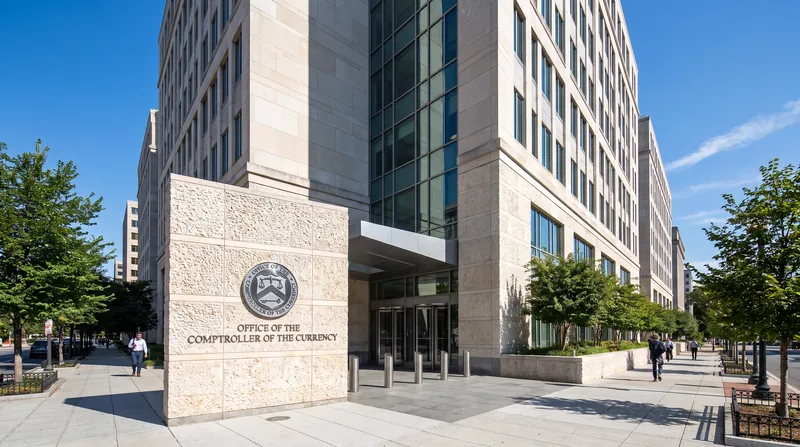
The Office of the Comptroller of the Currency is pushing small lenders to enter the payment stablecoin market before new federal rules take effect in January 2027. The initiative aims to keep traditional banks relevant in digital payments while addressing industry fears of deposit flight.
By Bo Feng

Share this story
The US Office of the Comptroller of the Currency (OCC) is actively encouraging community banks to begin issuing payment stablecoins, directing small lenders toward a newly finalized federal licensing framework.[1][2]
The regulatory push comes just months before the Guiding and Establishing National Innovation for U.S. Stablecoins (GENIUS) Act takes effect on January 18, 2027. After that date, issuing a dollar-pegged token without formal approval will carry criminal penalties.[1][2]
The OCC finalized its stablecoin rules on October 21, 2026, translating the GENIUS Act into a supervisory structure for bank subsidiaries and approved nonbank issuers. In a public appeal on October 26, the agency urged community banks to apply for permitted payment stablecoin issuer status.[1][2]
"The OCC wants community banks to help shape the future of payments and is encouraging the development of payment stablecoin capabilities within the community banking sector," the regulator stated.[2]
For insured national banks and federal savings associations, the finalized rules require stablecoin issuance to occur through a dedicated subsidiary rather than directly from the bank itself.[1][5]
The framework mandates that reserve assets consist exclusively of approved holdings, such as Treasury securities and demand deposits. The OCC stressed that these bank-issued tokens will not carry federal deposit insurance, a fact issuers must clearly disclose to consumers.[1][5]
Addressing Deposit Flight Concerns
The regulatory invitation arrives as banking advocacy groups warn that the rise of yield-bearing stablecoins could drain deposits from traditional financial institutions.[1][3]
If customers move their cash into digital tokens, community lenders could lose the core funding they rely on to issue local loans. The OCC acknowledged these fears in an accompanying fact sheet, noting that the effect of stablecoin adoption on community bank deposits remains uncertain.[1][5]
To mitigate the risk of deposit flight, the GENIUS Act and the OCC's final rule explicitly permit bank deposits to serve as reserve assets backing payment stablecoins.[1][5]
This provision ensures that even as money moves into digital tokens, a portion of those funds can remain within the traditional banking system. The agency noted it takes community banks' funding concerns seriously and is closely monitoring potential deposit outflows.[1][5]
The finalized framework also protects traditional banks by prohibiting stablecoin issuers from paying interest or yield directly to token holders. By preventing digital assets from competing directly with savings accounts on yield, the regulator aims to preserve the utility of standard bank deposits.[2][5]
However, the OCC left an opening for cryptocurrency platforms to offer stablecoin rewards. Third-party reward programs will be evaluated on a case-by-case basis to ensure they do not evade the statutory ban.[2][5]
The January 2027 Deadline
The January 18, 2027, enforcement date creates a tight window for both prospective and existing stablecoin operators. While the OCC has finalized the rules, it has not yet opened the application portal, pending approval of its information collection forms.[1]
Once the portal opens, the agency expects to notify applicants within 30 days if their submission is substantially complete. The regulator will then issue a final decision within 120 days.[1]
For companies already issuing stablecoins in the US, the GENIUS Act does not include a built-in transition period. To prevent market disruption, the OCC plans to offer temporary waivers for existing issuers that submit a substantially complete application before the January deadline.[1][3]
Prospective issuers, including community banks entering the market for the first time, will generally need full approval before they can begin operations.[1][3]
The regulatory burden for approved issuers will mirror traditional bank examinations, establishing standards for reserves, redemption, custody, and risk management. The agency will take a risk-based approach to supervision, maintaining authorities that expressly address financial stability and contagion risks.[2][5]
Comptroller of the Currency Jonathan V. Gould stated that the rule continues a tradition begun when the regulator was created in 1863 to guide the creation of a national currency and banking system.[2]
A Shift in the Crypto Landscape
If community banks heed the OCC's call, their entry could fundamentally alter a stablecoin market currently dominated by specialized cryptocurrency firms.[2]
A wave of bank-affiliated tokens would introduce heavily regulated, traditional financial players into a sector that has historically operated outside standard banking oversight. Gould noted that the framework allows stablecoins to achieve their potential while furthering dollar dominance.[2]
The push for community bank participation occurs against a backdrop of existing legal tension between small lenders and the regulator. The Independent Community Bankers of America recently filed a lawsuit accusing the OCC of exceeding its authority by granting national trust-bank charters to crypto firms.[3]
The banking group argues that digital asset companies bypass the stringent capital and liquidity requirements imposed on traditional banks, creating an uneven playing field.[3]
The OCC's approach to digital assets has also drawn political scrutiny. Senator Elizabeth Warren recently asked the agency to explain its rationale for granting charters to nine crypto-focused institutions.[3]
By explicitly inviting community banks into the stablecoin sector, the OCC is attempting to bridge the gap between traditional finance and digital assets, bringing the technology firmly under federal supervision.[1][2]
Key points
- The OCC is urging community banks to apply for permitted payment stablecoin issuer status before January 18, 2027.
- Issuing a dollar-pegged token without formal regulatory approval will carry criminal penalties once the GENIUS Act takes effect.
- The finalized rules prohibit stablecoin issuers from paying interest directly to token holders, protecting traditional bank deposits.
- Bank-issued stablecoins will not carry federal deposit insurance, and issuers must clearly disclose this to consumers.
What we don’t know
- It remains unclear how many community banks will actually apply to issue stablecoins given the high costs of regulatory compliance.
- The exact impact of stablecoin adoption on traditional bank deposit levels is still unknown, as historical data is limited.
How we got here
July 2025
The Guiding and Establishing National Innovation for U.S. Stablecoins (GENIUS) Act is enacted.
October 21, 2026
The OCC finalizes its rules translating the GENIUS Act into a supervisory framework.
October 26, 2026
The OCC publicly encourages community banks to develop payment stablecoin capabilities.
January 18, 2027
The GENIUS Act takes effect, requiring formal approval for all US stablecoin issuers.
- Federal Regulators
- Advocate for bringing stablecoin issuance under strict federal banking supervision to ensure stability.
- Community Banks
- Concerned about deposit flight and the unequal regulatory burden compared to crypto-native firms.
- Crypto Industry
- Focused on meeting the new compliance deadlines and securing waivers to continue operations.
Perspectives this story doesn't cover
- Consumer protection advocates
- Large multinational banks
Sources
Source coverage
5 outlets
3 viewpoints surfaced





- [1]The DefiantCrypto Industry
OCC Encourages Community Banks to Become Stablecoin Issuers
Read on The Defiant → - [2]PYMNTSFederal Regulators
OCC Encourages Community Banks to Consider Developing Payment Stablecoin Capabilities
Read on PYMNTS → - [3]Crypto BriefingCommunity Banks
OCC urges US community banks to become stablecoin issuers before January 2027 deadline
Read on Crypto Briefing → - [4]The Crypto TimesCrypto Industry
OCC Seeks Community Banks to Expand Regulated Stablecoin Issuance
Read on The Crypto Times → - [5]Office of the Comptroller of the CurrencyFederal Regulators
FACT SHEET: GENIUS ACT–COMMUNITY BANKS: CONCERNS AND RESPONSES
Read on Office of the Comptroller of the Currency →
More in Finance
See all →Stablecoin Regulation
HSBC Deploys Proprietary Stablecoin to 3.3 Million Retail Banking Users in Hong Kong
5 sources

Capital Requirements
UBS Prepares Up to 12,000 Swiss Job Cuts as Stricter Capital Mandates Prompt Relocation Threats
5 sources

Cloud Regulation
UK Regulators Question Google Over Cloud Outage That Disrupted Major Banks
5 sources

Capital Regulation
Bank of England Investigates Barclays Over Private Credit Capital Rules
7 sources

Comments
Every angle. Every day.
Get Finance stories with full source coverage and perspective breakdowns, free every day.