
The Seeded Bracket: How the Champions League's New Tennis-Style Knockout Phase Actually Works
UEFA's expanded Champions League format replaces the traditional open draw with a predetermined, tennis-style knockout bracket. Here is how the new seeding system mathematically restricts matchups and charts a direct path to the final.
By Jackson Reed

Share this story
In short
- The Champions League has replaced its open knockout draws with a predetermined, tennis-style bracket.
- Teams finishing 9th through 24th enter a playoff round, where seeded clubs face a binary choice of just two possible opponents.
- The top eight teams from the league phase receive a bye directly to the Round of 16.
Thirty-six teams enter, but the math of survival has fundamentally changed. Under the Champions League’s previous format, a group winner advancing to the Round of 16 stared down a pool of up to seven possible opponents. Today, that sprawling lottery has been replaced by a rigid, tennis-style bracket that cuts the initial draw randomness by more than 70 percent. The shift marks the most significant structural overhaul in European club soccer in two decades, abandoning the open draws that defined the spring knockout rounds in favor of a predetermined pathway.[2][4]
UEFA president Aleksander Čeferin defended the new model as a necessary evolution for the continent's premier competition. "UEFA has clearly shown that we are fully committed to respecting the fundamental values of sport and to defending the key principle of open competitions, with qualification based on sporting merit, fully in line with the values and solidarity-based European sports model," Čeferin stated following the format's approval. That sporting merit now translates directly into structural protection.
To understand the stakes, look at the 16-team playoff round that now bridges the league phase and the Round of 16. Teams finishing ninth through 16th are seeded, while those finishing 17th through 24th are unseeded. But they are not thrown into a single, chaotic bowl.
Instead, the bracket is split into four distinct sections. A seeded team—say, the club that finishes ninth—is locked into a specific quadrant. When the draw is made, that ninth-place team will only draw one of two specific unseeded opponents, such as the 23rd or 24th-place finishers.[2][4]
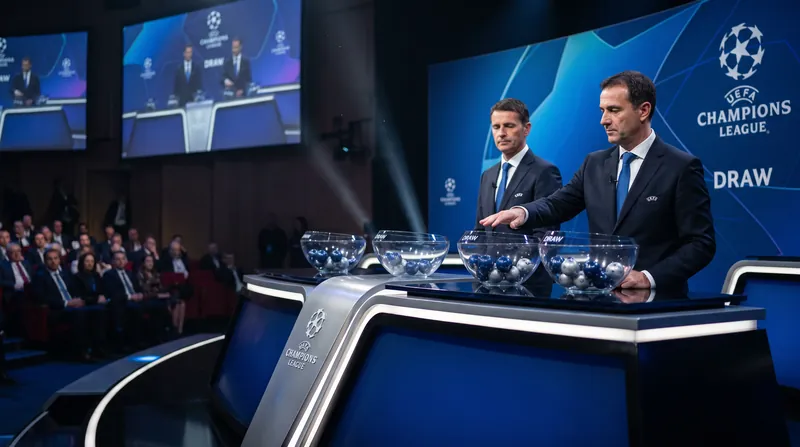
The mechanics of the draw itself have also been modernized to handle the complex constraints. Because a manual draw for the 36-team league phase and the subsequent bracket would take hours and require hundreds of balls, UEFA transitioned to a software-driven system. The computer instantly calculates the valid permutations, ensuring that the binary pairings in the playoff round—such as the 11th and 12th seeds facing the 21st and 22nd seeds—are assigned without violating any remaining country-protection rules.[1][4]
This binary choice eliminates the wild swings of fortune that used to define the February ties. During the 2023–24 season, a group winner like Real Madrid or Manchester City could draw almost any runner-up from across the continent, provided they did not share a domestic league or a qualifying group.
Now, the path is charted in advance. The top eight teams from the league phase bypass the playoff round entirely, earning a bye directly to the Round of 16. When they arrive, they step into a bracket that has already been mapped out.[2][6]
The top two seeds—the clubs that finish first and second in the 36-team league phase—are placed on opposite sides of the draw. They cannot meet until the final in Munich. The third and fourth seeds are similarly split, ensuring that the absolute best performers are shielded from early collisions. This structure mirrors the Grand Slam tennis tournaments, where a top seed like Novak Djokovic or Carlos Alcaraz knows their exact route to the final before the first serve.[1][2]
For soccer managers, this predictability is a tactical goldmine. A coaching staff can now look at the bracket in January and begin scouting a maximum of two potential opponents for the playoff round, rather than spreading their analytical resources across half a dozen possibilities. The stakes of the league phase are consequently massive. Finishing eighth instead of ninth is no longer just a matter of pride; it is the difference between a guaranteed Round of 16 berth and a grueling two-legged playoff in February.[5]
Furthermore, the country-protection rule—which previously prevented clubs from the same domestic league from meeting before the quarter-finals—has been adapted to fit the new reality. While the software still prevents domestic clashes in the playoff round, the predetermined bracket means that the quarter-final and semi-final matchups are locked in from the moment the Round of 16 draw concludes. There are no more quarter-final draws. There are no more semi-final draws. The route to the trophy is a single, unbroken line.[1][4]
The new bracket also removes the traditional safety net that defined the group stage era. Previously, teams that finished third in their Champions League groups dropped down into the Europa League knockout rounds. Under the 36-team single standings format, that parachute is gone. Teams that finish 25th through 36th are eliminated from European competition entirely, meaning the battle for the 24th spot—the final entry into the playoff bracket—carries season-defining weight for mid-tier clubs.[1]
The new bracket also removes the traditional safety net that defined the group stage era.
The financial implications of this certainty are equally profound. Clubs that secure a top-eight finish can budget for a guaranteed Round of 16 appearance, knowing exactly which side of the bracket they occupy and which heavyweight rivals they will avoid. As the season progresses, the race for those top seeds will dictate not just who survives the winter, but who holds the mathematical high ground when the tournament reaches its climax in May.[2][3]
Key terms
- League Phase
- The 36-team single standings table that replaces the traditional 32-team group stage.
- Knockout Playoff Round
- A two-legged tie for teams finishing 9th through 24th to determine who advances to the Round of 16.
- Seeded Team
- A club that earns a structural advantage—such as playing the second leg at home—based on their higher finish in the league phase.
- Predetermined Bracket
- A tournament tree where future matchups are mathematically locked in based on initial seedings, eliminating the need for subsequent draws.
- Country Protection
- A rule preventing clubs from the same domestic league from being drawn against each other in the early stages of the tournament.
Frequently asked
Do the top eight teams have to play in the playoff round?
No. The clubs that finish first through eighth in the league phase receive a bye directly to the Round of 16.
Are there still draws for the quarter-finals and semi-finals?
No. Once the Round of 16 bracket is set, the exact path to the final is predetermined, with draws only used to decide which team plays at home first.
Can teams from the same country play each other in the knockout phase?
Yes. While country protection applies in the league phase and the initial playoff round, clubs from the same domestic league can meet from the Round of 16 onward.
Do eliminated teams drop into the Europa League?
No. The safety net has been removed. Teams that finish 25th through 36th in the league phase are eliminated from European competition entirely.
Viewpoints in depth
Tactical Analysts
Value the predictability of the bracket for advanced scouting and preparation.
For coaching staffs and data departments, the predetermined bracket is a massive structural advantage. Under the old system, a team advancing to the Round of 16 had to prepare preliminary scouting reports on up to seven potential opponents before the draw was made. Now, a seeded team in the playoff round knows they will face exactly one of two specific unseeded clubs. This allows analysts to concentrate their resources, build deeper tactical profiles, and begin preparing for specific matchups weeks in advance.
Traditionalists
Argue that the elimination of round-by-round open draws removes the suspense and magic of the knockout phase.
The Champions League quarter-final and semi-final draws were once standalone television events, generating massive anticipation as the continent's heavyweights were pulled from the bowls in real-time. Traditionalists argue that mapping out the entire bracket in February strips the tournament of this inherent drama. By locking in the pathways early, the competition loses the chaotic, unpredictable collisions that often defined the spring calendar, replacing spectacle with mathematical efficiency.
Club Executives
Prioritize the logistical certainty and guaranteed revenue of a mapped-out spring campaign.
For the front offices of Europe's elite clubs, the predetermined bracket offers unparalleled logistical and financial stability. Knowing exactly which side of the draw a team occupies allows executives to project ticketing revenue, secure travel arrangements, and forecast commercial opportunities with far greater accuracy. The elimination of the Europa League safety net also forces clubs to invest heavily in their Champions League squads, as the financial penalty for finishing outside the top 24 is now absolute.
- Tactical Analysts
- Value the predictability of the bracket for advanced scouting and preparation.
- Traditionalists
- Argue that the elimination of round-by-round open draws removes the suspense and magic of the knockout phase.
- Club Executives
- Prioritize the logistical certainty and guaranteed revenue of a mapped-out spring campaign.
Perspectives this story doesn't cover
- Broadcasters who lose the programming inventory of dedicated quarter-final and semi-final draw ceremonies.
- Mid-tier clubs that rely on the Europa League drop-down mechanism for sustained continental revenue.
Sources
Source coverage
6 outlets
3 viewpoints surfaced





- [1]UEFAClub Executives
New format for Champions League post-2024: Everything you need to know
Read on UEFA → - [2]WikipediaTraditionalists
2024–25 UEFA Champions League
Read on Wikipedia → - [3]Olympics.comClub Executives
Football: 2024/25 UEFA Champions League knockout phase play-offs - All teams, ties, and match schedule following the draw
Read on Olympics.com → - [4]beIN SPORTSClub Executives
Champions League Playoff Draw: Date, Time, and Format
Read on beIN SPORTS → - [5]Factlen Editorial TeamTactical Analysts
Synthesis by Factlen editorial team
Read on Factlen Editorial Team → - [6]WikipediaTraditionalists
2023–24 UEFA Champions League
Read on Wikipedia →

More in Sports
See all →Football Finance
The 10% National TV Rights Split and the Two Proportionality Factors: How the Champions League Market Pool is Calculated
5 sources

Champions League Records
Erling Haaland Reaches 59 Champions League Goals in 59 Games, Closing in on Lionel Messi's Age Record
6 sources

Coefficient Rules
The 20% Association Floor and the Five-Year Rolling Average: How the UEFA Club Coefficient Actually Works
7 sources
Como 1907
The Relational Engine: How Cesc Fàbregas Engineered Como 1907's Historic Champions League Debut
6 sources

Comments
Every angle. Every day.
Get Sports stories with full source coverage and perspective breakdowns, free every day.