
Brewing Chemistry: How French Press, Pour-Over, and Espresso Alter Extraction and Health
How you brew your morning coffee fundamentally alters its chemical makeup, changing not just the flavor in your cup, but its impact on your cholesterol, energy levels, and mineral intake.
By Irina Belova

Share this story
The morning ritual is deeply sensory: the smell of roasted beans, the warmth of the ceramic mug, the quiet anticipation of the first sip. But before that liquid ever touches your palate, the device sitting on your kitchen counter has already made a series of invisible chemical decisions for your body. The difference between a French press, a pour-over, and an espresso is not just a matter of aesthetics or morning convenience; it is a matter of fundamental extraction chemistry.[6]
When hot water meets ground coffee, it acts as a solvent, pulling hundreds of distinct compounds out of the roasted seed and into your cup. This process, known as extraction, is governed by time, temperature, turbulence, and the physical barrier separating the grounds from the final liquid. How a brewing method manipulates these variables dictates the entire profile of the beverage.[3]
The compounds that make up coffee do not all extract at the same rate. Bright, fruity acids dissolve almost instantly, followed by the Maillard-derived sugars that provide sweetness, and finally, the heavier, bitter plant fibers and oils. How a brewing method navigates this timeline determines everything from the mouthfeel of the beverage to its physiological effects on your cardiovascular system.[1][3]
Consider the French press, a classic immersion brewer. In this method, coarse coffee grounds steep freely in hot water for several minutes before a metal mesh screen plunges them to the bottom. Because the water and coffee are in constant, static contact, the extraction is slow and even, producing a brew with a heavy, velvet weight that coats the tongue.
That signature heavy body comes with a specific chemical payload. The metal mesh of a French press allows microscopic coffee particles, known as fines, and natural coffee oils to pass freely into the cup. These oils contain high concentrations of diterpenes—specifically cafestol and kahweol—which are potent lipid-raising compounds naturally present in the coffee bean.
For individuals monitoring their cardiovascular health, this is a crucial detail. Regular consumption of unfiltered coffee like French press has been shown to measurably increase LDL cholesterol levels due to these diterpenes. However, this same unfiltered process also retains higher levels of beneficial minerals, such as calcium and potassium, making it a complex trade-off for the drinker.[4]
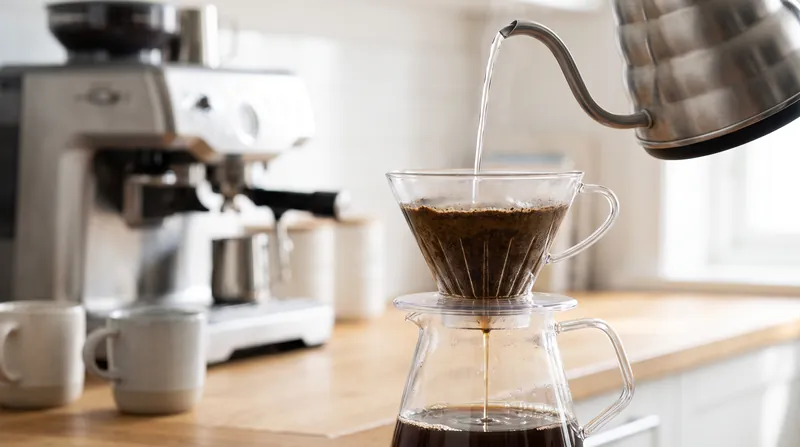
Contrast this with the pour-over method, a percolation technique where water is continuously poured over a bed of grounds housed in a paper filter. Gravity pulls the water through the coffee, constantly introducing fresh solvent to the grounds, which makes the extraction highly efficient and dynamic.
The defining feature of the pour-over is the paper filter itself. Paper acts as a highly effective chemical trap, catching the fines and absorbing the vast majority of the diterpene-rich oils before they can reach your mug. The result is a cup with brilliant flavor clarity, allowing the delicate, tea-like floral and fruit notes of the coffee to shine without the muddying effect of suspended solids.
From a health perspective, the pour-over is the cleanest option for your heart. Because the cafestol and kahweol are left behind in the paper, filtered coffee has virtually no impact on LDL cholesterol levels, making it the preferred daily brewing method for those with lipid concerns who still want to enjoy their morning ritual.
Then there is espresso, a method defined by violent, rapid extraction. Instead of relying on gravity or passive steeping, an espresso machine forces water heated to near-boiling through a tightly packed puck of finely ground coffee at nine bars of atmospheric pressure. The entire process takes roughly thirty seconds.[5]
This intense pressure fundamentally alters the physics of the brew. It emulsifies the coffee oils, trapping tiny bubbles of carbon dioxide to create the thick, golden foam known as crema. The role of microscopic coffee fines is critical here; they migrate through the puck during extraction, creating localized resistance that dictates the flow of water and the ultimate concentration of the shot.[5]
Because espresso uses a metal basket, it does allow diterpenes into the final beverage, placing it somewhere between a pour-over and a French press on the cholesterol-impact scale. However, because espresso is consumed in such small volumes—typically one to two ounces—the total load of cafestol per serving remains relatively low compared to a large mug of French press.
When it comes to the morning energy boost, the brewing method also dictates the caffeine payload. While espresso is highly concentrated, packing a massive amount of caffeine per ounce, a standard serving is quite small. Studies measuring the total caffeine kick per typical serving size have found that a standard mug of filtered or immersion coffee often delivers a higher total dose of caffeine than a single shot of espresso, simply due to the volume of water used to extract it.[2]
Ultimately, the ideal brewing method is a matter of aligning your sensory desires with your physiological needs. If you crave a rich, heavy mouthfeel and are unconcerned with cholesterol, the French press offers a robust, mineral-rich experience. If you prioritize flavor clarity and cardiovascular health, the paper-filtered pour-over is unmatched.[4]
And if you seek intense concentration, complex aromatics, and the unique textural experience of crema, the pressurized extraction of espresso remains a marvel of culinary physics. By understanding the chemistry happening on your countertop, you can stop leaving your morning ritual to chance and start brewing with intention.[5][6]
Analysis by camp
Cardiovascular Health Advocates
This perspective views coffee primarily through the lens of long-term lipid management and heart health.
For health professionals and consumers focused on cardiovascular longevity, the brewing method is just as important as the bean itself. Because the diterpenes cafestol and kahweol are known to elevate LDL cholesterol, this camp strongly advocates for paper-filtered methods like the pour-over or standard drip machines. They view the paper filter as a necessary health intervention that strips the coffee of its potentially harmful oils while leaving the beneficial antioxidants and caffeine intact, allowing for daily consumption without cardiovascular risk.
Sensory Traditionalists
This camp prioritizes the tactile and flavor experience of a full-bodied, unfiltered cup.
Sensory traditionalists argue that filtering coffee through paper strips the beverage of its soul. They favor the French press and other metal-filtered immersion methods because these techniques allow the natural oils and microscopic fines to remain in the cup. This creates a viscous, heavy mouthfeel and a lingering finish that paper filters simply cannot replicate. For this group, the retention of natural minerals and the robust flavor profile outweigh the potential cholesterol impacts, framing coffee as a whole-food experience rather than a refined extract.
Extraction Technicians
This perspective treats coffee brewing as an exercise in physics, precision, and fluid dynamics.
Extraction technicians—often professional baristas and coffee scientists—focus heavily on the mechanics of espresso. They study how microscopic fines migrate through a puck of coffee under nine bars of pressure, creating the necessary resistance to extract a balanced shot in exactly thirty seconds. For this camp, the goal is maximizing the concentration of desirable flavors while perfectly emulsifying the oils into crema. They view brewing not just as a morning routine, but as a highly controlled scientific process where tiny adjustments in grind size and pressure yield dramatically different chemical results.
- Cardiovascular Health Advocates
- Prioritize brewing methods that filter out lipid-raising compounds to protect heart health.
- Extraction Technicians
- Focus on the physics and precision of brewing, particularly the role of pressure and fines in maximizing concentration.
- Sensory Traditionalists
- Value the heavy mouthfeel, rich oils, and full-bodied flavor profile provided by unfiltered immersion brewing.
Sources
Source coverage
6 outlets
3 viewpoints surfaced





- [1]PMCExtraction Technicians
Influence of Brewing Methods on the Bioactive and Mineral Composition of Coffee Beverages
Read on PMC → - [2]University of Newcastle
Study reveals which cup of coffee delivers the biggest caffeine kick
Read on University of Newcastle → - [3]ResearchGateExtraction Technicians
How Different Traditional and Modern Coffee Brewing Methods Affect Its Aroma, Chemistry, Health Effects and Safety Attributes?—A Comprehensive Review to Maximize Coffee Brew Quality
Read on ResearchGate → - [4]MDPISensory Traditionalists
Mineral Composition and Antioxidant Potential of Coffee Beverages Depending on the Brewing Method
Read on MDPI → - [5]PMCExtraction Technicians
The role of fines in espresso extraction dynamics
Read on PMC → - [6]Factlen Editorial Team
Synthesis by Factlen editorial team
Read on Factlen Editorial Team →

More in Lifestyle
See all →Coffee Market
Specialty Coffee Consumption Hits Record High, Surpassing Traditional Coffee in the U.S.
4 sources

Coffee Science
150 ppm Total Dissolved Solids: How Water's Mineral Content Dictates Coffee Extraction and Equipment Scale
6 sources
Coffee Chemistry
195°F to 205°F: How Water Temperature Controls the Dissolution of Acids, Sugars, and Melanoidins in Coffee Extraction
5 sources

Coffee Science
The 2.5% vs. 4.5% Caffeine Content: How Arabica and Robusta Differ in Flavor, Growing Conditions, and Cost
5 sources
Comments
Every angle. Every day.
Get Lifestyle stories with full source coverage and perspective breakdowns, free every day.