
The Hygroscopic Tug-of-War: How Sucrose Steals Water from Gluten to Build a Tender Cake
Sugar does far more than sweeten a batter; it acts as a microscopic sponge that aggressively binds to water. By starving flour of the moisture it needs to form tough gluten networks, sucrose guarantees a soft, long-lasting crumb.
By Baran Demir

Share this story
In short
- Sugar acts as a hygroscopic agent, aggressively binding to water in a cake batter.
- By hoarding water, sucrose prevents gluten proteins from forming tough, chewy networks.
- Sugar delays the temperature at which starches gelatinize, giving the cake more time to rise in the oven.
Sugar keeps a cake moist by acting as a microscopic sponge that aggressively hoards water, starving the flour of the moisture it needs to build tough, elastic networks. By locking up this hydration during the bake, sucrose prevents starches from swelling too early and stops gluten from forming rigid webs, leaving the final crumb tender and soft.[4][9]
When you slice into a perfectly baked Victoria sponge or a rich devil's food cake, the knife glides through a structure that feels impossibly delicate. That melt-in-the-mouth texture is not an accident of the oven timer; it is the result of a high-stakes chemical competition happening at 350 degrees Fahrenheit.[9]
Inside the mixing bowl, three primary ingredients fight for a limited supply of liquid. Wheat flour brings starch and gluten-forming proteins to the arena, while sucrose—standard granulated sugar—enters as the ultimate disruptor.[6]
Sucrose is highly hygroscopic, meaning it attracts and binds water molecules with intense chemical affinity. According to a 2026 technical breakdown by the Puratos Bakery Academy, this water-binding capacity is one of the seven key functions sugar performs beyond simply adding sweetness, fundamentally dictating the architecture of the crumb.[4]
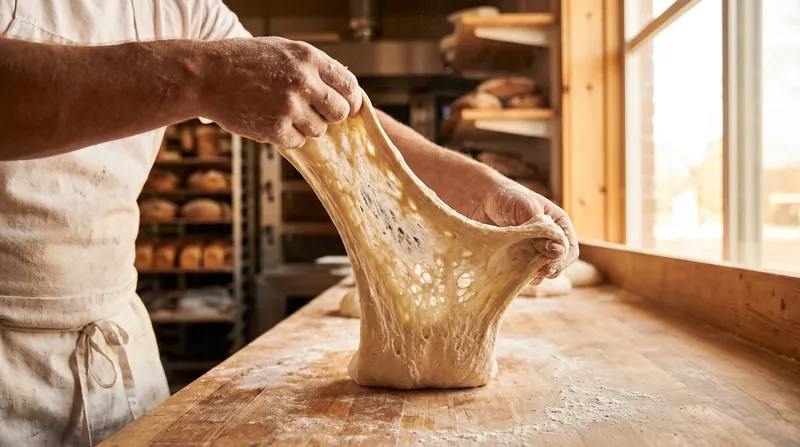
When water hits wheat flour, two proteins called glutenin and gliadin immediately attempt to link up and form gluten. This elastic network is essential for the chewy structure of a sourdough loaf, but it is the exact opposite of what a baker wants in a tender cake.[6][9]
"Sugar has a tenderising effect on cakes," notes a 2010 breakdown published by The Guardian. "It dissolves in the water in the batter, which means there is less water available for the flour to absorb."[7]
Because sucrose dissolves instantly and binds to the available liquid, it leaves the gluten proteins physically parched. Without sufficient free water, the gluten network cannot fully develop, which is why high-sugar batters bake into delicate crumbs rather than chewy breads.[5][7]
The second battle occurs between sugar and starch. As the batter heats up in the oven, starch granules want to absorb water, swell, and burst—a process called gelatinization that gives the cake its final solid structure.[8]
A 2021 study published in Starch - Stärke mapped this exact competition, demonstrating how sucrose restricts the water available to starch granules during heating. The sugar effectively holds the water hostage, forcing the starch to wait as the internal temperature of the cake climbs.[3]
By restricting water access, sucrose delays the temperature at which the starch gelatinizes. A 2022 analysis in the Journal of Food Science found that increasing sucrose concentrations significantly pushes back the pasting and retrogradation points of wheat starch, altering the entire timeline of the bake.[8]
Pushing the gelatinization temperature higher gives the cake batter more time to expand in the oven before the structure sets rigid. The leavening agents produce carbon dioxide bubbles for a longer period, resulting in a lighter, taller, and more aerated final product.[1][9]
Once the cake comes out of the oven, sugar's water-binding affinity continues to work. The sucrose molecules hold onto the moisture tightly, preventing it from evaporating into the air as the pastry cools on the rack.[5]
This is why a high-ratio cake—where the sugar weight exceeds the flour weight, often hitting 120% to 140%—can sit on a kitchen counter for three days without turning into a crouton. The Sugar Association's 2026 industry brief highlights this moisture retention as the primary driver of commercial bakery shelf life.[5]
The modern push to reduce dietary sugar often leads bakers to cut sucrose from their recipes by 25% or more. But as a 2023 paper in Food Hydrocolloids bluntly notes, sucrose substitution in cake systems is "not a piece of cake."[2]
When sugar is removed, the water it previously held is suddenly freed. The gluten proteins drink it up and form tough, rubbery webs, while the starches gelatinize too early in the oven, halting the cake's rise and resulting in a dense, gummy puck.[2][6]
To successfully reduce sugar, food scientists must replace its structural functions, not just its sweetness. As detailed in a 2020 review in Taylor & Francis, this requires carefully calibrated combinations of hydrocolloids, alternative bulking agents, and emulsifiers to mimic the exact water-binding choreography that sucrose performs naturally.[1]
Key terms
- Hygroscopy
- The ability of a substance, like sugar, to attract and hold water molecules from its surrounding environment.
- Gelatinization
- The process where starch granules absorb water, swell, and burst when heated, giving baked goods their solid structure.
- Glutenin and Gliadin
- The two proteins found in wheat flour that combine in the presence of water to form the elastic network known as gluten.
- High-ratio cake
- A baking formula where the total weight of the sugar is greater than the total weight of the flour.
- Retrogradation
- The process where gelatinized starches realign and expel water as they cool and age, causing baked goods to turn stale.
Frequently asked
Can I just cut the sugar in half to make a cake healthier?
No. Cutting sugar drastically frees up water in the batter, which activates gluten and causes starches to set too early, resulting in a dense, rubbery cake.
Does liquid sugar work the same way as granulated sugar?
Liquid sugars like honey or syrup also bind water, but they introduce additional moisture to the batter, requiring adjustments to the recipe's dry ingredients to maintain structure.
What is a high-ratio cake?
A high-ratio cake is a formula where the weight of the sugar equals or exceeds the weight of the flour, typically requiring special emulsified shortenings to hold the extra liquid.
Why does my low-sugar cake go stale so quickly?
Sugar retains moisture after baking by holding onto water molecules. Without enough sugar, that water evaporates rapidly into the air, leaving the crumb dry and stale.
Viewpoints in depth
The Structural Chemists' View
Food scientists view sugar as a functional building block that must be chemically replaced if removed.
For reformulators and food chemists, the sweetness of sucrose is almost secondary to its mechanical properties. When tasked with creating low-sugar baked goods, these scientists rely on complex matrices of hydrocolloids, gums, and alternative bulking fibers to mimic sugar's water-binding capacity. They argue that without these precise chemical substitutions, a reduced-sugar cake will inevitably suffer from premature starch gelatinization and aggressive gluten development, ruining the texture.
The Traditional Bakers' View
Classic pastry chefs defend traditional high-sugar ratios as essential for preserving the art of the crumb.
Traditional bakers and pastry instructors emphasize that baking is a rigid science where ratios dictate success. From their perspective, the high-ratio cake formula—where sugar outweighs flour—is a perfected system that guarantees a tender, moist, and long-lasting product. They often resist the modern push for sugar reduction, arguing that altering the sucrose levels fundamentally breaks the recipe's hydration balance and compromises the sensory experience that defines a true cake.
- Structural Chemists
- Focus on replacing sugar's structural and water-binding properties using hydrocolloids and fibers, viewing sucrose as a functional ingredient rather than just a sweetener.
- Traditional Bakers
- Rely on classic high-ratio formulas where sugar outweighs flour to guarantee texture, moisture, and shelf life, resisting substitutions that compromise the crumb.
- Public Health Advocates
- Push for overall sugar reduction in baked goods to combat metabolic diseases, prioritizing nutritional profiles over optimal traditional textures.
Perspectives this story doesn't cover
- Home bakers attempting low-sugar recipes without commercial hydrocolloids
- Alternative sweetener manufacturers
Sources
Source coverage
9 outlets
3 viewpoints surfaced








- [1]Taylor & Francis OnlineStructural Chemists
Understanding functionality of sucrose in cake for reformulation purposes
Read on Taylor & Francis Online → - [2]Food HydrocolloidsStructural Chemists
Sucrose substitution in cake systems is not a piece of cake
Read on Food Hydrocolloids → - [3]Starch - StärkeStructural Chemists
A Comprehensive Study on the Competition Between Starch and Sucrose on Access of Water During Heating
Read on Starch - Stärke → - [4]PuratosTraditional Bakers
The 7 key functions of sugar in bakery products
Read on Puratos → - [5]The Sugar AssociationPublic Health Advocates
Beyond Sweetness: Sugar's Many Roles in Food
Read on The Sugar Association → - [6]Cooker-O-CookTraditional Bakers
How Sugar Affects Baking Structure
Read on Cooker-O-Cook → - [7]The GuardianTraditional Bakers
The science of cake
Read on The Guardian → - [8]Journal of Food ScienceStructural Chemists
Mechanisms of the different effects of sucrose, glucose, fructose, and a glucose–fructose mixture on wheat starch gelatinization, pasting, and retrogradation
Read on Journal of Food Science → - [9]Factlen Editorial Team
Synthesis by Factlen editorial team
Read on Factlen Editorial Team →
More in Food & Drink
See all →Baking Science
Steam Condensation Delays Crust Setting to Maximize Oven Spring and Gelatinize Starches
6 sources
Gluten Chemistry
How Electrostatic Charge Screening Tightens Gluten Polymers to Prevent Slack Dough
5 sources
Food Science
Amylopectin Recrystallization Peaks at 4°C, Making Refrigerated Bread Stale Faster Than Countertop Storage
7 sources
Flour Milling
The 0.45% Ash Content: How European Flour Type Numbers Define Global Baking Grades
5 sources
Comments
Every angle. Every day.
Get Food & Drink stories with full source coverage and perspective breakdowns, free every day.