
Sora Shirai Leads Japanese Sweep as Veterans Stumble in World Skate Men's Street Standings
Sora Shirai, Kairi Netsuke, and Toa Sasaki swept the podium at the WST Rome World Cup, taking early command of the LA28 Olympic qualifying standings.
By Xia Wu

Share this story
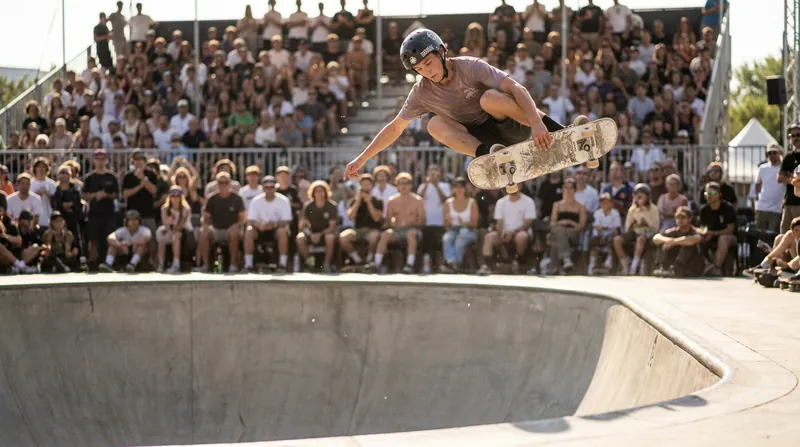
The Road to the Los Angeles 2028 Olympics has officially begun, and the Japanese men's street skateboarding team has already sent a resounding message to the rest of the world. At the World Skateboarding Tour (WST) World Cup in Rome, Japan delivered a flawless podium sweep, instantly reshaping the early Olympic qualifying standings and setting a daunting benchmark for the international field.[1][2]
Sora Shirai captured the opening victory of the cycle, putting down a commanding performance to finish with 177.92 points. The 24-year-old maintained his lead through the grueling best-trick section, securing the top spot, a massive injection of ranking points, and a $40,000 prize purse.[3][4]
Behind Shirai, the battle for the podium was a cliffhanger. Compatriots Kairi Netsuke and Toa Sasaki found themselves at the bottom of the leaderboard late in the final. However, both skaters delivered clutch performances on their final two trick attempts, vaulting into second with 172.19 points and third with 168.41 points, respectively, to complete the dramatic sweep.[1][2]
The result in Rome establishes Japan as the undisputed early powerhouse in the World Skateboarding Ranking (WSR). Under the LA28 qualification system, athletes have an 18-month window to accumulate points across WST events before the field is narrowed for the final Olympic Q-Series in the spring of 2028. Currently, Japanese skaters occupy a staggering 58 percent of the top-three ranked positions across all Olympic skateboarding disciplines.[2]
While the Japanese squad celebrated, the opening salvo of the Olympic cycle proved punishing for several of the sport's most established veterans. The grueling reality of the WST format meant that several heavyweights found themselves out of contention before the semifinals even began, missing out on vital early-cycle points.[1]
American Olympic medalist Jagger Eaton, Australian icon Shane O'Neill, and Brazilian standout Felipe Gustavo all suffered surprising early exits in Rome. They were joined on the sidelines by France's Vincent Milou and Canadian Olympians Matt Berger and Cordano Russell, all of whom failed to advance to the round of 16 in the sweltering Italian heat.[1][2]
For these veterans, the early stumble adds immediate pressure to the upcoming qualification calendar. The World Skate system heavily rewards consistency over time, meaning that early deficits must be offset by significant late-cycle performances to secure a spot in the top 44 who advance to the Q-Series.[1]
Analysts point out that the depth of the international field has never been stronger. With 134 skateboarders from 59 countries entering the Rome event alone, the margin for error has vanished. The days of coasting through early heats on reputation are over, replaced by a mathematically unforgiving ranking system where a single missed trick can derail a campaign.[1]
The internal competition within the Japanese team is equally fierce. With a maximum quota of three athletes per nation allowed at the Olympic Games, Shirai, Netsuke, and Sasaki are not just battling the world—they are battling a deep roster of domestic talent just to make the flight to Los Angeles.[1]
The tour now looks ahead to the World Skate Games in Asunción, Paraguay, this coming October, which will serve as the 2026 World Championships. For the Japanese leaders, it is a chance to cement their dominance; for the chasing pack, it is an urgent opportunity to get their Olympic campaigns back on track.[1][2]
The essentials
- Japan's Sora Shirai won the WST Rome World Cup with a score of 177.92.
- Kairi Netsuke and Toa Sasaki completed a clean podium sweep for Japan.
- The event marked the first points-earning opportunity for the LA28 Olympics.
- Veterans including Jagger Eaton and Shane O'Neill suffered surprising early exits.
- Skaters have an 18-month window to qualify for the final Olympic Q-Series.
Timeline
March 2026
World Skate officially announces the two-phase qualification system for the Los Angeles 2028 Olympic Games.
June 21, 2026
Sora Shirai leads a Japanese podium sweep at the WST Rome World Cup, the first points-earning event of the cycle.
October 2026
The qualification tour will head to Asunción, Paraguay, for the 2026 World Skate Games.
- Japanese Skateboarding Program
- Focuses on domestic depth and technical consistency to secure the maximum three Olympic quotas.
- Veteran Competitors
- Emphasizes the grueling nature of the 18-month qualification window and the need to bounce back from early deficits.
- Neutral Analysts
- Highlights the mathematical reality of the World Skateboarding Ranking, where incremental consistency outweighs occasional highlight-reel performances.
Perspectives this story doesn't cover
- Emerging Nations
Sources
Source coverage
4 outlets
3 viewpoints surfaced




- [1]World SkateJapanese Skateboarding Program
WST Rome Street 2026 Finals Report
Read on World Skate → - [2]ForbesVeteran Competitors
Co-Ed KPop Group KARD To Disband After First Album And World Tour
Read on Forbes → - [3]OlympicsJapanese Skateboarding Program
WST Street World Cup Rome 2026: All results and scores
Read on Olympics → - [4]The BoardrNeutral Analysts
Contest Results: World Skate Rome Mens Street Finals
Read on The Boardr →
More in Sports
See all →Standings
X Games League 2026 Final Standings: XC New York Edges XC Tokyo to Claim Inaugural Team Championship
6 sources

Injury
Skateboarding Injury Report: Aurelien Giraud Begins Knee Rehab as Jagger Eaton and Pamela Rosa Make Triumphant Returns
4 sources
Standings
WST Men's Park Standings: Tom Schaar and Issei Sakurai Surge as the Cutthroat US Olympic Race Tightens
3 sources
Injury
Nyjah Huston Completes Remarkable Comeback at X Games Following Life-Threatening Crashes
6 sources
Comments
Every angle. Every day.
Get Sports stories with full source coverage and perspective breakdowns, free every day.