
Olympic Champion Annabelle McIntyre Returns to Racing at Lucerne Following 18-Month Injury Hiatus
After undergoing back surgery, Australian rower Annabelle McIntyre is back on the water at the World Rowing Cup, highlighting a broader shift toward patient, science-backed injury rehabilitation in the sport.

Share this story
The Rotsee in Lucerne is famously unforgiving, a pristine Swiss lake that serves as the ultimate proving ground before the World Rowing Championships. But for Australian Olympic champion Annabelle McIntyre, simply sitting on the start line at the 2026 World Rowing Cup III represents a monumental victory.
McIntyre, who captured gold in the coxless four at the Tokyo Olympics and bronze in the pair at Paris 2024, has spent the last 18 months away from international competition. A severe back injury required surgery shortly after the Paris Games, forcing one of the sport's premier sweep rowers to completely rebuild her body and her stroke.
Her return this weekend in the Women's Single Sculls marks a deliberate shift in philosophy. By racing the single, McIntyre removes the pressure of matching a crewmate's rhythm, allowing her to row at her own physiological limits. National team management set absolutely no performance targets for her in Lucerne, prioritizing her long-term health over immediate podium results.
The grueling nature of rowing recovery requires athletes to find creative ways to maintain cardiovascular engines without loading compromised joints. During her rehabilitation, McIntyre temporarily abandoned the boat entirely, entering the UniSport Nationals Triathlon to rebuild her endurance through swimming, cycling, and running.
McIntyre explained during her recovery that she needed to build her endurance back up through anything but rowing, noting that the cross-training provided a mental break while protecting her healing spine.
Her journey highlights a systemic shift in how the sport manages physical breakdowns. According to World Rowing medical data, between 30 and 50 percent of elite rowers will experience an episode of lower back pain in any given 12-month period. The repetitive, high-force nature of the stroke places immense shear stress on the lumbar spine.
Rehabilitation protocols have evolved dramatically in recent years. Sports scientists now emphasize a 1:1 return timeline, advising athletes that for every month spent away from full training, they should expect to spend an equal amount of time gradually rebuilding to elite performance levels.
Clinical approaches have also pivoted away from static core exercises like planks. Modern rowing physiotherapists focus on dynamic trunk endurance and maximizing hip mobility, ensuring the pelvis can rotate freely so the spine doesn't have to absorb the full load of the oar.
But while chronic back issues require long-term patience, acute injuries demand real-time adaptation. Just days before the Lucerne regatta, the Australian men's sweep squad was forced into a frantic reshuffle when Austin Reinehr was sidelined with a rib injury.
Rib stress fractures are the second most common ailment in the sport, affecting roughly 10 percent of rowers annually. Caused by the intense muscular contractions of the serratus anterior and the force transmission from the oar handle, rib injuries heal slowly and cause the highest amount of missed training time per incident.
Reinehr's absence tested the depth of the Australian program. Head Coach Chris O'Brien immediately moved Paddy Holt into the Men's Eight and shifted Lachlan Doust into the Men's Four, relying on the squad's centralized training system to ensure the new combinations could seamlessly absorb the shock.
For athletes facing even more catastrophic physical setbacks, rowing has increasingly become a sanctuary of second chances. Earlier this month, Australian Paralympic gold medallist Nikki Ayers announced her retirement, closing the book on one of the most remarkable injury-redemption arcs in modern sport.[1]
Ayers was a rising rugby union star until a devastating tackle in 2016 severed her popliteal artery and caused permanent nerve damage. She endured 16 operations—including 10 in the first three weeks—and developed compartment syndrome before discovering para-rowing.[1]
Transitioning to the PR3 Mixed Double Sculls, Ayers found a community that focused on what her body could still achieve rather than what it had lost. She and partner Jed Altschwager ultimately captured Australia's first Paralympic rowing gold medal in Paris, proving that a career-ending injury in one arena can be the prologue to mastery in another.[1]
That same spirit of resilience permeated the Rotsee this weekend. In her opening heat, McIntyre didn't possess her usual explosive sprint, relying instead on base fitness and rhythm to navigate the 2,000-meter course.
She didn't win the race, but she comfortably secured a spot in the semi-finals, executing exactly what her medical team envisioned. In a sport defined by relentless, punishing repetition, the most valuable skill an athlete can develop is the patience to let the water wait.
Key points
- Olympic champion Annabelle McIntyre returned to international racing at the World Rowing Cup in Lucerne after an 18-month hiatus for back surgery.
- McIntyre shifted to the single sculls and cross-trained in triathlons to rebuild her endurance without loading her healing spine.
- Sports scientists now advocate a 1:1 return timeline, requiring rowers to spend an equal amount of time rebuilding as they spent sidelined.
- Acute injuries also forced a reshuffle in the Australian sweep squad after Austin Reinehr suffered a rib stress fracture.
- Paralympic gold medallist Nikki Ayers recently retired, highlighting how rowing serves as a powerful second chance for athletes recovering from catastrophic injuries.
How we got here
March 2016
Nikki Ayers suffers a catastrophic knee injury in rugby, leading to 16 surgeries.
August 2024
Annabelle McIntyre wins bronze at the Paris Olympics before stepping away for back surgery.
April 2025
McIntyre competes in the UniSport Nationals Triathlon to rebuild endurance without rowing.
June 2026
Austin Reinehr suffers a rib injury, forcing a reshuffle of the Australian Men's Eight.
June 2026
McIntyre successfully returns to international racing at the World Rowing Cup III in Lucerne.
- National Team Management
- Prioritizing long-term athlete welfare over immediate regatta results.
- Rehabilitation Specialists
- Advocating for methodical, science-backed recovery timelines.
- Adaptive Athletes
- Viewing the sport as a sanctuary for physical reinvention.
Perspectives this story doesn't cover
- Grassroots Club Coaches
- Equipment Manufacturers
Sources
Source coverage
1 outlets
3 viewpoints surfaced

- [1]Paralympics AustraliaAdaptive Athletes
Courage, Connection And A Life Changed By Rowing
Read on Paralympics Australia →
More in Sports
See all →Standings
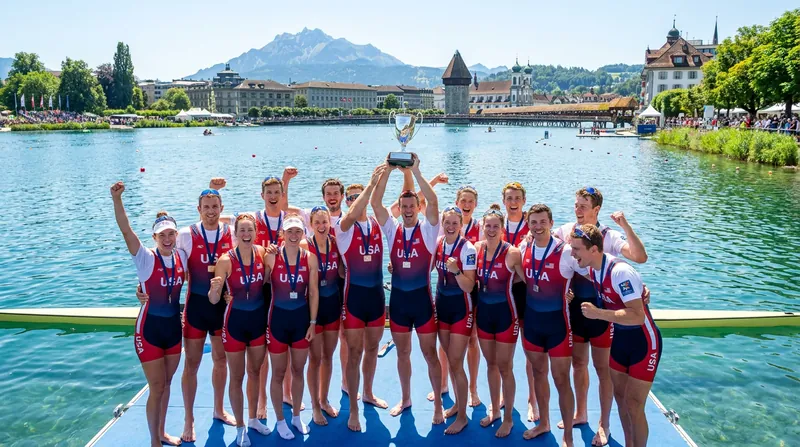
USA Claims Historic First Overall World Rowing Cup Title as Focus Shifts to Amsterdam Championships
5 sources
Standings
USA Claims Historic First Overall World Rowing Cup Title as Focus Shifts to Amsterdam Championships
2 sources

Injury
Reigning World Champion Emma Twigg Sidelined by Injury, Withdraws from New Zealand's US Beach Sprint Tour
6 sources
Standings
The Lightweight Men's Double Sculls Championship Picture: Asian Nations Surge as Olympic Transition Reshapes the Field
6 sources

Comments
Every angle. Every day.
Get Sports stories with full source coverage and perspective breakdowns, free every day.