
Nasal Cooling Halves Extracellular Vesicle Secretion to Suppress Antiviral Immunity
A 5°C drop in intranasal temperature reduces the secretion of antiviral extracellular vesicles by 42 percent and strips them of their decoy receptors. This cold-induced suppression of local innate immunity allows respiratory viruses to double their replication rate in the nasal mucosa.
By Jun Zhao

Share this story
In short
- A 5°C drop in nasal tissue temperature reduces the secretion of antiviral extracellular vesicles by 42 percent.
- Cold exposure strips the surviving vesicles of 77 percent of their viral decoy receptors, rendering them largely ineffective.
- This temperature-dependent immune failure allows respiratory viruses to double their replication rate within the nasal mucosa.
Public health officials and epidemiologists have long argued that winter viral surges are primarily a behavioral artifact. They maintain that cold weather drives populations indoors, where poor ventilation, dry air, and close physical proximity allow respiratory pathogens to spread effortlessly from host to host. Conversely, traditional practitioners have insisted that the physical cold itself makes the human body vulnerable to infection.[3]
The behavioral camp points to the physics of aerosols, noting that rhinoviruses and coronaviruses remain suspended significantly longer in the dry, heated air of winter interiors. The physiological camp counters that this environmental model fails to explain why rhinoviruses replicate so much more efficiently at 33°C—the exact temperature of a cold nasal cavity—than at the core body temperature of 37°C.[3]
A landmark 2022 study published in the Journal of Allergy and Clinical Immunology has now bridged this conceptual gap by identifying a previously unknown immune mechanism. Researchers from Massachusetts Eye and Ear and Northeastern University discovered that the nasal cavity deploys a highly coordinated swarm of extracellular vesicles to intercept viruses, and that this frontline defense physically collapses when the nose gets cold.[1][2]
The Extracellular Vesicle Swarm
The human upper respiratory tract serves as the first site of contact for inhaled pathogens, filtering thousands of liters of air daily. When a virus enters the nasal cavity, the mucosal cells do not simply wait passively to be infected. Instead, they detect the invader using the Toll-like receptor-3 (TLR3) signaling pathway, which triggers an immediate and aggressive counterattack.[1]
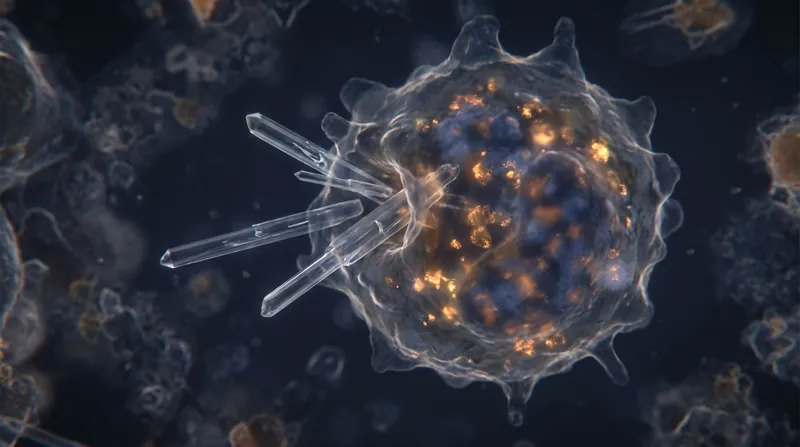
This counterattack takes the form of extracellular vesicles (EVs)—microscopic, lipid-enclosed particles that are naturally released from the cell membrane. Upon detecting a viral presence, the nasal epithelium dramatically increases its EV secretion, flooding the mucosal layer with billions of these particles to intercept the pathogen before it can bind to healthy tissue.
These vesicles act as highly effective, sacrificial decoys. They carry specific surface receptors, including low-density lipoprotein receptor (LDLR) and intercellular adhesion molecule 1 (ICAM-1), which are the exact proteins that rhinoviruses and coronaviruses use to latch onto human cells. The viruses bind tightly to the EVs instead of the actual nasal cells, effectively neutralizing the threat within the mucus layer.[1]
Beyond acting as simple physical decoys, the EVs also function as sophisticated cellular messengers. They are packaged with antiviral microRNAs, specifically miR-17, which they deliver directly to neighboring, uninfected host cells. This genetic payload primes the surrounding tissue, suppressing viral replication pathways even if the pathogen manages to bypass the initial decoy swarm.[1]
The Temperature Threshold
To understand precisely why this robust defense fails during the winter months, the research team tested the mechanism under controlled cold exposure. They moved four healthy volunteers from a comfortable 23.3°C (74°F) room into a 4.4°C (39.9°F) environment for exactly 15 minutes. Using specialized intranasal probes, they measured the resulting temperature drop inside the nasal cavity.[2]
The brief exposure to winter-like ambient air caused the temperature inside the nose to fall by exactly 5°C (9°F). The researchers then applied this precise 5°C reduction to live human nasal mucosal tissues cultured in the laboratory, simulating the physical reality of stepping outside on a cold December day and observing the cellular response.[2]
The laboratory results demonstrated a catastrophic failure of the EV swarm response. At the lower temperature, the nasal cells' ability to secrete extracellular vesicles plummeted by 42 percent. The sheer volume of the decoy swarm was nearly halved, leaving vast swaths of the mucosal barrier completely undefended against incoming viral particles.[2]
The cold exposure did not merely reduce the total number of vesicles; it severely compromised their structural integrity and functional capacity. The EVs produced at the lower temperature suffered a staggering 77 percent loss of their surface decoy receptors. Without these critical receptors, the vesicles could no longer effectively bind and neutralize the viruses suspended in the mucus.
Furthermore, the packaging of antiviral microRNAs into the surviving vesicles was significantly diminished. The delivery of miR-17 to uninfected cells dropped sharply, leaving the surrounding mucosal tissue unprimed and highly vulnerable. This combined loss of volume, binding affinity, and chemical payload effectively disarmed the nasal cavity's primary innate defense.[1]
Viral Replication Doubles
The consequence of this localized immune suppression is immediate, measurable, and clinically significant. When the researchers exposed the cold-impaired nasal tissues to two common rhinoviruses and a seasonal coronavirus, the pathogens encountered very little resistance. Without the EV swarm to intercept them, the viruses bound directly to the host cells.
In the absence of the decoy receptors and the protective microRNAs, viral replication within the infected nasal cells doubled. A mere 5°C drop in tissue temperature was sufficient to turn a highly defended mucosal barrier into a highly permissive environment for viral proliferation, allowing the infection to take hold rapidly.
"Conventionally, it was thought that cold and flu season occurred in cooler months because people are stuck indoors more where airborne viruses could spread more easily," explained Benjamin Bleier, MD, the senior author of the study. "Our study, however, points to a biological root cause for the seasonal variation in upper respiratory viral infections we see each year."
Clinical Implications and Prevention
For clinicians and public health officials, these findings fundamentally shift the paradigm of winter viral prevention. While handwashing, vaccination, and indoor ventilation remain critical pillars of infection control, maintaining the physical temperature of the nasal cavity emerges as a biologically validated strategy to preserve innate immunity.[3]
The data suggests that simple physical interventions, such as wearing a scarf over the nose or utilizing a standard face mask in cold weather, are not merely about thermal comfort. By preventing the 5°C intranasal temperature drop, these physical barriers help maintain the massive EV swarm response required to neutralize inhaled pathogens.[3]
"Combined, these findings provide a mechanistic explanation for the seasonal variation in upper respiratory infections," noted Di Huang, PhD, a co-author of the research. The data confirms that the nose's vulnerability is a direct function of its anatomy; as an exposed extremity, it cools much faster than the core body.[2]
This mechanism also explains why some individuals seem inherently more susceptible to winter colds than others. Natural variations in nasal anatomy, baseline mucosal temperature, and individual TLR3 signaling efficiency could dictate the baseline robustness of the EV swarm, making certain people's defenses significantly more fragile when exposed to cold air.[3]
Therapeutic Potential of EVs
The detailed mapping of the EV swarm opens entirely new avenues for antiviral therapeutics and prophylactic treatments. If pharmaceutical researchers can synthesize extracellular vesicles equipped with high densities of LDLR and ICAM-1 receptors, they could potentially develop nasal sprays that artificially replenish the decoy swarm during the winter months.[1][3]
Such a prophylactic treatment would not rely on the adaptive immune system's ability to generate specific antibodies, making it potentially highly effective against rapidly mutating viruses that easily evade preexisting immunity. By flooding the nasal cavity with synthetic decoys, clinicians could neutralize novel pathogens before they ever breach the cell membrane.[3]
Furthermore, the targeted delivery of antiviral microRNAs via synthetic EVs could provide a localized, rapid-onset immune boost. Unlike traditional systemic vaccines that require weeks to generate a protective response, an EV-based nasal spray could theoretically prime the mucosal tissue within minutes of application, offering immediate, on-demand protection.[3]
Redefining Respiratory Immunity
The identification of this temperature-dependent immune response challenges the traditional boundaries between environmental exposure and biological susceptibility. It validates the long-held observational link between cold weather and respiratory illness, grounding a common cultural belief in precise, quantifiable cellular mechanics.[3]
"This is the first time that we have a biologic, molecular explanation regarding one factor of our innate immune response that appears to be limited by colder temperatures," observed Zara Patel, MD, an otolaryngologist reviewing the findings. The research elevates the nasal cavity from a passive conduit into a highly reactive immune organ.
As researchers continue to map the staggering complexities of the human respiratory tract, the extracellular vesicle swarm stands out as a remarkably elegant defense system. It leverages the body's own cellular architecture to create a dynamic, sacrificial barrier against microscopic invaders, operating entirely independently of systemic antibodies.[3]
The fact that this sophisticated, highly effective mechanism is completely undone by a mere 5°C drop in tissue temperature highlights the fragile balance of human physiology. It underscores the evolutionary trade-offs inherent in a respiratory system that must constantly interface with a highly variable, often hostile external environment.[2][3]
The research from Massachusetts Eye and Ear provides a definitive, evidence-based answer to one of medicine's oldest and most debated questions. The reliable winter surge in colds and flu is not just a product of where populations spend their time, but a direct, measurable result of how our frontline immune defenses freeze under pressure.[2][3]
Key terms
- Extracellular Vesicles (EVs)
- Microscopic, lipid-enclosed particles released by cells that act as decoys to intercept viruses and deliver protective signals to neighboring tissue.
- Toll-like receptor-3 (TLR3)
- A specific signaling pathway used by nasal cells to detect the presence of a virus and trigger the immediate release of the extracellular vesicle swarm.
- Decoy Receptors
- Surface proteins on extracellular vesicles that mimic human cells, tricking viruses into binding to the vesicle instead of infecting actual nasal tissue.
- MicroRNAs (miRNAs)
- Small genetic molecules packaged inside extracellular vesicles that are delivered to uninfected cells to suppress viral replication.
Reader questions
Does being cold actually make you sick?
Being cold does not spontaneously create a virus, but it actively lowers your immune defenses. A 5°C drop in nasal temperature halves the secretion of protective extracellular vesicles, making it significantly easier for a virus to establish an infection.
Can wearing a scarf over my nose prevent a cold?
Yes, by maintaining the physical temperature of your nasal cavity. Keeping the nose warm prevents the cold-induced drop in extracellular vesicle secretion, allowing your innate immune system to effectively intercept inhaled viruses.
Are extracellular vesicles a type of white blood cell?
No, extracellular vesicles are microscopic, lipid-enclosed particles released by the nasal mucosal cells. They act as sacrificial decoys and chemical messengers, neutralizing viruses before traditional white blood cells need to be deployed.
Does this mechanism apply to COVID-19 as well as the common cold?
Yes, the researchers found that the extracellular vesicle swarm effectively intercepts seasonal coronaviruses using the same decoy receptors. The cold-induced suppression of this defense likely contributes to the winter surges seen during the COVID-19 pandemic.
Where opinion splits
Clinical Researchers
Focus on the quantifiable biological failure of the nasal immune response.
For cellular biologists and immunologists, the discovery of the temperature-dependent extracellular vesicle swarm represents a paradigm shift in understanding innate immunity. They argue that the 42 percent drop in EV secretion and the 77 percent loss of decoy receptors provide a definitive, mechanistic explanation for viral susceptibility that behavioral models alone cannot account for. By quantifying exactly how a 5°C tissue cooling dismantles the mucosal barrier, researchers emphasize that the nasal cavity operates under strict thermal constraints, making physical cold a primary driver of infection rather than just a correlative environmental factor.
Public Health Officials
Maintain that behavioral factors and indoor crowding remain critical drivers of transmission.
While acknowledging the biological reality of the impaired EV swarm, epidemiologists and public health officials caution against dismissing the behavioral model of winter illness. They argue that even a fully functioning mucosal immune system can be overwhelmed by the high viral loads present in poorly ventilated, crowded indoor spaces. From this perspective, the cold-induced immune deficit acts as a multiplier rather than a sole cause; the physical cold lowers the body's defenses precisely when indoor crowding maximizes exposure to pathogens, creating a perfect storm for seasonal epidemics.
Otolaryngologists
Focus on the anatomical vulnerability of the nose and practical thermal interventions.
Ear, nose, and throat specialists view these findings through the lens of human anatomy. They point out that the nose, as an exposed cartilaginous extremity, lacks the dense vascularization required to maintain core body temperature in freezing conditions. Otolaryngologists argue that this anatomical vulnerability makes the nasal cavity the weak link in the respiratory defense system. Consequently, they advocate for simple, practical interventions—such as wearing scarves or masks outdoors—to artificially maintain the intranasal temperature, thereby preserving the EV swarm and keeping the mucosal barrier intact during the winter months.
- Clinical Researchers
- Focus on the quantifiable biological failure of the nasal immune response.
- Public Health Officials
- Maintain that behavioral factors and indoor crowding remain critical drivers of transmission.
- Otolaryngologists
- Focus on the anatomical vulnerability of the nose and practical thermal interventions.
Perspectives this story doesn't cover
- Vaccine Developers
- Traditional Medicine Practitioners
Sources
Source coverage
3 outlets
3 viewpoints surfaced



- [1]Journal of Allergy and Clinical ImmunologyClinical Researchers
Cold exposure impairs extracellular vesicle swarm-mediated nasal antiviral immunity
Read on Journal of Allergy and Clinical Immunology → - [2]ScienceDailyClinical Researchers
A newly discovered immune response inside the nose is suppressed by colder temperatures
Read on ScienceDaily → - [3]Factlen Editorial TeamPublic Health Officials
Synthesis by Factlen editorial team
Read on Factlen Editorial Team →

More in Health
See all →Air Quality
Wildfire Smoke Linked to Higher Hospitalization Risk Than Other Air Pollution in Major Studies
5 sources

Bipolar Disorder
Phase 3 Trial Shows Caplyta Rapidly Relieves Bipolar Mania Symptoms
5 sources

SGLT2 Mechanism
How SGLT2 Inhibitors Block Glucose Reabsorption in the Proximal Tubule to Provide Cardiorenal Protection
10 sources

Inflammasome Biology
How Monosodium Urate Crystals Activate the NLRP3 Inflammasome to Initiate the Acute Gout Flare
10 sources
Comments
Every angle. Every day.
Get Health stories with full source coverage and perspective breakdowns, free every day.