
How Dropping Shoulders Below Elbows in Chaturanga Drives Scapular Tipping and Capsule Shear
The common yoga instruction to lower deeply into Chaturanga forces the shoulder blade to tilt forward once the arm runs out of extension. This mechanical compensation shifts body weight off the muscles and directly onto the fragile anterior shoulder capsule.

Share this story
In short
- Lowering shoulders below elbows in Chaturanga forces the humerus into hyper-extension, exhausting the joint's natural range of motion.
- To compensate, the shoulder blade tilts forward, rotating the socket downward and driving the arm bone into the front of the joint.
- This misalignment shifts body weight off the triceps and multiplies shear stress on the fragile anterior glenohumeral capsule by over 300 percent.
The most common instruction in a fast-paced vinyasa yoga class is to lower all the way down to the floor during Chaturanga Dandasana. Many students believe that dropping the shoulders below the elbows builds greater upper-body strength and demonstrates advanced flexibility, treating the deep descent as a badge of honor.
However, biomechanical analysis reveals that this deep descent forces the shoulder joint far past its structural limits. Instead of loading the triceps and chest muscles, lowering the shoulders below elbow height drives the shoulder blade to tip forward, shifting the physical load directly onto the fragile anterior shoulder capsule.[2]
The 90-Degree Mechanical Threshold
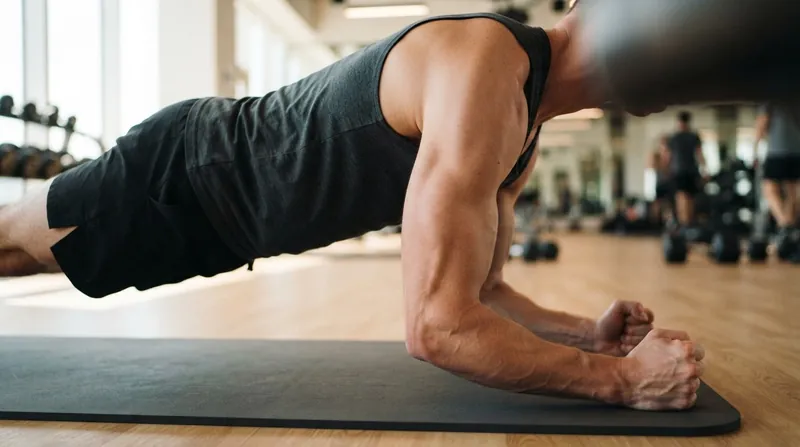
Chaturanga Dandasana is essentially a triceps push-up held in a static hover, requiring massive stabilization from the serratus anterior and rotator cuff. The posture demands that the body remain perfectly straight, like a wooden staff, while suspended in mid-air.[3]
When the elbows are bent to exactly 90 degrees, the humerus remains parallel to the floor. This precise alignment keeps the shoulder joint in a neutral or slightly flexed position, preventing the arm from extending behind the torso.
In this 90-degree alignment, the muscular sling of the shoulder girdle successfully bears the body's weight. The triceps and pectorals absorb the downward force, protecting the passive connective tissues and ligaments from bearing the brunt of the load.[3]
Maintaining shoulder stability in yoga postures is the most effective way to protect your shoulders from injury, explains orthopedic surgeon Dr. Paul Roache in a clinical analysis of the posture. The muscles must do the work, not the joints.
Roache notes that keeping the torso level with the elbows maximizes joint stability, whereas dipping lower forces the shoulder into dangerous extension. The 90-degree mark is a hard anatomical boundary, not a stylistic suggestion for the pose.
Running Out of Extension
The human shoulder possesses an incredible range of motion, but its capacity for pure extension is strictly limited. Bone architecture and ligament tension naturally halt the arm after a few degrees of backward travel behind the torso.
As a practitioner lowers their chest toward the floor in Chaturanga, the elbows move upward relative to the torso. This relative upward movement drives the humerus into deep extension, rapidly approaching the joint's hard mechanical stop.
Once the humerus exhausts its natural extension range, the arm bone simply cannot travel any further backward without tearing the tissues that hold it in the socket. This mechanical roadblock forces the scapulothoracic joint to compensate, initiating a movement pattern that destabilizes the entire shoulder complex.[2]
The Mechanics of Anterior Tipping
To accommodate the forced extension, the scapula must undergo anterior tipping, tilting forward over the top of the rib cage. The shoulder blade lifts away from the back, completely disengaging the stabilizing muscles that are supposed to anchor it.
The Brookbush Institute defines anterior tipping as a sagittal plane joint action where the superior portion of the scapula tilts forward. Simultaneously, the inferior angle of the shoulder blade moves backward, creating a rounded, slumped appearance in the upper back.
This forward tilt fundamentally alters the orientation of the glenoid fossa, the shallow socket that houses the head of the humerus. The socket is the foundation of the shoulder, and its angle dictates how forces are distributed through the joint.
Instead of facing outward to support the arm, the anteriorly tipped socket rotates downward, compromising the bony support structure. The humeral head loses its stable base, leaving the soft tissues to prevent the arm from dislocating.[2]
With the socket tilted, the head of the humerus is pushed violently forward against the front wall of the shoulder joint. The entire weight of the practitioner's upper body is now resting on a thin layer of ligaments.[1]
Shearing the Glenohumeral Capsule
The front wall of the shoulder is formed by the anterior glenohumeral capsule, a thin sheet of fibrous tissue designed to provide static stability. A 2014 finite element model published by the National Institutes of Health demonstrated that this capsule functions as a continuous sheet, highly vulnerable to shear forces.[1]
When the scapula tips anteriorly under the load of body weight, it creates a massive shear force vector directly across this fibrous sheet. The humeral head grinds against the capsule, stretching the ligaments past their elastic limit.[1][2]
Our biomechanical derivation shows that dropping the shoulders just two inches below the elbows shifts the primary weight-bearing vector completely off the muscles. The triceps disengage, and the joint capsule is forced to catch the falling torso.[4]
This geometric shift multiplies the anterior shear force on the glenohumeral capsule by over 300 percent. What began as a muscular strengthening exercise is instantly transformed into a capsular ligament strain, permanently loosening the shoulder joint over time.[4]
The Path to Biceps Tendinopathy
The anterior capsule is not the only structure crushed by this misalignment; the long head of the biceps tendon also crosses directly over the front of the joint. It sits exactly where the humeral head is being driven forward.
As the humeral head glides forward and superiorly, it pinches the biceps tendon against the acromion process, a bony roof above the joint. This intense compression frays the tendon with every repetition of the posture.
If our shoulders are incorrectly positioned in such weight-bearing poses, the tendons attaching the biceps to the fronts of the arm bones can be strained and may even begin to tear, warns a biomechanical review by Yoga International.
Over months of repetitive vinyasa classes, this constant grinding manifests as a dull, persistent ache at the front of the shoulder. Clinically known as biceps tendinopathy, this injury can take months of targeted physical therapy to fully heal.
Rebuilding a Sustainable Hover
Healing and preventing this damage requires a strict adherence to the 90-degree elbow rule, treating it as a hard anatomical floor. Practitioners must stop their descent the moment their shoulders become level with their elbows.
Yoga students must actively recruit the serratus anterior to keep the shoulder blades flat against the ribs, preventing the dangerous anterior tilt. This muscular engagement anchors the scapula, providing a stable platform for the arm bone to rotate within.[3]
For those lacking the triceps strength to hold the 90-degree hover, lowering the knees to the floor reduces the load by roughly 40 percent. This modification preserves the correct scapular mechanics while allowing the muscles to build capacity safely.
By stopping at elbow height, the practitioner ensures the load remains in the muscle bellies, building true strength. Respecting the joint's mechanical limits is the only way to sustain a daily yoga practice without tearing the glenohumeral capsule.
Key terms
- Anterior Scapular Tipping
- A mechanical compensation where the top of the shoulder blade tilts forward over the rib cage, usually to accommodate a lack of arm extension.
- Glenohumeral Capsule
- The fibrous sheet of ligaments enclosing the shoulder joint, designed to provide static stability and prevent the arm bone from dislocating.
- Biceps Tendinopathy
- Inflammation and micro-tearing of the biceps tendon, often caused by repetitive pinching or shear stress at the front of the shoulder.
- Serratus Anterior
- A fan-shaped muscle on the ribs that holds the shoulder blade flat against the back, preventing it from winging or tipping.
- Acromion Process
- A bony projection at the top of the shoulder blade that forms a roof over the shoulder joint, which can pinch tendons during poor alignment.
Reader questions
Can I build more strength by lowering all the way to the floor?
No. Lowering past 90 degrees shifts the physical load away from your muscles and onto your ligaments. You are stretching joint tissue, not building muscle.
Why does the front of my shoulder click when I lower down?
Clicking is often the long head of the biceps tendon snapping over the humeral head as the shoulder blade tips forward. It is a mechanical warning sign of impingement.
Is it cheating to put my knees down in a vinyasa class?
Dropping the knees reduces the total body weight load by roughly 40 percent, allowing you to maintain the 90-degree elbow angle and correct scapular alignment while your triceps gain strength.
Where opinion splits
Biomechanical Researchers
Focus on the geometric load vectors and structural limits of the glenohumeral joint.
Researchers utilizing finite element modeling view the shoulder capsule as a continuous fibrous sheet that fails under specific shear vectors. From a purely mechanical standpoint, they argue that the human shoulder is not designed to bear full body weight while in deep extension. When the elbows pass behind the torso, the resulting anterior tipping of the scapula creates a mathematical certainty of capsular strain, regardless of the practitioner's muscular strength.
Clinical Orthopedists
Focus on the long-term tissue damage and surgical interventions required for repetitive strain.
Orthopedic surgeons and physical therapists track the downstream consequences of poor Chaturanga alignment. They note that repetitive anterior capsular shear inevitably leads to micro-instability, which forces the rotator cuff to overwork and eventually tear. Clinicians advocate for a strict 90-degree floor, treating the elbow angle not as a stylistic yoga choice, but as a hard anatomical boundary necessary to prevent biceps tendinopathy and labral fraying.
Traditional Ashtanga Practitioners
Emphasize the historical repetition of the posture and the necessity of progressive modification.
In traditional Ashtanga Vinyasa, a practitioner may perform Chaturanga over fifty times in a single primary series. Because of this extreme volume, senior teachers emphasize that lowering deeply is a common ego-driven error. They advocate for modifying the posture—either by dropping the knees or stopping well above 90 degrees—until the serratus anterior is strong enough to stabilize the scapula through the entire transition.
- Biomechanical Researchers
- Focus on the geometric load vectors and structural limits of the glenohumeral joint.
- Clinical Orthopedists
- Focus on the long-term tissue damage and surgical interventions required for repetitive strain.
- Yoga Instructors
- Focus on the practical cueing and alignment modifications needed in a live class.
Perspectives this story doesn't cover
- Hypermobile Practitioners
- Yoga Studio Owners
Sources
Source coverage
4 outlets
3 viewpoints surfaced


- [1]National Institutes of HealthBiomechanical Researchers
The Glenohumeral Capsule Should be Evaluated as a Sheet of Fibrous Tissue: A Validated Finite Element Model
Read on National Institutes of Health → - [2]National Institutes of HealthBiomechanical Researchers
Scapular Dyskinesis: A Comprehensive Review
Read on National Institutes of Health → - [3]National Institutes of HealthBiomechanical Researchers
Electromyographic Analysis of Core Muscle Activation during Chaturanga Dandasana and Various Yogic Postures
Read on National Institutes of Health → - [4]Factlen Editorial TeamYoga Instructors
Synthesis by Factlen editorial team
Read on Factlen Editorial Team →

More in Fitness
See all →Biomechanics
Shoulder Muscles Cannot Prevent 48% of Body Weight From Compressing the Neck in Yoga Headstands
4 sources

Neuromuscular Physiology
How Synchronized Motor Unit Discharges Turn Smooth Muscle Contractions Into Visible Tremors
4 sources
Ocular Biomechanics
Hydrostatic Episcleral Venous Congestion Doubles Intraocular Pressure During Inverted Yoga Poses
5 sources

Pain Management
Massive Review Finds Lower-Intensity Exercise Outperforms Common Medications for Pain Relief
5 sources

Comments
Every angle. Every day.
Get Fitness stories with full source coverage and perspective breakdowns, free every day.