
The Neuroscience of Yoga: How Breath and Movement Shift the Autonomic Nervous System
Clinical researchers are increasingly studying yoga not as a physical workout, but as a targeted neurological intervention capable of shifting the body from chronic stress to parasympathetic recovery.

Share this story
In short
- Yoga is increasingly studied as a neurological intervention to shift the body from chronic stress to parasympathetic recovery.
- The autonomic nervous system controls involuntary functions, balancing 'fight or flight' and 'rest and digest' states.
- Slow, diaphragmatic breathing mechanically stimulates the vagus nerve, increasing vagal tone and signaling safety to the brain.
Millions of people unroll their yoga mats each day seeking a physical workout, sweating through fast-paced Vinyasa flows to burn calories, build core strength, and increase flexibility. In the West, yoga is overwhelmingly marketed as a fitness modality, complete with heart-rate trackers and calorie-burn estimates.
Yet, clinical researchers and neuroscientists are increasingly focused on the exact opposite effect: yoga’s ability to act as a targeted neurological intervention. Rather than viewing the practice through the lens of muscular endurance, researchers are mapping how specific breathing and movement patterns mechanically alter the brain's stress response.[1]
The tension at the heart of modern yoga lies in how the body processes stress. A vigorous, fast-paced yoga class acts as a sympathetic stressor—elevating the heart rate, increasing cortisol slightly, and triggering a mild "fight or flight" state, much like running or weightlifting. While this has cardiovascular benefits, the clinical benefits of yoga for anxiety, trauma, and recovery stem from practices that deliberately "downregulate" the nervous system. These targeted practices shift the body away from hyperarousal and into a state of parasympathetic dominance, fundamentally changing how the body recovers.[2]
To understand how this downregulation works, one must look at the autonomic nervous system (ANS). The ANS is the body's unconscious control center, responsible for regulating vital, involuntary functions like heart rate, blood pressure, digestion, and respiration. The system is divided into two primary branches that operate in a continuous push-and-pull dynamic: the sympathetic nervous system, which drives the "fight or flight" survival response, and the parasympathetic nervous system, which governs "rest, digest, and heal" functions.[1][2]
In a perfectly healthy body, these two systems operate in a flexible, dynamic balance, shifting seamlessly based on environmental demands. However, modern life—characterized by chronic psychological stress, poor sleep, and constant digital stimulation—often leaves individuals trapped in a state of sympathetic dominance. This chronic hyperarousal narrows attentional focus, increases baseline muscle tension, disrupts digestion, and suppresses the body's natural capacity to heal and recover. Over time, this pattern maintains anxiety and systemic inflammation even without an active external threat.[2]
Yoga practices, specifically slow breathing and restorative postures, offer a mechanical pathway to break this cycle of chronic stress. They achieve this primarily by stimulating the vagus nerve, the main superhighway of the parasympathetic nervous system. The vagus nerve wanders from the brainstem down through the neck, chest, and abdomen, directly innervating the heart, lungs, and digestive tract. It acts as the primary communication line between the brain and the body's internal organs, carrying signals that dictate the body's physiological state.[5]
In clinical literature, "vagal tone" refers to the activity, responsiveness, and overall health of this nerve. When vagal tone is high, the body can rapidly calm itself after a stressful event, returning heart rate and blood pressure to baseline.
When vagal tone is low, the body remains locked in a state of vigilance, unable to effectively hit the physiological brakes. Clinical studies have consistently shown that specific yoga techniques can mechanically increase vagal tone, sending safety signals up to the brain that physically slow the heart rate and lower blood pressure.[2][4]
The most reliable, non-invasive biomarker for measuring this autonomic shift is Heart Rate Variability (HRV). HRV tracks the tiny, millisecond fluctuations in the time between individual heartbeats. Counterintuitively, a heart that beats like a perfect, rigid metronome is a sign of stress and autonomic dysfunction. High variability indicates a responsive, flexible nervous system that can seamlessly toggle between sympathetic and parasympathetic states, adapting to the demands of the moment. Higher HRV is universally correlated with better cardiovascular health and greater stress resilience.[3][4]
Multiple clinical trials have demonstrated that consistent yoga practice improves this critical biomarker. In one study, eight weeks of Hatha yoga significantly increased HRV in healthy adults, indicating a clear shift toward parasympathetic dominance and reduced sympathetic activity. Another physiological analysis of young adults found that a 10-week yoga intervention resulted in higher overall HRV and improved autonomic self-regulation compared to standard physical education classes. These measurable changes prove that the calming effect of yoga is not merely a placebo, but a structural adaptation.[3][4]
The primary mechanism driving these autonomic changes is pranayama, or controlled breathwork. Because a branch of the vagus nerve runs directly through the larynx and the respiratory diaphragm, the way a person breathes mechanically dictates their neurological state. Short, shallow breaths into the upper chest signal danger to the brain, activating the sympathetic nervous system and preparing the body for action. This is the default breathing pattern for most adults living in a state of chronic stress.[2]
Conversely, slow, diaphragmatic breathing—particularly when the exhalation is deliberately lengthened to be longer than the inhalation—mechanically stimulates the vagus nerve. This triggers the baroreflex, a homeostatic mechanism that regulates blood pressure. As the breath slows to a resonance frequency of around five or six breaths per minute, the heart rate synchronizes with the respiratory cycle. This synchronization maximizes HRV and floods the nervous system with parasympathetic signals, forcing the body into a state of deep recovery.[2][4]
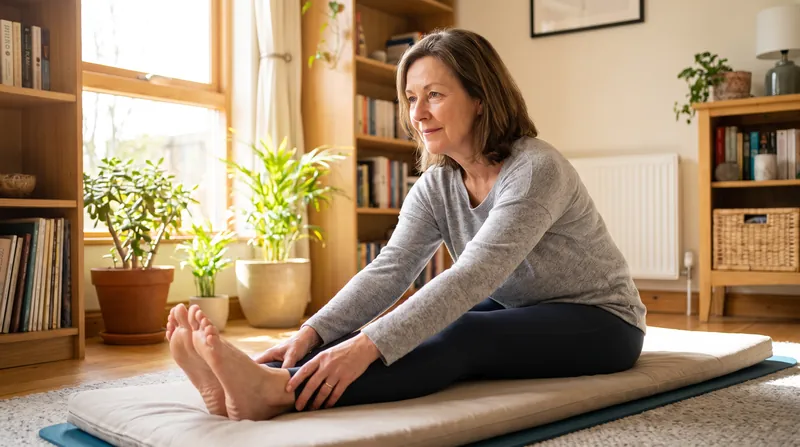
Physical movement, or asana, also plays a critical role in autonomic regulation, provided it is approached correctly. Restorative postures and inversions, such as "Legs Up the Wall" (Viparita Karani) or supported forward folds, alter blood flow and pressure dynamics in the chest and neck. This localized pressure stimulates baroreceptors in the carotid arteries, which in turn signal the brainstem to decrease sympathetic output, lower the heart rate, and dilate blood vessels.[4]
Beyond the peripheral nervous system, these practices trigger profound neurochemical shifts within the brain itself. Researchers have hypothesized that yoga helps correct underactivity in the gamma-aminobutyric acid (GABA) system. GABA is the brain's primary inhibitory neurotransmitter—it acts as the neurological brakes for brain activity, promoting a sense of calm and reducing the excessive, looping neural firing that is characteristic of clinical anxiety and chronic stress disorders.[5]
By increasing parasympathetic activity through vagal stimulation, yoga simultaneously boosts GABA levels in the brain. This dual action reduces "allostatic load," the cumulative, long-term wear and tear on the body caused by chronic stress and elevated cortisol. It is this specific neurochemical mechanism that explains why yoga has shown significant promise as an adjunct treatment for severe conditions exacerbated by stress, including treatment-resistant depression, epilepsy, and post-traumatic stress disorder.[5]
Furthermore, advanced neuroimaging studies reveal that regular yoga practice induces structural and functional changes in the brain over time. Consistent practice increases activation and gray matter volume in the prefrontal cortex, the area responsible for high-order cognitive functions, decision-making, and emotional regulation. Simultaneously, it modulates and calms the activity of the amygdala, the brain's primitive threat-detection center, allowing practitioners to respond to stressors thoughtfully rather than reacting impulsively.[1]
However, researchers caution that yoga is not a monolithic intervention, and its effects on the nervous system are highly specific to the style and intensity practiced. A rigorous Power Yoga or heated Vinyasa class will reliably activate the sympathetic nervous system. While this serves as an excellent cardiovascular workout and builds muscular endurance, it can potentially exacerbate hyperarousal in someone who is already suffering from burnout, chronic fatigue, or severe anxiety.[2][4]
Systematic reviews of yoga and HRV have also noted that while the physiological theories are sound, the quality of clinical trials varies significantly. Some studies suffer from small sample sizes, lack of control groups, or fail to adequately detail the specific breathing ratios and postures used. This lack of standardization makes it difficult for researchers to isolate exactly which components of the practice drive the most significant autonomic changes, highlighting the need for more rigorous, large-scale clinical trials.[3]
Despite these methodological limitations, the clinical consensus is shifting rapidly. Medical and behavioral health providers are increasingly prescribing targeted yoga therapy as an evidence-informed adjunct to standard psychiatric and medical care. Unlike pharmaceutical interventions that often come with systemic side effects, breathwork and restorative movement offer a self-directed, accessible toolkit for autonomic regulation that patients can utilize anywhere.[2]
For the average practitioner, the science offers a clear, practical directive: intentionality matters. If the goal is to build resilience to stress, improve sleep, and enhance recovery, the most advanced yoga practice is not the one that burns the most calories or achieves the most complex physical shape. Chasing a sweat in a heated room may feel productive, but it often reinforces the very sympathetic drive the practitioner is trying to escape.[1][6]
Instead, the most neurologically potent practice is often the simplest and the slowest. By prioritizing extended exhalations, supported postures, and deliberate stillness, practitioners can actively rewire their autonomic responses. In doing so, they transform yoga from a mere physical exercise into a profound tool for neurological healing, allowing the nervous system to finally shift out of survival mode and into a state of true restoration.[6]
Definitions
- Autonomic Nervous System (ANS)
- The part of the nervous system that unconsciously regulates vital bodily functions like heart rate, digestion, and breathing.
- Vagus Nerve
- The primary nerve of the parasympathetic nervous system, running from the brainstem to the abdomen, responsible for regulating internal organ functions and promoting relaxation.
- Heart Rate Variability (HRV)
- A biomarker measuring the variation in time between heartbeats, used to assess the health and resilience of the autonomic nervous system.
- GABA (Gamma-aminobutyric acid)
- The brain's primary inhibitory neurotransmitter, which acts as a neurological brake to reduce excessive neural activity and promote calm.
- Allostatic Load
- The cumulative physiological wear and tear on the body caused by chronic stress and repeated activation of the fight-or-flight response.
Questions & answers
What is the difference between the sympathetic and parasympathetic nervous systems?
The sympathetic nervous system drives the body's 'fight or flight' stress response, elevating heart rate and alertness. The parasympathetic nervous system governs 'rest and digest' functions, slowing the heart rate and allowing the body to heal and recover.
How does breathing affect the vagus nerve?
Slow, diaphragmatic breathing—especially when the exhalation is longer than the inhalation—mechanically stimulates the vagus nerve. This sends a safety signal to the brain, which lowers blood pressure and shifts the body into a state of relaxation.
Can a fast-paced yoga class increase stress?
Yes. Vigorous styles like Power Yoga or heated Vinyasa act as sympathetic stressors. While excellent for cardiovascular fitness, they can exacerbate hyperarousal in individuals already suffering from chronic stress or burnout.
What is Heart Rate Variability (HRV)?
HRV measures the tiny fluctuations in time between individual heartbeats. Higher variability indicates a flexible, resilient nervous system that can easily switch between stress and recovery states.
Analysis by camp
Clinical Neuroscientists' view
Focus on measurable biomarkers like HRV, vagal tone, and GABA to quantify yoga's neurological impact.
For clinical neuroscientists, the value of yoga lies not in its spiritual origins, but in its measurable, mechanical effects on human physiology. By utilizing tools like electrocardiograms and functional MRI scans, researchers in this camp aim to quantify exactly how specific breathing ratios and postures alter the autonomic nervous system. They view practices like resonance frequency breathing as precise, dose-dependent interventions that can structurally increase heart rate variability (HRV) and boost inhibitory neurotransmitters like GABA. Their primary goal is to standardize these protocols so they can be reliably prescribed in clinical settings.
Clinical Yoga Therapists' view
Focus on applying breathwork and restorative movement as targeted interventions for anxiety and trauma.
Yoga therapists bridge the gap between clinical data and patient experience. They argue that while understanding the vagus nerve is crucial, the true power of yoga lies in its ability to teach patients interoception—the awareness of internal bodily sensations. For individuals suffering from trauma or severe anxiety, the body often feels like an unsafe place. Therapists use restorative postures and guided breathwork not just to mechanically lower blood pressure, but to help patients actively experience a shift from sympathetic hyperarousal to parasympathetic safety, giving them a self-directed toolkit for emotional regulation.
Integrative Health Analysts' view
Focus on translating complex physiological mechanisms into practical, actionable advice for the general public.
Integrative health analysts emphasize the practical application of this science for the average person. They point out a critical disconnect in the modern wellness industry: millions of stressed, overworked individuals are attending high-intensity, heated yoga classes in an attempt to relax, inadvertently compounding their allostatic load. This perspective advocates for a paradigm shift in how fitness is marketed, urging practitioners to match their physical activity to their neurological needs. If the nervous system is already redlining, they argue, the most productive choice is to skip the sweat and prioritize stillness.
- Clinical Neuroscientists
- Focus on measurable biomarkers like HRV, vagal tone, and GABA to quantify yoga's neurological impact.
- Clinical Yoga Therapists
- Focus on applying breathwork and restorative movement as targeted interventions for anxiety and trauma.
- Integrative Health Analysts
- Focus on translating complex physiological mechanisms into practical, actionable advice for the general public.
Perspectives this story doesn't cover
- Cardiologists
- Psychiatrists
Sources
Source coverage
6 outlets
3 viewpoints surfaced





- [1]Stanford UniversityClinical Neuroscientists
The Neuroscience of Yoga
Read on Stanford University → - [2]Yoga Therapy AssociatesClinical Yoga Therapists
Yoga for Anxiety and Autonomic Nervous System Regulation
Read on Yoga Therapy Associates → - [3]PLOS OneClinical Neuroscientists
Effects of yoga on heart rate variability and depressive symptoms
Read on PLOS One → - [4]PubMed CentralClinical Neuroscientists
Eight weeks of hatha yoga improved HRV significantly
Read on PubMed Central → - [5]PubMed CentralClinical Neuroscientists
Effects of yoga on the autonomic nervous system, gamma-aminobutyric-acid, and allostasis
Read on PubMed Central → - [6]Factlen Editorial TeamIntegrative Health Analysts
Synthesis by Factlen editorial team
Read on Factlen Editorial Team →
More in Fitness
See all →Tendon Rehab
The Isometrics-HSR-Plyometrics Sequence: How Progressive Tendon Loading Restores Collagen Structure and Load Capacity
9 sources
Resistance Training
Why a 1.5-Second Pause at the Bottom of a Squat Maximizes Motor Unit Recruitment
5 sources

Heart Rate Variability
The 6-Breaths-Per-Minute Rate: How Slow Respiration Maximizes Vagal Tone and Heart Rate Variability
7 sources

Anti-Doping Policy
WADA Bars Olympic Host Nations' Anti-Doping Agencies From Testing Their Own Athletes
6 sources

Comments
Every angle. Every day.
Get Fitness stories with full source coverage and perspective breakdowns, free every day.