
The 24% Retention Bump: How Course-Based Research is Erasing the Sophomore Slump in STEM
Universities are replacing traditional 'cookbook' science labs with authentic research courses, yielding a massive retention boost for first-generation students at risk of dropping out.
By Tiago Sousa

Share this story
In short
- The highest risk of college attrition occurs during the sophomore year, particularly for first-generation students.
- Traditional undergraduate research experiences boost retention but primarily benefit a self-selecting group of high-performing students.
- Course-based Undergraduate Research Experiences (CUREs) embed authentic discovery directly into mandatory classes.
On September 9, 2026, the University of Michigan launched its First Fellows program, an initiative that "will provide dedicated support to first-generation students during their sophomore year." This targeted intervention marks a growing shift in how higher education administrators handle student attrition, moving resources away from freshman orientation to focus directly on the second year of study.[1]
The data driving this reallocation is stark. While the first year of university receives the bulk of institutional attention, the highest risk of a student dropping out actually occurs during the second year—a phenomenon widely documented in higher education as the "sophomore slump."[4]
For students who are the first in their families to attend a four-year university, this second-year drop-off is severe. According to federal education data, the overall dropout rate for first-generation undergraduate students approaches 73%, compared to roughly 40% for the broader undergraduate population.[4]
In science, technology, engineering, and mathematics (STEM) disciplines, the attrition pipeline is even more pronounced. Roughly half of all students who declare a STEM bachelor's degree eventually change majors or leave school entirely before graduation, draining the future scientific workforce.[3]
The traditional academic solution to STEM attrition has been the Undergraduate Research Experience (URE). By pairing a student with a faculty mentor to conduct real, publishable science, universities successfully anchor students to their majors. The National Academies of Sciences, Engineering, and Medicine has extensively documented how these experiences clarify career paths and increase graduation rates.[3]
However, the evidence shows a severe scaling and equity problem with the traditional URE model. Faculty laboratories can only accommodate a fraction of the student body, meaning these opportunities typically attract a self-selecting group of students who are already high-performing and well-connected. First-generation students, who often lack the social capital to navigate faculty office hours or the financial stability to accept unpaid lab internships, are routinely left out of the very intervention designed to keep them in school.[3][4]
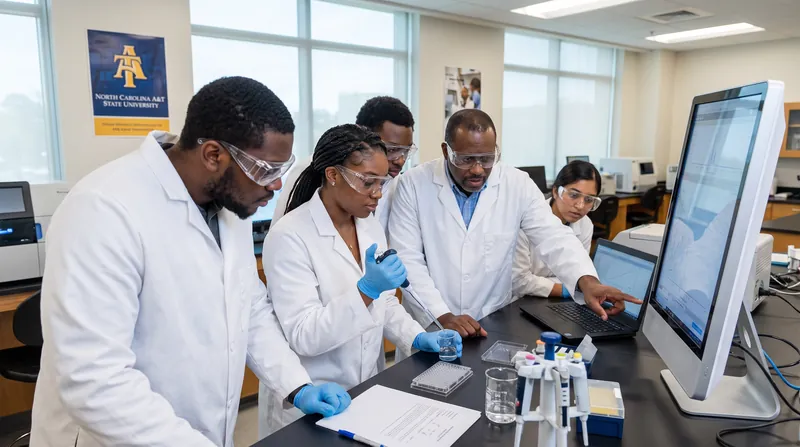
To bridge this gap, curriculum reformers are replacing traditional "cookbook labs"—where students follow step-by-step instructions to achieve a known, predetermined result—with Course-based Undergraduate Research Experiences (CUREs). In a CURE, the entire enrolled class participates in novel, authentic research where the answers are genuinely unknown to both the students and the instructor.[5]
The statistical impact of this curricular shift is substantial. According to researchers publishing in Frontiers in Education, "Student participation in course-based undergraduate research experiences (CUREs) leads to improved academic performance and increased intent to persist in STEM, especially when compared to traditional lecture courses with standard assignments."[2]
Retention data tracking community college and university cohorts confirms this effect. Studies measuring the impact of integrating authentic research into introductory biology and chemistry courses show that participating in a CURE yields a 24% higher one-year retention rate compared to students placed in traditional laboratory control groups.[2][6]
Crucially, the evidence indicates that CUREs disproportionately benefit the students most at risk of the sophomore slump. By embedding research directly into the mandatory, credit-bearing curriculum, universities remove the barrier of entry. This structural change has been shown to narrow the graduation gap between first-generation and continuing-generation students, while simultaneously improving the scientific literacy of minoritized students relative to their peers.[2][6]
The limits of the current evidence remain transparent. While the short-term retention bump from sophomore CUREs is well-documented, tracking whether these retained students ultimately enter the professional STEM workforce years later is statistically difficult. Furthermore, scaling authentic, resource-intensive laboratory research to fully online or hybrid undergraduate degree programs remains an unresolved logistical challenge for many institutions.[6]
As universities rethink their support structures for the 2026-27 academic year, the shift from extracurricular research to curricular research represents a permanent structural fix. By making scientific discovery a graduation requirement rather than an elective privilege, institutions are engineering the sophomore slump out of the STEM pipeline.[1][6]
Key terms
- CURE
- Course-based Undergraduate Research Experience; a class where all enrolled students participate in novel, authentic scientific research rather than following predetermined lab exercises.
- Sophomore Slump
- A recognized period of decreased academic motivation and increased dropout risk during the second year of college.
- First-Generation Student
- A college student whose parents did not complete a four-year university degree.
- Cookbook Lab
- A traditional science laboratory course where students follow step-by-step instructions to achieve a known, predetermined result.
Viewpoints in depth
Curriculum Reformers
Advocates for replacing traditional lectures with discovery-based learning.
This camp argues that traditional 'cookbook' laboratories fail to teach actual scientific thinking, instead training students merely to follow instructions. By implementing Course-based Undergraduate Research Experiences (CUREs), they believe universities can democratize the thrill of discovery. Evidence cited by this group emphasizes that when students feel ownership over novel research, their intrinsic motivation to remain in difficult STEM majors increases dramatically.
Institutional Administrators
University leaders focused on improving retention and graduation metrics.
For administrators, the sophomore slump represents a massive leak in institutional resources and tuition revenue. This perspective focuses on the scalable nature of CUREs and targeted second-year fellowships. Rather than relying on expensive, one-on-one faculty mentorships that only reach a fraction of the student body, administrators view mandatory research courses as a cost-effective structural intervention that reliably boosts cohort retention rates.
- Education Researchers
- Scholars measuring the statistical impact of curriculum design on student retention and graduation rates.
- University Administrators
- Higher education leaders focused on deploying targeted support programs to improve institutional graduation metrics.
- Curriculum Reformers
- Advocates pushing to replace traditional lecture and rote laboratory models with authentic, discovery-based learning.
Perspectives this story doesn't cover
- Community College Transfer Students
- Adjunct Laboratory Instructors
Sources
Source coverage
6 outlets
3 viewpoints surfaced





- [1]Inside Higher EdUniversity Administrators
Rethinking Support for First-Gen Sophomores
Read on Inside Higher Ed → - [2]Frontiers in EducationEducation Researchers
Student interest development in course-based undergraduate research experiences (CUREs): a longitudinal case study analysis
Read on Frontiers in Education → - [3]National Academies PressEducation Researchers
Undergraduate Research Experiences for STEM Students: Successes, Challenges, and Opportunities
Read on National Academies Press → - [4]Journal of College Student RetentionEducation Researchers
Retention in first-generation college students
Read on Journal of College Student Retention → - [5]WikipediaCurriculum Reformers
Undergraduate research
Read on Wikipedia → - [6]Factlen Editorial TeamCurriculum Reformers
Synthesis by Factlen editorial team
Read on Factlen Editorial Team →

More in Education
See all →HBCU Research
NC A&T Poised to Become First Public HBCU to Achieve Top-Tier R1 Research Status
5 sources
Screen Time
Eight-Year Longitudinal Study Finds Higher Screen Time Correlates With Better Teen Cognitive Processing
7 sources

Admissions Strategy
Elite Colleges Mandate SAT/ACT, Signaling End of Test-Optional Admissions Era
4 sources
Test Scores
Landmark Study Finds US 'Learning Recession' Began in 2013, Predating Pandemic Decline
3 sources

Comments
Every angle. Every day.
Get Education stories with full source coverage and perspective breakdowns, free every day.