
Melbourne Demons Escape the Wildcard Zone, Crushing Hawthorn to Seize Top-Six Spot
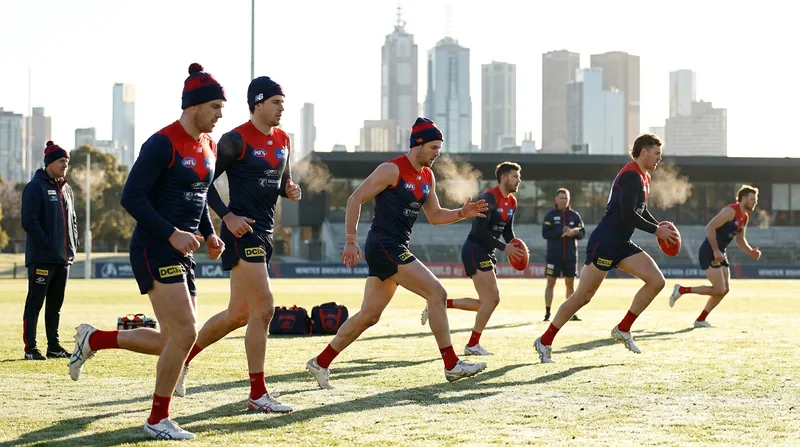
A dominant 35-point victory over Hawthorn has catapulted the Melbourne Demons out of the AFL's mid-season logjam and into the coveted top six. The win reshapes the 2026 playoff picture, moving Melbourne away from the perilous new wildcard round.

Share this story
Entering Round 17, the Melbourne Demons were suffocating in the Australian Football League's most congested ladder in recent memory. Mired in a historic deadlock of 9-6 teams, they sat precariously in seventh place—squarely in the crosshairs of the league's new, unforgiving wildcard zone.
Every percentage point and every quarter mattered, with predictive models giving the Demons a mere coin-flip chance of escaping the sudden-death bracket. The pressure was mounting on head coach Steven King's squad to find an extra gear before the finals arrived, especially after a month of inconsistent performances that left fans questioning their premiership credentials.[1][2]
On Saturday afternoon at UTAS Stadium in Launceston, the Demons shattered that logjam in spectacular fashion. Delivering their most emphatic performance of the 2026 season, Melbourne dismantled the third-placed Hawthorn Hawks 125-90. The 35-point statement victory reverberated across the premiership race, proving that Melbourne's offensive firepower remains elite when fully unleashed.
To score 125 points against a Hawthorn defense that had been among the stingiest in the entire competition sent a clear warning to the rest of the league. The Demons controlled the midfield battle from the opening bounce, translating clearances into rapid, precise entries inside the forward 50.
The victory catapults Melbourne to a 10-6 record, fundamentally altering the trajectory of their season. By leapfrogging the stumbling Geelong Cats—who fell to the Brisbane Lions earlier in the round—the Demons have seized a coveted spot in the top six.
For a team that spent the past month trapped in the middle of the pack, the sudden elevation provides both psychological relief and a massive structural advantage for the upcoming postseason. The win also drastically improves their percentage, a crucial tie-breaker that could determine their final seeding when the 25-round marathon concludes in late August.
That ladder positioning is more critical this year than ever before. The AFL's newly introduced 10-team finals system grants the top six teams a vital first-week bye, allowing them to rest and recover while the lower seeds battle it out. Teams finishing seventh through tenth, however, are condemned to a sudden-death wildcard weekend.
It is a high-variance trap that premiership contenders are desperate to avoid, knowing that a single bad afternoon against a surging lower-ranked team can end a season prematurely. By securing a top-six foothold, Melbourne has taken a massive step toward avoiding that perilous elimination scenario.
For Hawthorn, the heavy defeat on their Tasmanian home turf raises sudden alarm bells. The Hawks entered the weekend comfortably in third place at 10-4-1, boasting a formidable 113.7 percentage and looking like an absolute lock for a deep September run.
While they remain in the upper echelon of the ladder, the 35-point margin exposed unexpected defensive frailties and a vulnerability to rapid counter-attacks. It also allowed the chasing pack—including the surging Brisbane Lions and Adelaide Crows—to close the gap on their top-three status, turning what looked like a secure position into a genuine race over the final eight rounds.[2]
Melbourne's ascent comes at the direct expense of their closest rivals, who faltered under the pressure of Round 17. Geelong's 123-101 loss to Brisbane at GMHBA Stadium drops the Cats to 9-7, dragging them down into the wildcard mire they had fought so hard to avoid.
Similarly, the Western Bulldogs suffered a brutal 90-55 thrashing at the hands of the second-placed Sydney Swans. That defeat leaves the Bulldogs clinging to eighth place and highly vulnerable to the surging Carlton Blues and Collingwood Magpies, who are both gaining momentum just below them in the standings.[1]
Analysts tracking the "Run Home" probabilities have drastically revised Melbourne's outlook following the Launceston masterclass. Prior to Round 17, predictive models had the Demons hovering on the edge of the top eight, heavily reliant on other results going their way to secure a favorable draw.
Their offensive explosion against the Hawks has re-established them as genuine premiership threats, proving they have the scoring capacity to match the league's heavyweights like Fremantle and Sydney. Statistical projections now heavily favor Melbourne to retain their top-six status, provided they can maintain this newfound level of consistency.[1]
With eight rounds remaining in the 25-round marathon, the ladder remains incredibly volatile, and no position is entirely safe. But for the first time in two months, the Melbourne Demons control their own destiny without relying on the failures of others.
If they can maintain the blistering form they unleashed against Hawthorn, they won't just avoid the perilous wildcard round—they will enter September as the team nobody wants to face. The race for the top six has found its newest frontrunner, and the rest of the competition is officially on notice.
Key points
- Melbourne defeated Hawthorn 125-90 at UTAS Stadium in Launceston.
- The 35-point victory moves the Demons to a 10-6 record for the season.
- Melbourne leaps out of the 9-6 logjam and secures a spot in the top six.
- The top six teams in the 2026 format earn a crucial first-week finals bye.
- Geelong and the Western Bulldogs suffered losses, dropping into the wildcard zone.
- Hawthorn remains in third place but faces questions over their defensive performance.
How we got here
March 2026
The AFL introduces a new 10-team finals format, adding a sudden-death wildcard round for teams finishing 7th through 10th.
June 2026
A historic logjam forms on the ladder, with five teams deadlocked at a 9-6 record entering the mid-season.
July 4, 2026
Melbourne crushes Hawthorn by 35 points, breaking the deadlock and securing a spot in the top six.
- Melbourne Supporters
- Thrilled that the team has found its offensive rhythm and escaped the sudden-death wildcard zone.
- Neutral Forecasters
- Focused on the mathematical chaos of the new 10-team format, where a single win swings a team from safety to jeopardy.
- Hawthorn Analysts
- Concerned that a heavy loss at their Tasmanian fortress exposes defensive vulnerabilities ahead of the finals.
Perspectives this story doesn't cover
- Fans of teams currently in 11th-18th place whose seasons are effectively over.
- AFL executives monitoring the success and reception of the new wildcard format.
Sources
Source coverage
2 outlets
3 viewpoints surfaced


- [1]Fox SportsNeutral Forecasters
AFL 2026: The Run Home after Round 16, predicted ladder and wildcard analysis
Read on Fox Sports → - [2]Monash UniversityNeutral Forecasters
AFL Ladder 2026 After Round 16
Read on Monash University →
More in Sports
See all →Standings
From the Cellar to the Wildcard Hunt: North Melbourne's Remarkable AFL Resurgence
3 sources

Injury
Brisbane Lions Injury Relief: Lincoln McCarthy and Oscar Allen Cleared for Crucial Returns
6 sources

Standings
GWS Giants Emerge as the AFL's Ultimate Wildcard Threat Following Giant-Killing Run
6 sources

Injury
Sydney Swans Injury Relief: Logan McDonald Cleared to Return as Justin McInerney Eyes Late-Season Comeback
6 sources

Comments
Every angle. Every day.
Get Sports stories with full source coverage and perspective breakdowns, free every day.